Houleye on the Africa Mercy: A Neck Mass, an Eight-Hour Road, and a Child Who Could Play Again
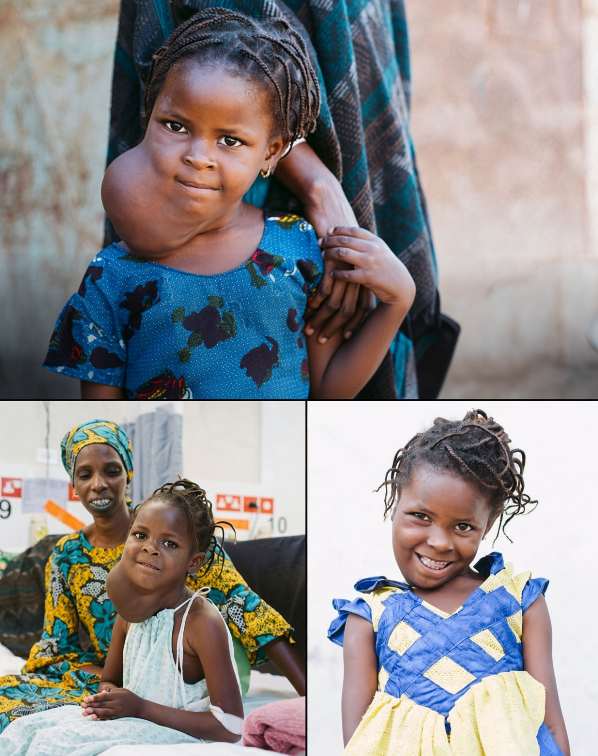
Houleye was five, from Senegal, and had lived with a tumour on her neck since birth. It grew until it was nearly half the size of her face. It hurt when she turned her head. Other children stared and teased. Her aunt Khadiatou said the pain made her stop playing and cry. Surgery in a paying hospital was out of reach. A local doctor mentioned a hospital ship. Aunt and niece travelled eight hours to the port to see whether the Africa Mercy was real. It was. Mercy Ships took her aboard.
Volunteer surgeons removed the mass and spared the nerves and vessels of the neck. In the first days she was shy. Within weeks she was running with other children on the ship, without the lump and without the mockery that had followed it. That is the version Mercy Ships published in 2022, with the same photographs that now circulate in Spanish overlays: the blue patterned dress and the bulge; the ward with Khadiatou; the smile after the dressing came off.
A cervical mass that large in a small child is usually a congenital or slow-growing lesion — cystic hygroma, lymphatic malformation, or a benign tumour of salivary or soft tissue — not a slogan. Left alone it can restrict movement, ulcerate, or crowd the airway. Removal on a ship does not invent a new operation. It puts an anaesthetist, a head-and-neck surgeon and a free bed in a country where those three things rarely arrive together. Houleye’s story is one of hundreds the organisation tells for the same reason: the before picture is the argument for the dock.
Sources: Mercy Ships official patient page “Meet Houleye” (October 2022); Mercy Ships Deutschland profile of Houleye and Khadiatou.