Karim Abdallah: A Market Strike in Eastern Ghouta and a Photograph That Travelled
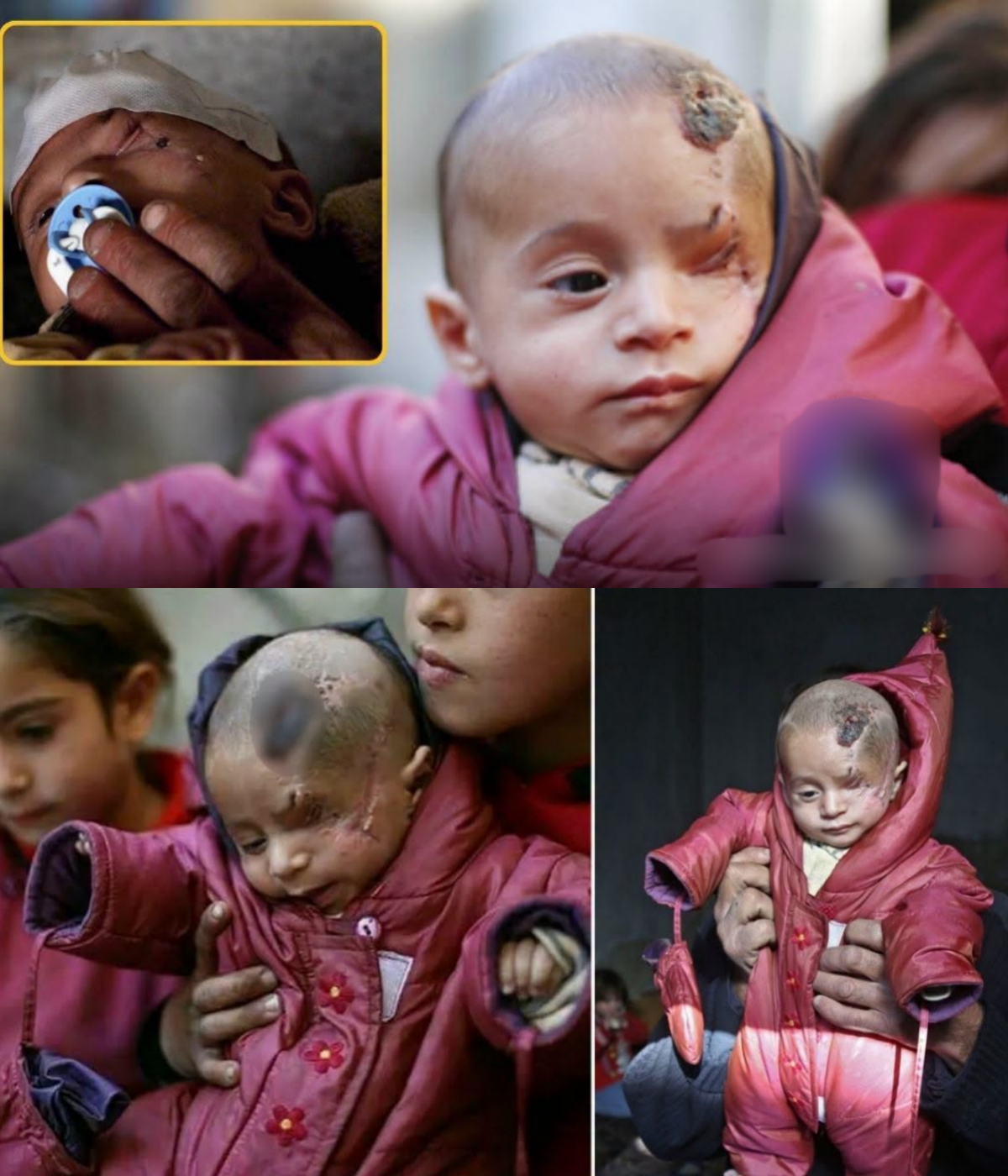
Karim Abdallah (also reported as Karim Abdel Rahman) was about forty days to two months old on 29 October 2017 when a strike hit a market in Hammuriya, in rebel-held Eastern Ghouta outside Damascus. His mother, named in some accounts as Fadiya, was killed. Relatives and the doctor who treated him said the infant lost his left eye, suffered facial lacerations and a skull injury with loss of bone over the socket. White Helmet volunteer Moyad Haifee later told DW he found the baby crying under a woman’s body in the rubble. Makeshift hospitals in the enclave, short of specialists and supplies under a years-long siege, cleaned the wounds and closed what remained of the orbit. Some English reports say a second strike about ten days later sent shrapnel through the family roof and further damaged the skull. His father, who used the kunya Abu Muhammad, said the child stayed dangerously thin.
In mid-December photographer Amer Almohibany published pictures of Karim in a puffy pink coat, left eye sealed under a crescent scar, a raw patch on the forehead. He then photographed himself with a hand over one eye. The gesture spread as #SolidarityWithKarim and #StandWithKarim. Residents of Douma posed the same way. So did Britain’s UN ambassador Matthew Rycroft at the Security Council, Lebanese prime minister Saad Hariri, footballer Franck Ribéry and Bana al-Abed. The campaign did not reopen the eye. It was an argument about a siege the UN already called catastrophic: blocked aid, delayed medical evacuations, hundreds of wounded children. UOSSM and local doctors said Karim needed neurology, ophthalmology and later reconstructive work that Ghouta could not provide.
The Spanish overlay uses precise trauma language—blast, traumatic evisceration, vault fracture—that field notes only partly support. What is documented is an infant with a destroyed globe and an open cranial wound treated under siege conditions, not a named protocol of formal enucleation in a equipped theatre. Attribution of the strike follows opposition, AFP, AP and Western outlets that described government bombardment of a market; Damascus denied targeting civilians. That dispute is the war, not a caption error to resolve here.
In April 2018 Karim, his father and two sisters reached Hatay, Turkey, after the forced evacuation of Eastern Ghouta. The father told Anadolu Agency he had also lost a daughter in a later strike and that another son taken for treatment had not returned. The pink coat and the covered-eye selfies remain the public image. The medical remainder is ordinary and unfinished: one seeing eye, a reconstructed or empty socket, a childhood spent after a market that no longer exists.
Sources
- The Telegraph; AFP via Al Arabiya, Dawn
- AP / Times of Israel; BBC Trending
- Reuters / Thomson Reuters Foundation
- DW interview with White Helmets volunteer
- Daily Sabah / Anadolu Agency on the family’s arrival in Hatay, April 2018