Lucy Gathoni’s Extraordinary Journey: How 18 Hours of Surgery Rebuilt Her Face
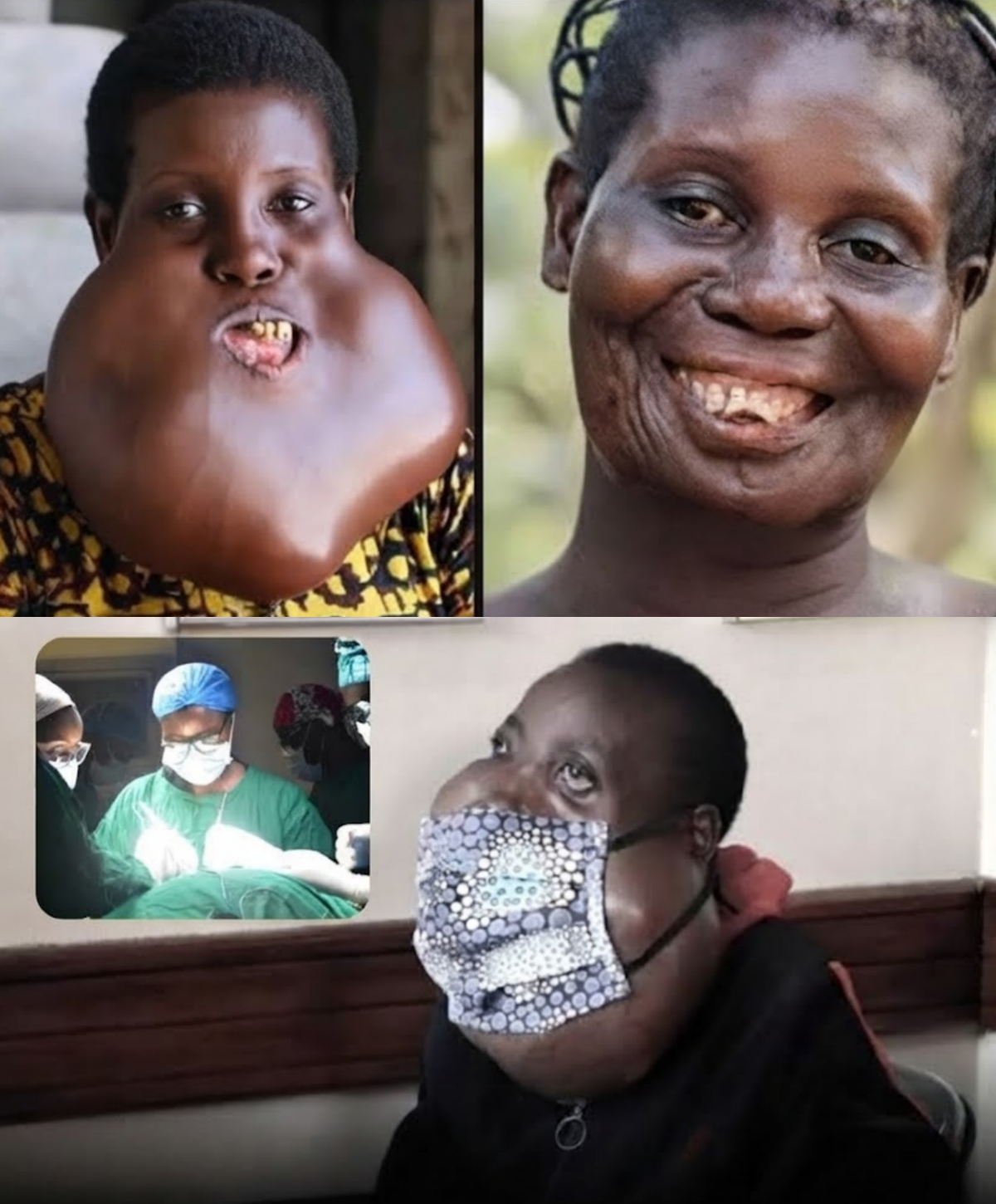
For more than a decade, Lucy Gathoni lived with a rare and severe bone disorder that progressively transformed her face and interfered with some of the most basic functions of daily life. What began as a small swelling when she was just 12 years old eventually developed into massive growths affecting both her upper and lower jaws and extending toward the base of her skull.
In April 2025, a multidisciplinary team at The Nairobi Hospital undertook an extraordinarily complex operation: removing the abnormal bone growths and reconstructing Lucy’s facial skeleton using patient-specific titanium implants designed through advanced 3D planning.
The 18-and-a-half-hour procedure was described by the reporting team as a historic milestone in facial reconstruction in Kenya and Africa.
A Disease That Began in Childhood
Lucy’s condition was diagnosed as severe craniofacial fibrous dysplasia, a rare disorder in which normal bone is replaced by abnormal fibrous tissue. In her case, the disease affected both the maxilla—the upper jaw—and the mandible, or lower jaw, with the upper growth extending toward the cranial base.
Her mother, Peris Mwaura, recalled that Lucy’s problems began with a small swelling when she was approximately 12 years old.
Over the following years, the growth repeatedly returned after previous operations and became progressively larger. Eventually, the abnormal tissue dramatically altered Lucy’s facial structure and interfered with her ability to speak, eat and breathe normally. She was reportedly unable to breathe through her nose and relied largely on mouth breathing, while her diet was restricted to soft foods.
By the time she reached adulthood, the condition had affected almost every aspect of her life.
A Reconstruction That Required a Different Approach
Lucy had already undergone several operations, but the growth continued to return. The scale and complexity of the disease eventually made conventional reconstruction extremely difficult.
According to the surgical team, using large amounts of bone from elsewhere in Lucy’s body was not considered practical because of her small frame and the extent of the reconstruction required. Instead, the doctors turned to patient-specific titanium implants.
Biomedical engineer Michael Mwasha and the surgical team digitally mapped Lucy’s skull and facial structures. Using 3D planning, they could virtually identify the diseased areas and design implants to fit the anatomy that would remain after the abnormal growths were removed.
The customized titanium components were manufactured in Belgium and imported specifically for Lucy’s operation. Reports placed the cost of the implants at approximately 5 million Kenyan shillings, separate from the surgical expertise that was donated.
An 18-and-a-Half-Hour Operation
The historic operation took place at The Nairobi Hospital on April 18, 2025, during Good Friday.
The procedure began with the removal of the enormous abnormal growths. One mass from the upper jaw weighed approximately 1.1 kilograms, while another involving the lower jaw weighed about 2.2 kilograms. Together with another smaller mass, the removed tissue totaled approximately 3.3 kilograms.
The upper growth had extended toward the skull base, while the lower tumor was highly vascularized, creating significant risks during surgery.
Once the abnormal tissue had been removed, the team began the reconstruction.
Titanium implants were positioned to reconstruct the upper facial skeleton and support the eye sockets and midface. The surgeons then reconstructed the lower jaw and incorporated specialized components designed to allow the jaw muscles to attach and function with the new structure.
The reconstruction also incorporated dental and palatal components to help restore Lucy’s ability to eat and speak.
After approximately 18 and a half hours, the operation was completed in the early hours of April 19.
More than 20 specialists contributed their expertise to the case, including oral and maxillofacial surgeons, prosthodontists, biomedical engineering specialists and other medical professionals.
More Than Appearance: Restoring Function
The goal of the procedure was not simply to change Lucy’s appearance.
For years, the abnormal growth had compromised her ability to breathe, eat and speak. The reconstruction therefore focused on restoring the underlying facial framework while giving her a structure capable of supporting movement and function.
The customized implants included features intended to allow the muscles responsible for jaw movement to attach to the reconstructed framework. This was particularly important because the operation involved reconstruction of both jaws rather than a single facial structure.
Following surgery, Lucy spent two days in intensive care and approximately another two weeks in hospital before returning home.
At a postoperative review, surgeon Prof. Symon Guthua reportedly handed Lucy a mirror. For the first time after years of progressive facial distortion, she could see a dramatically reconstructed version of her face.
Learning to Live Again
Recovery did not end when the operation was over.
Lucy initially continued receiving nutrition through a feeding tube and required ongoing follow-up and rehabilitation. Her recovery involved learning to adapt to the reconstructed facial structures and gradually regain functions such as eating, swallowing and speaking.
Nevertheless, early reports described significant improvements. She was able to speak and breathe without the struggle that had characterized much of her life before surgery.
For Lucy and her family, the change represented far more than a physical transformation. After years in which the disease had shaped her relationships, mobility, nutrition and social life, she could begin imagining ordinary experiences that had once seemed out of reach.
Her friend and family members described her as beginning to dream again about travel and a more normal life.
A Milestone for Reconstructive Medicine in Kenya
Lucy’s operation also highlighted the growing role of advanced medical engineering in complex reconstructive surgery.
The combination of digital anatomical mapping, computer-assisted surgical planning, biomedical engineering and custom titanium implants allowed surgeons to create a reconstruction tailored specifically to one patient’s anatomy.
The operation was performed on a pro-bono basis, with more than 20 specialists donating their expertise. Community and religious support also played a major role in helping Lucy reach the point where the operation could take place.
Her case also exposed an important challenge: while complex surgery may be supported through Kenya’s health system, highly specialized patient-specific implants can remain extremely expensive and may require additional fundraising or charitable assistance.
Lucy Gathoni’s story is therefore not simply about a dramatic facial transformation. It is about what can happen when surgery, engineering, technology and long-term human support converge around a patient whose condition had progressively taken away her ability to live normally.
After years of illness, Lucy was finally given an opportunity to rebuild not only the structure of her face, but also the everyday functions and possibilities that had been lost along the way.
Sources:
- Willow Health Media, “18-Hour Miracle: Inside Kenya’s Historic Surgery That Built a New Face”, April 2026.
- Willow Health Media, “How Kenya’s World-First Full Facial Reconstruction Surgery Was Done”, May 2026.
- Willow Health Media, “A Tumour, Two Jaws, One Chance: The Doctors Behind Kenya’s Most Complex Surgery”, May 2026.
- The Star Kenya, “18-Hour Miracle: Inside Kenya’s Historic Surgery That Built a New Face”, April 2026.
- K24 Digital, “18 Hours, 20 Specialists, 3.3kg Tumours: Inside Marathon Surgery That Saved Lucy Gathoni”, April 2026.