Chapter 1: The Laughter on the Hillside
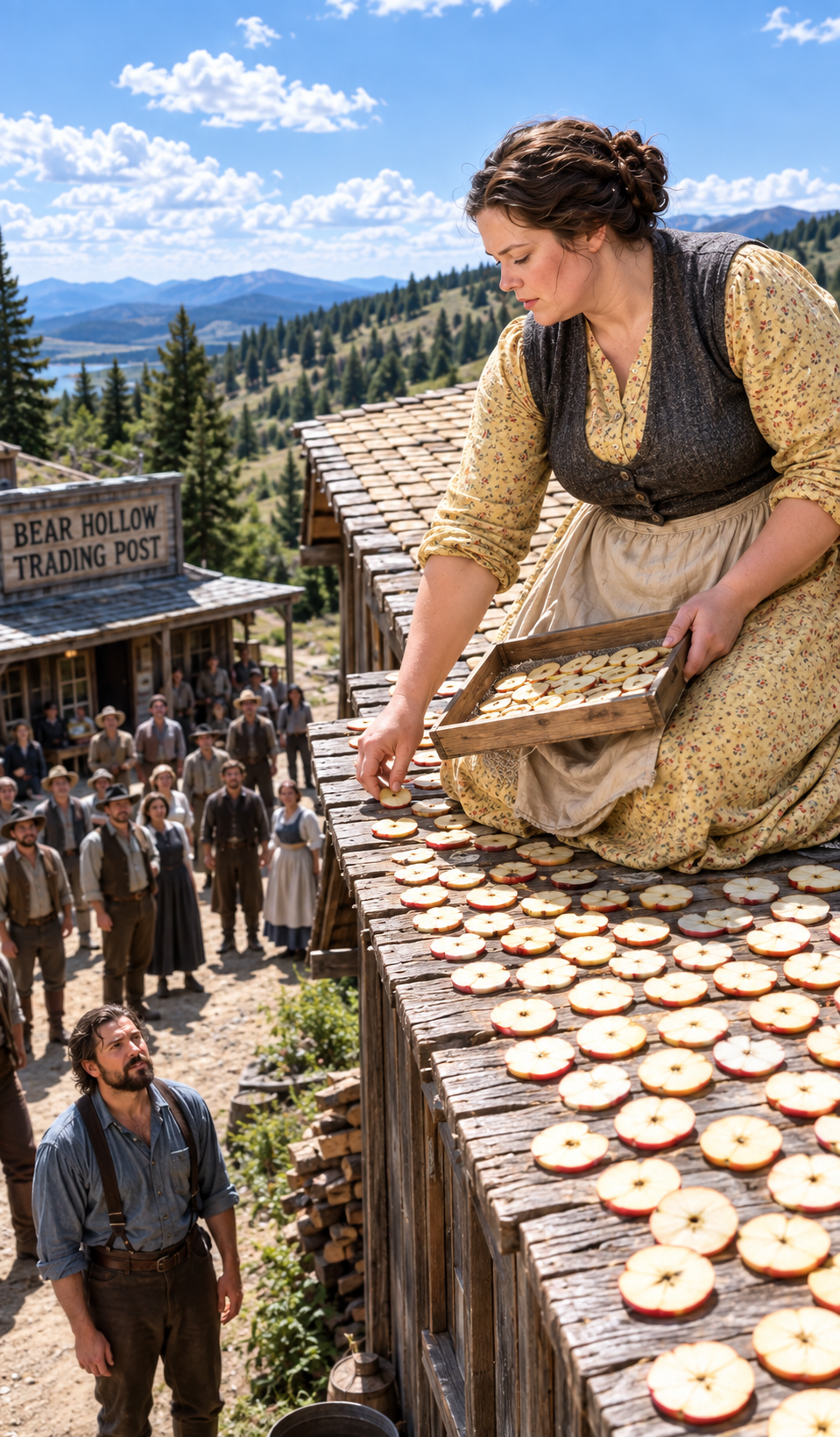
The laughter carried all the way up the hillside, clear and mocking over the afternoon breeze.
Below, outside the weather-beaten trading post in Briar Hollow, a knot of settlers pointed toward the broad roof of Elowen Harrow’s cabin, where hundreds of thin apple slices gleamed beneath the blazing June sun. From a distance, the roof looked as though someone had scattered pieces of rough gold across the weathered shingles.
And everyone in town thought Elowen had finally lost her mind.
“Look at that,” one man scoffed, leaning against a fence post. “She’s covering her house with food like the winter’s coming tomorrow.”
“Maybe sorrow finally got to her,” another muttered, shaking his head.
A loud laugh rippled through the group. “What kind of fool prepares for winter in June?”
Their voices drifted uphill, carried on the warm mountain air. Elowen heard every word. She didn’t stop. She didn’t even look down. With steady, practiced movements, she turned another apple slice beneath the sunlight, checking that both sides would dry evenly before nightfall.
They could laugh all they wanted. She remembered what they didn’t.
Four years earlier, a sudden, merciless winter had almost taken everything from her. That was why her cabin now smelled constantly of woodsmoke, coarse salt, dried fruit, wild herbs, and preserved meat. From sunrise until her hands cramped and swelled at night, Elowen prepared.
At thirty-eight, Elowen was a plus-size frontier woman with a gentle face, powerful arms, and the kind of deep endurance that hardship carves into a person rather than teaches in books. She sliced apples and pears until her fingers stained amber. She smoked thick strips of venison over smoldering hickory. She packed dry beans into canvas sacks, measured salt by the heavy pound, sealed preserved vegetables inside glass jars with melted beeswax, and counted every single portion twice.
Nothing was wasted. When the pantry shelves filled, she stacked supplies beneath the beds. When the heavy wooden trunks became crowded, she tucked smaller packages neatly along the walls, turning every inch of their home into a fortress against famine.
Her husband, Gideon, occasionally watched her with a look of quiet concern.
“Elowen,” he murmured one evening, resting a hand on her flour-dusted shoulder. “We have enough. The cellar is full.”
Her hands stopped moving over the wooden table. For several seconds, she said nothing, staring blankly at the wall.
“No,” she finally whispered, her voice tight. “We don’t.”
Because she could still hear the breathing.
Four winters earlier, snow had begun falling one December morning with an almost innocent softness. By afternoon, it was five feet deep against the windows. Then the blizzard settled in and refused to stop. For three brutal weeks, Elowen, Gideon, and their two young children were imprisoned inside their cabin while the world beyond their glass disappeared beneath an endless, suffocating white sheet.
Firewood vanished frighteningly fast as the temperature plummeted below zero. Gideon finally pulled on his heavy wool coat and tied rags around his boots.
“I’m going out to the shed,” he said grimly.
“No.” Elowen grabbed his sleeve, her eyes wide with terror. “Please. We’ll burn something else. The old crates.”
“We need real wood, Elowen. The fire is dying.”
“Gideon, you can barely see the barn! You’ll lose your bearings in the whiteout!”
He went anyway.
When he staggered back inside an hour later, ice coated his clothing like armor, and his boots had frozen nearly solid to his feet. Elowen dragged him toward the hearth, weeping as she rubbed his frost-bitten hands, terrified by how violently he shook.
He survived. But afterward, something inside him was never quite the same; a quiet shadow of dread lingered behind his eyes.
Soon, the last of the firewood was completely gone. In desperation, they burned the chairs first. Then the heavy dining table Gideon had built with his own hands after their wedding. Next came the spare shelves, wooden crates, and finally, the small bookcase holding Elowen’s treasured poetry volumes.
One by one, the physical pieces of their life became flames in the hearth. Yet cold was not what haunted Elowen most.
Hunger was.
By the twelfth day of the siege, the grain ran completely out. There was no flour, no cornmeal, nothing left in the larders. Elowen scraped together the final, microscopic portions of dried oats, divided them carefully between her children’s wooden bowls, and placed them before them.
Her youngest son stared down at the nearly empty bowl, then looked up with hollow eyes.
“Mama… where’s yours?”
Elowen forced a bright, trembling smile to her face.
“I already ate, sweetheart.”
The lie nearly broke her heart in two. That night, she lay awake beside them in the dark, listening as the storm battered the wooden walls of the cabin. In the stillness, her children’s cheeks looked sunken and hollow. Beneath thick blankets, their small bodies seemed impossibly fragile, like broken twigs.
Then she noticed their breathing.
Weak. Slow. Shallow. Different.
Elowen stared into the pitch-black room, counting every single fragile, agonizing breath, terrified that the next one wouldn’t come.
She never forgot that sound. It was carved permanently into her soul.
So now, four years later, while Briar Hollow mocked her beneath a peaceful, indifferent summer sky, Elowen prepared as though every single jar of food might someday mean another sunrise for her family.