THE QUEEN OF ROT — PART 2 (FULL ENDING): THE SECRET THAT BROUGHT RED HOLLOW TO ITS KNEES
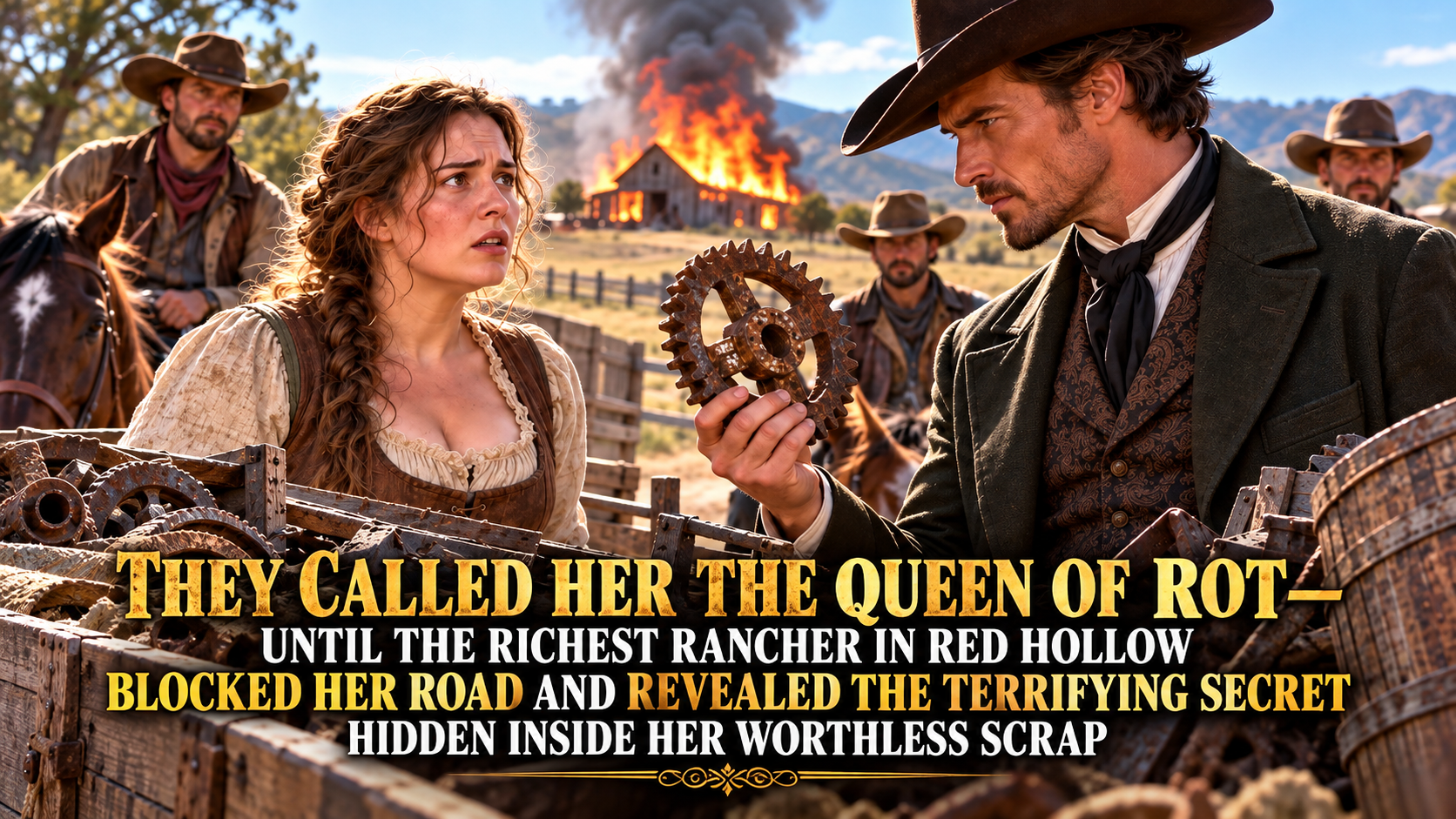
“They know you found the gears.”
Those six words were still hanging in the air when I saw the flames rise above my farmhouse.
For eighteen months, I had lived with the grief of losing my husband.
For six months, I had endured the laughter of an entire town.
And for one terrible afternoon, I had believed that the three rusted gears in my cart might finally help me finish the machine Thomas had dreamed of building.
Now someone was burning that dream to the ground.
I tore my arm from Silas Crowe’s grip.
“Get out of my way!”
“Eleanor, listen to me!”
“MY WORKSHOP IS BURNING!”
I lunged toward my cart, but Silas caught my wrist again.
“You’re not going there.”
I stared at him.
“Then you’ll have to shoot me.”
One of his cowboys shifted uneasily.
Silas looked toward the smoke, then back at the gear in his hand.
For the first time, I noticed something strange.
He wasn’t smiling.
He wasn’t enjoying my fear.
He looked like a man watching a terrible mistake unfold exactly as he had predicted.
“Who is burning my property?” I demanded.
Silas swallowed.
“The same people who killed your husband.”
My knees nearly buckled.
Before I could answer, a sharp crack echoed across the valley.
A gunshot.
The cowboy behind my cart jerked sideways and fell from his saddle.
His horse bolted.
Another shot struck the wooden railing inches from my hand.
Silas seized my shoulders and shoved me behind the cart.
“DOWN!”
A third bullet tore through a barrel.
Water exploded across the road.
The remaining cowboy drew his revolver and fired toward the ridge.
I crouched beside the wheel, my heart pounding so violently I could barely hear.
Silas dropped beside me.
“There’s a drainage ditch beyond the fence,” he said. “When I tell you, run.”
I stared at him.
“Why should I trust you?”
“Because if I wanted you dead, Eleanor, I wouldn’t have brought witnesses.”
Another bullet struck the cart.
A rusty pulley shattered.
Silas flinched.
Then he pressed the gear into my hands.
“Whatever happens, don’t let them take this.”
“Who are they?”
His face tightened.
“The men who own Red Hollow without owning a single acre.”
Then he stood and fired twice toward the ridge.
“RUN!”
I ran.
***
The drainage ditch was dry, narrow, and filled with thorny brush.
I crawled through it on my hands and knees while gunfire cracked behind me.
My skirt snagged on roots.
Dust filled my mouth.
Blood ran down my palm where a broken stone had cut it.
But I kept moving.
Beyond the ditch stood a line of cottonwoods.
Beyond those trees lay the old irrigation channel that ran behind my property.
Thomas had shown me that channel years earlier.
He used to say it was the most important piece of engineering in Red Hollow.
Not because it was impressive.
Because almost nobody understood what it could become.
I reached the trees and turned.
Silas was still beside the cart.
His surviving cowboy had taken cover behind a fallen log.
The first rider lay motionless in the road.
Then I saw something that made my blood freeze.
Three mounted men appeared on the ridge.
One wore a dark gray coat.
One carried a long rifle.
And the third wore a familiar black hat with a silver band.
I knew that hat.
Every family in Red Hollow knew it.
It belonged to Dr. Nathaniel Voss.
The man who had treated Thomas during his final illness.
The man who had stood beside my husband’s bed and told me there was nothing more he could do.
The man who had signed his death certificate.
I pressed a hand over my mouth.
Dr. Voss raised his rifle.
And aimed directly at Silas Crowe.
***
I don’t remember deciding to go back.
One moment I was hidden among the cottonwoods.
The next I was running toward the road, shouting a warning.
“Silas! BEHIND YOU!”
He turned.
The rifle fired.
Silas staggered backward.
For a horrifying instant, I thought the bullet had struck his heart.
Then he dropped behind the cart, clutching his shoulder.
The remaining cowboy fired toward the ridge.
The attackers retreated behind the rocks.
I reached Silas as blood soaked the sleeve of his expensive coat.
“You fool,” he rasped.
“You’re welcome.”
He almost laughed.
Then his face twisted in pain.
“Listen carefully. There’s something beneath your workshop floor.”
I stared at him.
“What?”
“Thomas hid it there. Under the north wall. Third floorboard from the stove.”
“How do you know?”
Silas shut his eyes.
“Because I helped him hide it.”
The words struck harder than the gunfire.
“You knew Thomas?”
“Better than you think.”
“You mocked me. You threatened me. You stood in the street and laughed while everyone called me the Queen of Rot.”
“I know.”
“Then why would my husband trust you?”
Silas opened his eyes.
“He didn’t. Not at the end.”
Before I could demand another explanation, he caught my wrist.
“Your husband discovered something that could destroy the men who control this valley. Those gears are only the beginning.”
He coughed.
“And Eleanor…”
“What?”
“The fire isn’t meant to destroy your machine.”
He looked toward the column of smoke.
“It’s meant to destroy the proof.”
***
I reached my farmhouse shortly before sunset.
The workshop was burning from one end to the other.
Flames roared through the roof.
The windows had shattered.
My carefully labeled shelves, my handmade valves, my pulleys, my drawings, and the machine I had spent six months rebuilding were disappearing into an inferno.
I stood frozen.
For a moment, I was back beside Thomas’s deathbed.
Watching everything I loved slip beyond my reach.
Then I heard a voice.
“Mrs. Whitcomb!”
Old Samuel Pike, my nearest neighbor, came running from the barn.
He was seventy years old, walked with a cane, and had never once called me the Queen of Rot.
“Thank heaven you’re alive!”
“Samuel, who started the fire?”
“Two men rode in from the eastern road. They broke the lock and carried something inside. I heard glass breaking. Then the whole place went up.”
“Did you recognize them?”
He hesitated.
“One was Dr. Voss.”
I closed my eyes.
The confirmation hurt more than I expected.
“And the other?”
“Couldn’t see his face.”
I looked toward the burning workshop.
The north wall was already collapsing.
Under the third floorboard from the stove.
Whatever Thomas had hidden was being consumed.
Unless…
“Samuel, where’s the old cellar entrance?”
He blinked.
“The one Thomas sealed after the flood?”
“Yes.”
“Behind the chicken shed. But Eleanor, that tunnel hasn’t been opened in years.”
I was already running.
***
Thomas had built the workshop above an abandoned root cellar.
Most people believed the cellar had been filled with dirt after a flood damaged its foundation.
But Thomas never destroyed useful things.
He reinforced them.
He sealed the old entrance beneath loose stones and covered it with a wooden hatch.
I found the hatch exactly where I remembered.
It took both of us to lift it.
A wave of damp, stale air rose from the darkness.
Samuel grabbed my arm.
“That building could collapse any moment.”
“I know.”
“Then don’t go in there.”
I looked at the burning roof.
“Thomas left something for me.”
Samuel’s expression changed.
He released my arm.
Then he handed me his lantern.
“Be quick.”
I descended the narrow steps.
The cellar smelled of wet earth and old timber.
Above me, flames crackled through the workshop floor.
I followed the wall toward the north side.
Third floorboard from the stove.
But from underneath, there was no stove to guide me.
Only beams.
Stone supports.
And darkness.
I searched desperately.
Then I saw it.
Three small scratches carved into a support beam.
T.W.M.
My husband’s initials.
I reached above my head.
One board moved beneath my fingers.
I pushed.
It lifted.
A small iron box dropped into my arms.
At that exact moment, something enormous crashed overhead.
The floor shuddered.
Dust poured into the cellar.
Samuel shouted from outside.
“ELEANOR!”
I tucked the box beneath my arm and ran.
The tunnel shook as I climbed the steps.
I stumbled into the evening air just as the workshop roof collapsed behind me.
A fountain of sparks shot into the sky.
Samuel pulled me away from the hatch.
For several minutes, neither of us spoke.
We simply watched the building burn.
Then I looked down at the box.
It was blackened with age.
Locked.
And stamped with three letters.
T.W.M.
***
We opened the box inside my farmhouse.
Samuel used a chisel to break the rusted lock.
Inside lay a thick leather notebook, several folded engineering drawings, a sealed envelope, and a small glass bottle wrapped in cloth.
My hands trembled as I lifted the envelope.
Across the front, in Thomas’s unmistakable handwriting, were six words.
FOR ELEANOR, IF I DO NOT RETURN.
I stopped breathing.
Samuel moved toward the door.
“I’ll give you some privacy.”
“No.”
My voice broke.
“Please stay.”
I opened the letter.
My dearest Ellie,
If you are reading this, then I have failed to keep a promise I made you.
I promised I would tell you everything when the time was right.
But I have waited too long.
And the men I trusted have become the men I fear.
You must understand something before you read the drawings.
The machine we dreamed of building was never merely a machine.
It was a way to free Red Hollow.
I looked at Samuel.
He frowned.
“Free us from what?”
I continued reading.
For years, the valley has depended on water controlled by the Red Hollow Irrigation Company.
Ranchers pay for access.
Farmers pay for delivery.
Families who cannot afford the fees lose their crops.
And those who lose their crops are forced to sell their land.
But the company has been lying.
The northern aquifer contains enough water to serve the entire valley.
The water is there.
It has always been there.
What the company lacks is a cheap way to raise it without expensive steam engines or constant fuel.
I have designed that way.
I have built a water-lifting system that can operate using the seasonal current, counterweights, and a series of carefully balanced gears.
It is not magic.
It is engineering.
And it can be constructed from materials most people throw away.
My vision blurred.
Thomas had told me about his dream.
A machine that could lift water using the force of moving water itself, transferring power through gears and pulleys.
But I had never understood the true reason he was so determined to finish it.
The letter continued.
If the design works, small farmers will no longer have to purchase every gallon from the company.
The water itself will still need to be shared fairly, and the machinery will require careful maintenance.
But no single wealthy man will be able to hold an entire valley hostage by controlling the pumps.
That is why they want the drawings.
That is why they have offered me money.
And that is why I am afraid.
The last paragraph was written in darker ink.
Ellie, if anything happens to me, do not trust Dr. Voss.
And do not trust Silas Crowe unless he has finally found the courage to tell you what he did.
I lowered the letter.
Samuel’s face had gone white.
“What did Silas do?”
I opened the notebook.
And there, on the first page, was the answer.
***
Thomas had documented everything.
Every meeting.
Every payment.
Every threat.
Every attempt to purchase his invention.
According to his notes, the Red Hollow Irrigation Company was secretly controlled by three men.
Dr. Nathaniel Voss.
Banker Horace Bell.
And Silas Crowe.
Together, they had purchased water rights, manipulated debts, and acquired struggling farms at prices far below their value.
But Thomas’s invention threatened their entire business.
It could not create water from nothing.
It could not end drought.
Yet it could make existing water far less expensive to lift and distribute.
And that was enough to terrify them.
The notebook described a meeting held nineteen months earlier.
Thomas had presented his plans to the three men.
Silas offered him five thousand dollars for the patent rights.
Thomas refused.
Bell offered ten thousand.
Thomas refused again.
Then Dr. Voss suggested that the design was too dangerous to place in inexperienced hands.
Thomas wrote that Voss had smiled while making the threat.
The final entry was dated four days before my husband’s death.
I believe they have decided to stop negotiating.
Silas came to warn me tonight.
He says Bell has hired men to search the workshop.
Voss insists my recent illness is nothing serious, but I have begun to suspect the medicine he prescribed.
I have hidden a sample.
If I become worse, someone must have it examined by an independent physician.
I stared at the little glass bottle.
The room seemed to turn cold.
Thomas had not died suddenly without warning.
He had suspected.
He had known something was wrong.
And he had tried to leave me the truth.
I pressed the letter against my chest.
For the first time in eighteen months, I did not cry because I missed him.
I cried because I finally understood how alone he must have felt.
***
The next morning, Silas Crowe appeared at my farmhouse with his wounded shoulder wrapped in bloody linen.
He arrived without his expensive stallion.
Without his polished coat.
Without the men who usually followed him.
He looked exhausted.
Samuel stood in the doorway holding a shotgun.
“That’s far enough.”
Silas stopped.
“I need to speak with Eleanor.”
“You’ve done enough speaking.”
I stepped onto the porch.
“Let him through.”
Samuel looked at me.
“Eleanor…”
“I want answers.”
Silas entered the kitchen and sat opposite me.
I placed Thomas’s notebook on the table.
His face changed immediately.
“You found it.”
“Yes.”
He lowered his eyes.
“Then you know.”
“I know you offered to buy my husband’s invention.”
“Yes.”
“I know you helped men who were taking farms from families who couldn’t pay their water bills.”
Silas said nothing.
“And I know Thomas believed Dr. Voss was poisoning him.”
Silas’s face twisted.
“God help me.”
I leaned forward.
“Did you kill my husband?”
“No.”
“Did you know someone intended to?”
Silas looked at the notebook.
Then he answered.
“Yes.”
The word seemed to empty the room.
Samuel tightened his grip on the shotgun.
I felt strangely calm.
“Tell me everything.”
Silas rubbed his face.
“Bell wanted Thomas ruined. Voss wanted the machine destroyed. I wanted the invention for myself.”
He swallowed.
“I thought if I owned it, I could control the damage.”
“By becoming the only man allowed to use it?”
“Yes.”
“That isn’t protecting people, Silas.”
“I know that now.”
He looked toward the window.
“Thomas refused us all. Bell began threatening his creditors. Voss offered to handle the problem quietly.”
“What did that mean?”
“I told myself he meant to frighten Thomas.”
“But you knew better.”
Silas did not answer.
“After Thomas became sick, I went to see him. He accused Voss of poisoning his medicine. He asked me to take the bottle to a doctor outside the county.”
My throat tightened.
“Did you?”
Silas shook his head.
“I was afraid of what it would mean if he was right.”
I stared at him.
“So you left him to die.”
“Yes.”
There was no excuse in his voice.
Only shame.
“I have lived with that every day.”
“Thomas doesn’t get to live with anything.”
Silas lowered his head.
I stood.
“Why did you come to my road yesterday?”
“Because Bell found out you were buying the missing gears.”
“How?”
“The blacksmith told him.”
I thought of the three warped gears buried beneath the wagon parts.
“Those gears weren’t there by accident, were they?”
Silas shook his head.
“Thomas had them made in Denver. He hid them separately after the threats began. Bell spent months trying to locate them.”
“Why?”
“Because those pieces complete the power-transfer mechanism. Without them, the design cannot operate as Thomas intended.”
I stared at the notebook.
“And Bell knew I was finishing it.”
“Yes.”
“Who told him?”
Silas hesitated.
Then he spoke the name.
“Samuel Pike.”
***
I turned toward the doorway.
Samuel stood motionless.
For a moment, I could not understand what I had heard.
Samuel Pike.
The kind old neighbor who brought me eggs when my hens stopped laying.
The man who helped repair my fence.
The man who had just risked his life helping me recover Thomas’s box.
I shook my head.
“No.”
Samuel’s face had gone gray.
“Eleanor…”
“Tell me he’s lying.”
Silas looked away.
Samuel slowly lowered the shotgun.
“I never meant for anyone to get hurt.”
My heart sank.
“What did you do?”
Samuel’s hands trembled.
“Bell came to me three months ago. He said he was worried about you. Said you were spending all your money on broken machinery and might hurt yourself.”
I stared at him.
“He offered me twenty dollars to tell him what you were building.”
“Twenty dollars?”
Samuel began to cry.
“My granddaughter needed medicine. I didn’t have the money.”
“You could have asked me.”
“You barely had enough to feed yourself.”
I wanted to hate him.
For a moment, I did.
But then I saw the shame in his face.
The same shame I had seen in Silas.
And I understood something terrible.
The men who controlled Red Hollow had not survived through wealth alone.
They had survived by making desperate people betray one another.
Samuel wiped his eyes.
“I told Bell about the barrels and pulleys. I told him you were working at night. But I never knew about the gears.”
Silas nodded.
“Bell found out about those through the blacksmith.”
I looked from one man to the other.
“Then why did you help me save the box, Samuel?”
He met my eyes.
“Because when I saw your workshop burning, I finally understood what kind of man I’d helped.”
I sat down slowly.
I was surrounded by people who had betrayed Thomas.
Some through greed.
Some through fear.
Some through desperation.
And yet, the only man who had never betrayed me was buried beneath the cottonwoods.
I closed the notebook.
“Both of you are going to help me.”
Silas looked up.
“With what?”
I met his eyes.
“Finishing the machine.”
***
We had eleven days.
That was how long remained before the annual meeting of the Red Hollow Water Association.
At that meeting, Horace Bell intended to announce a new water-rate increase.
Families already struggling through the dry season would face charges they could not afford.
Some would lose their farms before winter.
Thomas had documented the company’s plans.
Bell was using the water shortage to force more land sales.
And unless we could prove the machine worked, nothing would change.
Silas offered money.
I refused it.
Not because I didn’t need it.
But because I refused to become indebted to another powerful man.
Instead, I made him an offer.
“You own the old north mill.”
“Yes.”
“And the diversion channel beside it.”
“Yes.”
“Give the valley access to the mill for thirty days.”
Silas frowned.
“What for?”
“To build a demonstration.”
He studied me.
“How much equipment will you need?”
I almost smiled.
“Everything the town has thrown away.”
***
By the third day, people began arriving at the ruined workshop.
At first, they came out of curiosity.
Then they came because rumors were spreading.
Silas Crowe had been shot.
Dr. Voss had disappeared from town.
Horace Bell had hired armed guards for the bank.
And the Queen of Rot was apparently building something at the abandoned north mill.
The first person to offer help was the blacksmith.
He arrived carrying a heavy sack.
Inside were bolts, brackets, and two iron shafts.
“I heard about your workshop,” he said.
I looked at him.
“Did you tell Bell about my gears?”
His face reddened.
“Yes, ma’am.”
“Why?”
“He said they were stolen property.”
“And you believed him?”
The blacksmith looked down.
“I wanted to.”
I waited.
He sighed.
“Because it was easier than asking questions.”
I considered sending him away.
Instead, I pointed toward the mill.
“Those shafts need straightening.”
He nodded.
“Yes, ma’am.”
The next morning, three farmers arrived with broken wagon wheels.
A carpenter brought timber.
Two brothers from the southern farms delivered a cracked water trough and a length of chain.
A widow named Margaret Ellis brought the brass fittings from her late husband’s steam engine.
Every object had once been considered worthless.
Now each had a purpose.
And slowly, the people of Red Hollow began to understand what Thomas had taught me.
Value was not the same as price.
***
The machine took shape beside the old mill channel.
It stood nearly twelve feet tall.
Its frame was built from salvaged timber reinforced with iron braces.
A waterwheel sat in the flowing channel, driving a shaft connected to a train of gears.
Those gears transferred power to a reciprocating pump.
Counterweights helped balance the motion.
Valves fashioned from repaired brass fittings controlled the flow.
The pump would draw water from a shallow test well connected to the northern aquifer and lift it into a storage tank above the mill.
From there, gravity could carry the water through irrigation pipes.
The system would not operate without a reliable source of moving water.
It would not solve every problem in the valley.
But Thomas had calculated that, under the right conditions, it could provide a practical alternative to the expensive fuel-driven pumps controlled by Bell’s company.
And the most important parts had been salvaged.
Three rusted gears.
The same gears Silas Crowe had tried to purchase for fifty dollars.
On the ninth day, we installed the final one.
I stood beside the machine with grease covering my hands.
Samuel tightened the last bolt.
The blacksmith checked the alignment.
Silas watched from the bank, his injured arm still in a sling.
“Ready?” he asked.
I looked at the waterwheel.
“Almost.”
I opened Thomas’s notebook to the final page of his calculations.
He had drawn a small heart beside the last equation.
Underneath, he had written:
For Ellie, who always sees what others miss.
My eyes filled.
I closed the book.
“Ready.”
Samuel released the gate.
Water rushed through the channel.
The wheel turned.
Slowly at first.
Then faster.
The gears began moving.
Iron teeth caught against iron teeth.
The counterweight rose.
The pump rod descended.
A deep mechanical groan rolled through the mill.
Then the machine stopped.
A gear slipped.
The entire frame shuddered.
And the pump went silent.
Nobody spoke.
I stared at the mechanism.
Something was wrong.
I checked the valves.
The rods.
The balance weights.
Then I saw it.
The third gear was not merely warped.
Its teeth had been deliberately cut at an unusual angle.
Thomas had designed it that way.
Not to fit the visible shaft.
But to engage a second hidden coupling.
I turned toward Samuel.
“Bring me the smallest pulley.”
He hurried away.
I studied the drawings again.
There.
A tiny notation beside the gear assembly.
Reverse drive under load.
My breath caught.
Thomas had built a safeguard into the design.
A way to prevent the mechanism from running backward when the pump was under pressure.
I repositioned the gear.
Adjusted the coupling.
Tightened the shaft.
Then stepped back.
“Try again.”
Water rushed through the gate.
The wheel turned.
The gears engaged.
The pump rod began rising and falling.
Once.
Twice.
Three times.
Then a hollow gurgling sound came from the pipe.
A moment later, muddy water spilled into the storage tank.
Someone gasped.
The flow sputtered.
Then strengthened.
Clearer water followed.
A steady stream.
For several seconds, nobody moved.
Then Samuel began laughing.
The blacksmith dropped his wrench.
Margaret Ellis covered her mouth.
And I stood beside the machine Thomas had dreamed of building, watching water pour into a tank that had been empty for twenty years.
It worked.
After eighteen months of grief.
After six months of ridicule.
After a fire, a shooting, and a lifetime of being told that broken things were worthless…
It worked.
I pressed my hand against the warm iron frame.
“We did it, Thomas,” I whispered.
But the celebration lasted less than a minute.
Because a voice behind us said:
“Shut it down.”
***
Horace Bell stood at the entrance to the mill yard.
Six armed men surrounded him.
Dr. Nathaniel Voss stood at his side.
I felt every muscle in my body tighten.
Voss wore the same black hat with the silver band.
The same hat I had seen on the ridge.
He looked at the running machine.
Then at me.
“Mrs. Whitcomb,” he said calmly. “You have caused an extraordinary amount of trouble.”
Silas stepped forward.
“Bell, this ends now.”
Bell laughed.
“Does it?”
He drew a folded document from his coat.
“This property is under a lien held by my bank. The machinery assembled here constitutes an unauthorized improvement.”
I stared at him.
“You don’t own the mill.”
“Not yet.”
Silas’s jaw tightened.
Bell smiled.
“Your outstanding loans are due, Crowe. Every last one.”
Silas went pale.
I realized then that Bell had prepared for this.
If he couldn’t destroy the machine, he intended to seize the property beneath it.
Voss approached me.
“Mrs. Whitcomb, your husband was a gifted man. Unfortunately, he lacked judgment.”
I looked directly into his eyes.
“Did you poison Thomas?”
The mill yard fell silent.
Voss smiled faintly.
“Grief can make people imagine terrible things.”
“I found his notes.”
“Notes are not proof.”
“I found the medicine.”
His smile disappeared.
For one instant, I saw the man behind the respectable doctor’s face.
Then Bell spoke.
“Enough.”
He nodded toward his guards.
“Take the machine apart.”
The men moved forward.
And that was when the church bell began ringing.
***
At first, I thought I had imagined it.
One deep clang.
Then another.
Then another.
The sound carried across the valley.
Bell turned.
“What is that?”
Samuel smiled.
“That would be the town.”
From the western road came a wagon.
Then two more.
Then a line of riders.
Farmers.
Carpenters.
Shopkeepers.
Women carrying lanterns.
Men carrying tools.
Families whose land had been threatened by Bell’s debts and water fees.
They came from every direction.
By the time the first wagon reached the mill, more than a hundred people had gathered.
At their head rode Sheriff Daniel Mercer.
Beside him sat a stranger in a dark traveling coat.
A silver badge gleamed beneath his lapel.
Bell’s face tightened.
“What’s the meaning of this?”
The sheriff dismounted.
“Horace Bell, these people have requested a public accounting of the Red Hollow Irrigation Company.”
Bell laughed.
“On whose authority?”
The stranger stepped forward.
“Mine.”
He introduced himself as Deputy United States Marshal Henry Lawson.
I had never seen him before.
But Samuel had.
Three nights earlier, Samuel had carried copies of Thomas’s notebook and the water company’s records to a telegraph office in the next county.
The sheriff had also sent word about the shooting on the road and the attack on my workshop.
Lawson had arrived with a county prosecutor and an independent physician from Denver.
They had come to investigate.
Not to declare anyone guilty without evidence.
But to preserve the records and prevent anyone from destroying them.
Bell’s confidence began to crack.
“You cannot simply arrest respectable businessmen because a hysterical widow tells stories.”
Lawson looked at me.
“Mrs. Whitcomb, do you have the original notebook?”
“Yes.”
“And the medicine sample?”
“Yes.”
“And the drawings?”
I looked toward the machine.
“You’re standing beside them.”
***
Bell made one final mistake.
He ordered his guards to seize the notebook.
One of the men stepped toward me.
Sheriff Mercer drew his revolver.
“Don’t.”
The guard stopped.
Bell’s face reddened.
“You work for this town, Sheriff!”
“I do,” Mercer replied.
“Then remember who pays your salary!”
The sheriff looked around at the farmers, widows, ranch hands, and shopkeepers standing in the mill yard.
“I believe I just did.”
A murmur spread through the crowd.
Bell turned toward Voss.
For the first time, the doctor looked nervous.
Then Silas Crowe stepped forward.
“I’ll testify.”
Bell stared at him.
“You wouldn’t dare.”
Silas’s voice was quiet.
“I helped you acquire those farms. I helped you conceal the company’s ownership. I knew about the threats against Thomas Whitcomb.”
He swallowed.
“And I failed to report what I suspected about his death.”
Bell’s face went white.
“You’ll destroy yourself.”
Silas nodded.
“I expect so.”
He looked at me.
“Some debts ought to be paid.”
The marshal ordered Bell and Voss detained while the investigation continued.
Voss resisted.
He lunged toward the wagon carrying Thomas’s documents.
But two deputies intercepted him before he reached it.
Bell began shouting about corruption, unlawful seizures, and political enemies.
Nobody answered.
For years, his voice had been the loudest in Red Hollow.
That afternoon, it was merely another voice in a crowd.
***
The truth did not emerge in a single dramatic confession.
It came slowly.
Through records.
Witnesses.
Bank ledgers.
Letters.
And the testimony of men who had spent years believing they were untouchable.
The investigation revealed that Bell and Voss had used concealed ownership arrangements to control the irrigation company.
They had manipulated lending terms, pressured struggling landowners, and concealed important financial information.
Several land transfers were challenged.
Some were eventually reversed.
Others required months of litigation.
The medicine Thomas had preserved was examined by an independent laboratory.
The investigators found a poisonous compound inconsistent with the treatment recorded in his medical notes.
Additional evidence connected Voss to the preparation of that medicine.
A former assistant testified that Voss had instructed him to alter records after Thomas’s death.
The evidence was not simple.
And it was not painless.
I had to sit in a courtroom and hear strangers discuss the final days of my husband’s life.
I had to listen to Voss deny responsibility.
I had to watch Bell’s attorneys attempt to discredit Thomas as an unstable inventor.
But the documents survived.
The witnesses spoke.
And eventually, the jury reached its verdict.
Dr. Nathaniel Voss was convicted of murdering Thomas Whitcomb.
Horace Bell was convicted on charges arising from the fraud and conspiracy uncovered during the investigation.
Silas Crowe pleaded guilty to offenses connected with the company’s fraudulent dealings.
His cooperation was considered at sentencing, but it did not erase his responsibility.
He lost much of his fortune.
Several of his properties were sold to satisfy judgments and debts.
And the richest rancher in Red Hollow became a man who had to learn how to live without the power he once believed made him important.
***
The machine changed Red Hollow more slowly than the townspeople expected.
That was something Thomas would have appreciated.
Real engineering, he always said, was less dramatic than people imagined.
The first pump worked.
But it needed repairs.
The wooden frame swelled in damp weather.
One valve failed after three weeks.
The channel had to be cleared after a storm.
And during periods of low flow, the system produced less water.
We learned.
We adjusted.
We replaced weak components.
We trained people to maintain the equipment.
The machine did not make water free.
It did not make drought disappear.
But it reduced the cost of lifting water where the right conditions existed.
And it gave small farmers an option they had never possessed before.
Within a year, three more pumping systems had been built.
Each was adapted to its location.
Each used a combination of salvaged and newly manufactured parts.
The valley established a cooperative to manage the shared equipment and distribute water according to agreed rules.
Families who had once feared losing their land began planting again.
Children helped clean the channels.
Young apprentices learned to repair gears.
And the north mill, once abandoned, became the busiest workshop in Red Hollow.
But the greatest change was not mechanical.
It was the way people looked at one another.
***
One Saturday morning, nearly two years after the fire, I walked down the main street carrying an empty wooden cart.
The general storekeeper stepped outside.
“Morning, Mrs. Whitcomb!”
“Morning.”
“Got a broken pulley out back if you’re interested.”
“I’ll take a look.”
The blacksmith waved from his forge.
“Found two old gear assemblies yesterday. Saved them for you.”
“Much obliged.”
Outside the bakery, three little girls stood beside a pile of damaged barrels.
One of them whispered something.
The others giggled.
I stopped.
For a brief moment, I felt the old sting.
The Queen of Rot.
The laughter.
The humiliation.
Then the smallest girl stepped forward.
“Mrs. Whitcomb?”
“Yes, sweetheart?”
“Is it true you can make machines out of garbage?”
I smiled.
“Sometimes.”
She pointed toward my cart.
“Can we help?”
I looked at the three eager faces.
“Do you know how to sort iron from brass?”
They shook their heads.
“Then that’s where we’ll begin.”
The girls climbed onto the back of the cart.
And together, we walked toward the blacksmith’s forge.
Nobody laughed.
Not at me.
Not at the broken machinery.
Not at the children who wanted to learn.
***
That afternoon, I visited Thomas’s grave.
The cottonwood above it had grown taller.
Its leaves moved softly in the breeze.
I brought fresh flowers.
And a small brass gear.
Not one of the original three.
Those remained inside the first machine at the north mill.
This one had been made by a twelve-year-old apprentice.
Her name was Ruth.
She had lost her father during the drought.
Her mother had nearly lost their farm.
And now Ruth wanted to become an engineer.
I placed the gear beside Thomas’s headstone.
“You would have liked her,” I whispered.
The wind stirred the grass.
For a long time, I sat there remembering him.
His laughter.
His patience.
The way he could hold a broken object in his hands and see what it might become.
I had spent so many months believing that finishing his machine would somehow bring him back.
But grief did not work that way.
Nothing could return the years we had lost.
Nothing could undo what Voss had done.
Nothing could erase the fear and loneliness that followed.
Yet something had survived.
Not merely Thomas’s invention.
His belief.
That usefulness could be hidden beneath rust.
That dignity did not depend on wealth.
That the worth of a person could never be measured by the cruelty of those who mocked them.
I touched the headstone.
“We did it, Thomas.”
Then I stood and walked home.
***
There was one more surprise waiting for me.
A letter.
It had arrived from Denver that morning.
The envelope bore the seal of an engineering association.
Inside was an invitation.
The association wanted me to present Thomas’s water-lifting design at its annual exhibition.
They also wanted to discuss establishing a workshop to train women and young apprentices in mechanical trades.
I read the letter twice.
Then a third time.
For six months, Red Hollow had called me the Queen of Rot.
Now men who had spent their lives studying machinery wanted to hear what I had learned.
I sat at the kitchen table and laughed until tears ran down my cheeks.
Not because I had become wealthy.
I hadn’t.
Not because everyone suddenly admired me.
Some still didn’t.
But because the thing I had once been most ashamed of had become the thing that gave my life purpose.
My cart.
My scraps.
My stubborn refusal to throw away what could still be useful.
***
Five years after Thomas’s death, the old north mill had become the Whitcomb Mechanical Works.
Its doors were painted blue.
Its windows were wide and bright.
Inside, twelve apprentices worked beside experienced craftsmen.
Women learned drafting.
Young men learned to build and repair pumps.
Children from struggling families received training without paying tuition.
And on the wall above my workbench hung a wooden sign.
THOMAS WHITCOMB MECHANICS
BENEATH THE RUST, THERE IS STILL WORTH.
The original machine continued to operate beside the mill.
We had repaired it so many times that little remained untouched.
But the three gears were still there.
Rust removed.
Teeth restored.
Turning steadily.
One spring afternoon, a visitor arrived.
He was older now.
His hair had gone gray.
His clothes were plain.
And the confident arrogance I remembered had disappeared from his face.
Silas Crowe stood in the doorway holding a battered toolbox.
He had served his sentence and returned to Red Hollow with almost nothing.
“I heard you needed someone to repair the eastern channel,” he said.
I studied him.
“Can you work a full day?”
“Yes, ma’am.”
“Can you take instructions from a woman?”
A faint smile crossed his face.
“I’ve learned a few things.”
I looked toward the workshop.
“Then speak to the foreman. He’ll tell you what’s needed.”
Silas nodded.
He turned to leave.
Then stopped.
“Eleanor?”
“Yes?”
“I never properly thanked you.”
“For what?”
“For making me tell the truth.”
I considered his words.
“Truth doesn’t erase what happened, Silas.”
“I know.”
“But it gives people a chance to stop repeating it.”
He lowered his head.
Then walked toward the mill.
I watched him go.
I had not forgiven everything.
Perhaps I never would.
But I no longer needed to carry his guilt alongside my own grief.
That burden belonged to him.
***
That evening, I stood outside the workshop as the sun settled behind the mountains.
The valley glowed gold.
Water moved through the irrigation channels.
Cattle grazed on land that had once been brown and dying.
From inside the workshop came the steady rhythm of hammers.
The laughter of apprentices.
The turning of gears.
I looked down at my hands.
They were rough.
Scarred.
Marked with grease.
The same hands that had once dragged a cart of garbage through town while people laughed.
The same hands that had held Thomas as he slipped away.
The same hands that had recovered his notebook from beneath a burning workshop.
And the same hands that had helped build something no one believed was possible.
I thought of the day Silas Crowe stopped me on the road.
The guns.
The smoke.
The terror in his eyes when he recognized the three rusted gears.
Back then, I believed the secret hidden inside my cart was a machine.
A valuable invention.
A design powerful men were willing to kill to control.
But I had been wrong.
The greatest secret was not inside the gears.
It was inside the idea Thomas had left me.
That the world could be changed by people who refused to accept that something broken had no future.
A ruined machine.
A struggling town.
A frightened widow.
Even a man who had wasted his life chasing power.
Not everything could be repaired.
Thomas’s death had taught me that.
But more things could be saved than people imagined.
And sometimes, the person everyone laughed at was the only one willing to try.
I turned toward the workshop.
A young apprentice called from inside.
“Mrs. Whitcomb! We found another cracked gear!”
I smiled.
“Bring it here!”
“Should we throw it away?”
I laughed.
The same laugh I had once been too frightened to share in public.
“Not until we’ve seen what it can do.”
And as the sun disappeared behind Red Hollow, the gears kept turning.
The water kept flowing.
And the Queen of Rot finally understood that she had never been collecting garbage.
She had been collecting possibilities.
THE END.