Part 4 — The Fire at Carter Ranch
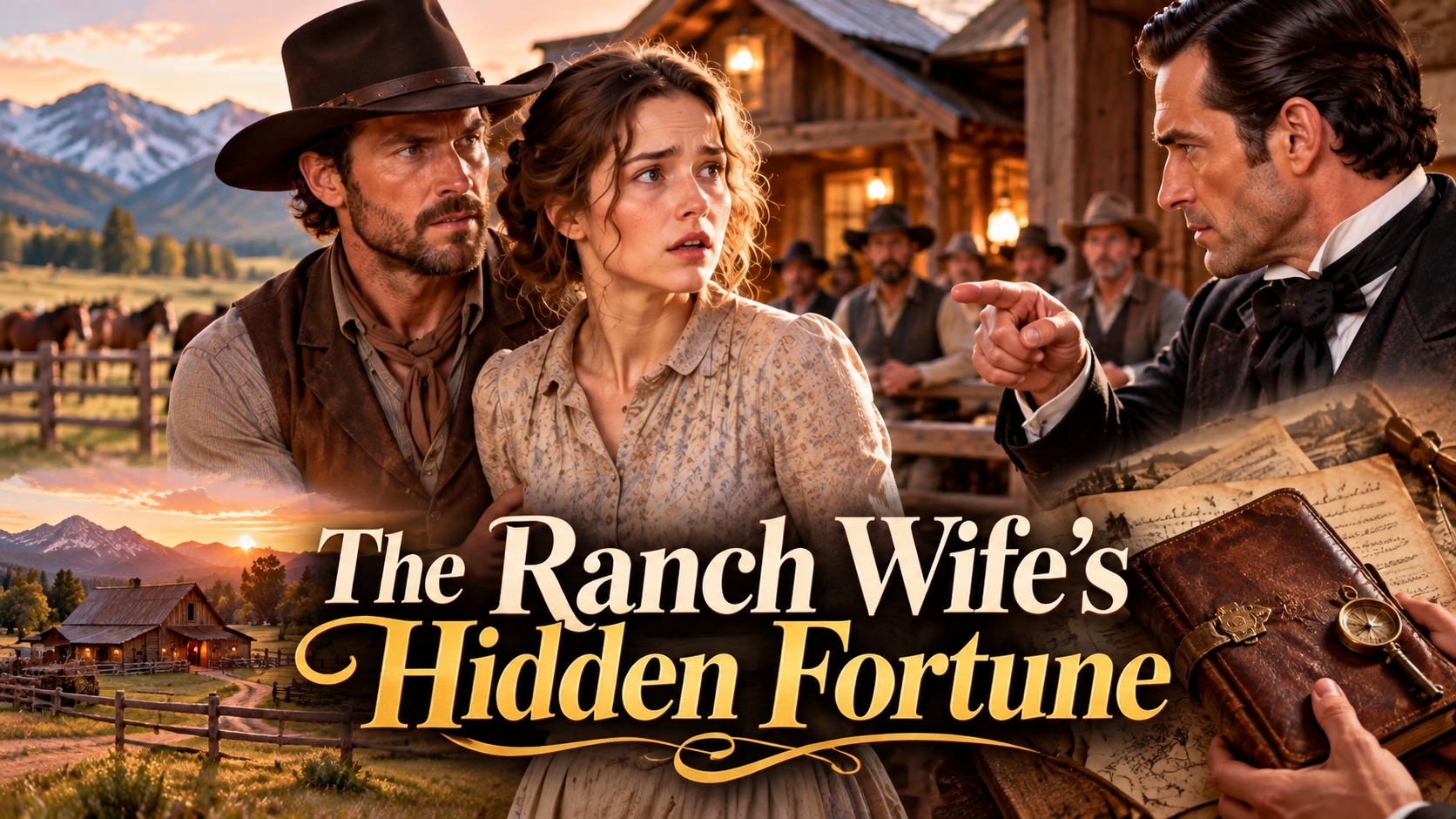
James waited until midnight before moving the iron stove.
Walter and two ranch hands helped him lift it from its stone foundation.
Beneath the hearth was a narrow metal compartment.
The brass key fit perfectly.
Inside lay a sealed packet, a small leather pouch, and a letter addressed to Sarah.
James opened the packet first.
It contained railroad surveys, mortgage transfers, and signed statements from landowners whose properties had been taken through fraudulent debt purchases.
One document carried Edmund Vale’s signature.
Another bore the name of the banker who held James’s original mortgage.
But the third signature made James’s hands tremble.
It belonged to a man named Nathaniel Carter.
His own grandfather.
James sat heavily on a chair.
Walter leaned over his shoulder.
“Boss?”
James could barely speak.
“My family was involved.”
The documents showed that Nathaniel Carter had once been hired to survey the proposed railroad corridor.
He had discovered that the route would cross valuable water rights and mineral-rich land.
But instead of helping investors seize those properties, Nathaniel had secretly warned several ranchers.
He had also hidden the original survey.
His refusal had ruined the investors’ plans.
And for decades, the Carter family had been punished through manipulated debts and dishonest contracts.
James looked up.
“That’s why the bank kept raising the interest.”
Walter nodded grimly.
“They were trying to take this land.”
James opened the leather pouch.
Inside was a small silver compass.
On its back were engraved three words.
For the rightful owner.
He turned to Sarah’s letter.
It was written in Arthur Whitcomb’s handwriting.
“My dearest Sarah,
If this reaches you, then the men I feared have found the ranch.
I owe you an explanation that I should have given long ago.
The Carter property is more important than anyone realizes. The original survey proves that the spring beneath the eastern ridge belongs to the ranch, not the railroad company.
Whoever controls that spring controls the only reliable water source for the proposed railway settlement.
Nathaniel Carter protected that right at great personal cost.
I have spent years trying to recover the evidence that would restore his family’s property.
But there is one truth I have not told you.
James Carter must never surrender the land.
And the answer to everything is hidden where his grandfather marked the beginning.”
James read the final sentence twice.
Where his grandfather marked the beginning.
He turned the compass over.
A tiny arrow had been engraved beside the words.
It pointed east.
At sunrise, James rode toward the eastern ridge.
Walter accompanied him.
They found an old stone marker half buried beneath weeds.
Carved into its surface were Nathaniel Carter’s initials.
James dug beside it.
Less than two feet below the ground, his shovel struck metal.
They uncovered a rusted survey box.
Inside was a rolled map wrapped in waxed cloth.
The original railroad survey.
And attached to it was a notarized deed confirming that the Carter family held permanent ownership of the spring and the surrounding land.
James laughed in disbelief.
“This could save the ranch.”
Walter grinned.
“It could save half the valley.”
But as they rode home, they saw smoke rising above the trees.
Carter Ranch was burning.
James drove his horse into a desperate gallop.
Flames climbed the barn walls.
The dining room windows glowed orange.
Ranch hands formed a line from the well, passing buckets of water.
James jumped from his horse.
“Where’s everyone?”
“Out of the house!” Walter shouted.
Then a woman’s scream came from the kitchen.
Eleanor Price had returned with her little boy.
They had been resting upstairs when the fire started.
The boy was outside.
But Eleanor had gone back inside to retrieve a bag containing her husband’s documents.
Now she was trapped.
James wrapped a wet blanket around himself and rushed through the doorway.
Smoke filled the hall.
He found Eleanor near the pantry, coughing and struggling to stand.
He carried her outside moments before part of the roof collapsed.
The barn could not be saved.
The kitchen was badly damaged.
The dining room, where Sarah had built their new life, was almost completely destroyed.
James stood in the yard, blackened with soot, staring at the ruins.
Then Walter approached.
“Boss, we caught one of them.”
A young rider had been found trying to escape through the southern pasture.
He carried a flask of lamp oil.
Under questioning, he admitted that Edmund’s men had paid him to set the fire.
James clenched his fists.
“Where is Sarah?”
The rider looked frightened.
“At the old courthouse.”
“Why?”
“Mr. Vale’s holding a private hearing tomorrow morning.”
James frowned.
“A hearing?”
The rider swallowed.
“He says once the judge signs the papers, Mrs. Carter won’t be allowed to claim anything belonging to the Whitcomb family.”
James stared at the smoking remains of his home.
Then he looked toward the mountains.
He had lost his barn.
Nearly lost his house.
And the woman he loved was being held by the very man who had orchestrated it.
But the original survey was still in his coat.
He turned to Walter.
“Gather every man who ever ate at Sarah’s table.”
Walter blinked.
“Every man?”
“Every traveler. Every rancher. Every stagecoach driver. Anyone who remembers what she did for them.”
“What are you planning?”
James looked toward the road.
“I’m going to show Edmund something he doesn’t understand.”
“What’s that?”
James mounted his horse.
“A woman who feeds strangers doesn’t stay a stranger for long.”
And by dawn, a line of wagons was rolling toward the courthouse.
What Edmund did not know was that the first wagon carried someone he believed would never speak against him.