Part 5 — The Fortune Nobody Expected
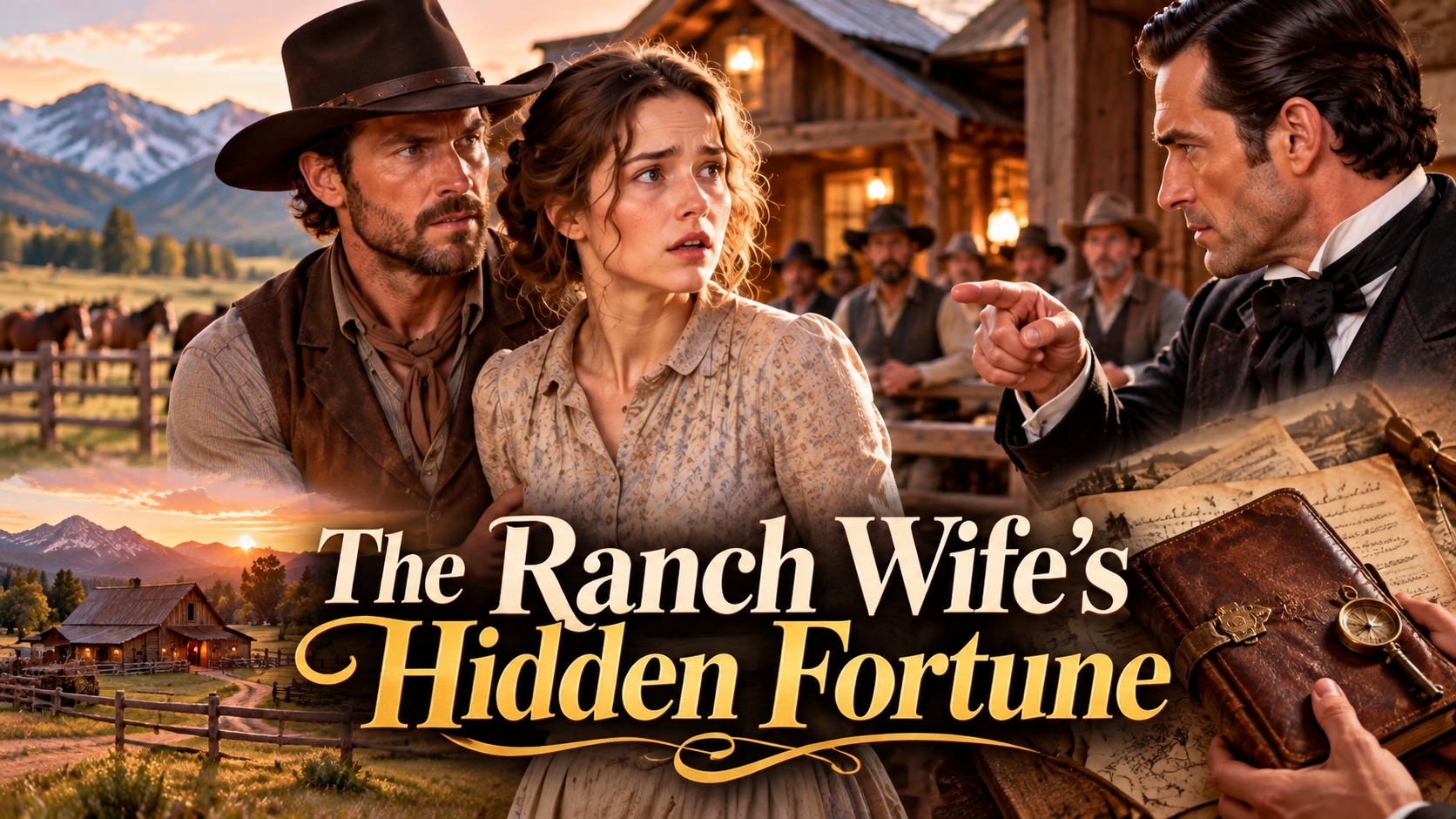
The courthouse square was already crowded when James Carter arrived.
Edmund Vale stood on the steps beside the sheriff, wearing the same expensive black coat he had worn when he first entered the ranch dining room.
He looked pleased.
Then he saw the wagons.
One after another, they rolled into the square.
Ranch hands.
Farmers.
Stagecoach drivers.
Miners.
Families.
Men and women who had once arrived at Carter Ranch hungry, exhausted, or desperate for shelter.
Now they had come for Sarah.
Edmund watched them gather.
“What is this nonsense?”
James dismounted.
“People who know my wife.”
Edmund laughed.
“Then they can watch her lose everything.”
Inside the courthouse, Sarah sat at a wooden table.
Her face was pale.
But when James entered, she rose so quickly that her chair scraped against the floor.
“James!”
He crossed the room and took her hands.
“The ranch?”
“Still ours.”
“The kitchen?”
James hesitated.
“Needs rebuilding.”
Sarah’s eyes filled with tears.
“I’m sorry.”
He shook his head.
“You saved that place once. We’ll save it again.”
The judge entered.
Edmund immediately presented his claims.
He accused Sarah of stealing family property, concealing financial records, and interfering with legitimate business transactions.
He also demanded recognition of his right to seize Carter Ranch through the purchased mortgage.
For nearly an hour, he spoke confidently.
Then James placed the original survey on the judge’s desk.
The room fell silent.
The judge examined the signatures.
He read the land description.
Then he studied the notarized deed.
“Mr. Vale,” he said, “this document appears to establish ownership of the eastern spring and surrounding property in the Carter family.”
Edmund’s expression tightened.
“That survey is obsolete.”
James placed the second packet beside it.
“Then perhaps you can explain why your associates spent twenty years trying to hide it.”
The judge began examining the mortgage transfers.
His expression grew increasingly severe.
Edmund took one step backward.
“These documents were stolen.”
A voice came from the rear of the courtroom.
“No, Edmund.”
Everyone turned.
An elderly man stood beside Eleanor Price’s husband, a senior railroad records officer who had brought the sealed files from his office.
The old man wore a plain brown coat.
His hair was silver.
His face was thinner than the portrait Sarah remembered.
But she knew him instantly.
“Father?”
Arthur Whitcomb looked at her.
“I’m sorry, Sarah.”
She ran toward him.
For a moment, neither could speak.
Then Sarah buried her face against his chest and wept.
Edmund stared.
“Impossible.”
Arthur turned toward him.
“I’ve spent years waiting for you to make a mistake you couldn’t purchase your way out of.”
He approached the judge.
Arthur explained that he had been gathering evidence with Thomas Bell and several railroad employees.
He had remained hidden because the men involved in the land scheme controlled local officials and had threatened witnesses.
But Sarah’s growing reputation had changed everything.
Travelers who ate at her ranch carried news across the territory.
Among them were people who had unknowingly transported letters, documents, and testimony between settlements.
Arthur had used those ordinary routes to gather the final evidence.
Edmund had followed Sarah to Carter Ranch because he feared she possessed the ledger.
But his attempt to seize the ranch and destroy its records had exposed the entire scheme.
The railroad officer presented certified copies of the missing contracts.
The judge reviewed them.
Then the young rider arrested after the fire was brought forward.
He identified the men who had paid him.
Edmund’s face lost its color.
The sheriff who had accompanied him began moving toward the door.
But two territorial marshals were already standing there.
The judge ordered the disputed mortgage enforcement suspended pending a full investigation.
He also directed that Sarah be released from the accusations based on Edmund’s unsupported claims.
Edmund was taken into custody for questioning in connection with the fraudulent land transactions and the attempted destruction of evidence.
As he passed Sarah, he stopped.
“You think you’ve won?”
Sarah looked at him calmly.
“No, Edmund.”
She glanced toward James.
“I think I’ve finally stopped running.”
Outside, the courthouse square erupted in cheers.
But the greatest surprise was still waiting.
Arthur approached James carrying the small leather pouch.
“Your grandfather was an extraordinary man,” he said.
James looked confused.
“You knew him?”
Arthur nodded.
“Nathaniel Carter saved my life when I was a young survey assistant. I was caught in a mountain flood. He pulled me from the water and sheltered me for three days.”
James stared.
“He never told us.”
“He never asked for anything in return.”
Arthur smiled sadly.
“Years later, when I discovered the land scheme, I realized his family was one of its targets. I promised myself I would make things right.”
He opened the pouch and removed the silver compass.
“Your grandfather gave me this the day we parted.”
James turned it over.
For the rightful owner.
Arthur continued.
“The spring beneath your ranch is valuable. But not because of the railroad.”
James frowned.
“What do you mean?”
Arthur unfolded a second map.
It showed the eastern ridge, the spring, and a broad stretch of land beyond the Carter boundary.
“The railroad has already decided to move its main route farther north. Edmund never knew. The company kept the revised plans confidential while negotiations continued.”
James looked at the map.
“Then why did they want our spring?”
“Because a new settlement is planned near it. A place for families, merchants, and travelers. Your water rights could support the entire community.”
James stared at him.
“You’re saying the ranch is worth more than we thought?”
“Considerably more.”
Sarah looked at her father.
“How much?”
Arthur smiled.
“Enough that you could sell it and never work another day.”
James looked toward Sarah.
She looked back at him.
For a moment, neither spoke.
Then Sarah shook her head.
“We’re not selling.”
Arthur seemed surprised.
“Sarah—”
“That ranch was dying when I arrived. Those men worked without knowing whether they’d be paid. James gave me a home when I had nowhere safe to go.”
She took her husband’s hand.
“I won’t sell the place that taught me what family means.”
James smiled.
“Neither will I.”
Arthur studied them for a long moment.
Then he laughed.
“Good.”
He reached into his coat and removed another envelope.
“Because I hoped you’d say that.”
Inside was a bank draft.
James stared at the amount.
It was more money than his ranch had earned in twenty years.
“What is this?”
“Restitution,” Arthur said. “Money recovered from accounts tied to the fraudulent contracts, together with funds I set aside to repay the Carter family.”
James shook his head.
“I can’t accept—”
“You can,” Arthur interrupted gently. “Your grandfather saved my life. Your family protected land that dishonest men wanted to steal. And my daughter found happiness here.”
Sarah covered her mouth.
Arthur’s eyes softened.
“Let an old man repay a debt.”
But James was still staring at the envelope.
There was something else inside.
A small handwritten note.
He unfolded it.
The words were familiar.
Sarah had written them.
“Please find a man who needs a wife more than he needs a fortune. Someone who will never know my name.”
James looked at her.
“What is this?”
Sarah turned bright red.
Arthur began to smile.
“Ah. I wondered when you’d find that.”
James looked between them.
Sarah finally confessed.
Months before arriving in Colorado, she had asked her father to help her disappear from the wealthy world that had become a prison.
She wanted an ordinary life.
A place where she could work, be useful, and be loved without anyone calculating the value of her inheritance.
Arthur had arranged for a trusted intermediary to place a marriage advertisement in a frontier newspaper.
But there had been one condition.
Sarah would choose the man herself.
She had read dozens of replies.
Some men wanted a servant.
Others wanted a woman with money.
One promised fine clothes and a comfortable house.
Then she found James Carter’s letter.
It contained only a few lines.
“My ranch is struggling. I cannot promise wealth or ease. I can promise an honest home, a place at my table, and a husband who will never ask his wife to carry more than he is willing to carry himself.”
Sarah had kept that letter beneath her pillow throughout their marriage.
James stared at her.
“You chose me?”
She nodded.
“Before you ever saw my face.”
He swallowed.
“But you told me you’d never managed a house that large.”
Sarah laughed through tears.
“That part was true.”
“And the cooking?”
“My mother taught me. Father taught me how to feed a hundred people with supplies meant for fifty.”
James shook his head, smiling.
“I thought I married a poor woman who needed a home.”
Sarah squeezed his hand.
“And I thought I married a stubborn rancher who needed someone to tell him to eat supper.”
Arthur cleared his throat.
“There’s one more thing.”
James and Sarah turned.
Arthur pointed toward the bank draft.
“The money is yours to use. But the land beyond the eastern ridge is still waiting for someone to develop it.”
Sarah looked at James.
A slow smile spread across her face.
“I have an idea.”
Six months later, Carter Ranch looked nothing like the place Sarah had first entered.
The barn stood taller.
The fences were new.
The cattle were healthy.
The old kitchen had been rebuilt into a spacious dining hall with long wooden tables and windows overlooking the mountains.
Beside it stood a modest inn for travelers.
A bakery opened near the road.
Walter managed the ranch hands and claimed he had become too important to wash his own dishes.
Nobody believed him.
Families began settling near the eastern spring.
James and Sarah helped establish a market where farmers could sell food directly to travelers and railroad workers.
And above the dining hall entrance hung a wooden sign.
The Carter Table.
Everyone Welcome.
One autumn evening, Sarah stood on the porch watching the sunset.
James came up behind her.
“You know,” he said, “I still haven’t figured out your greatest secret.”
Sarah smiled.
“I thought we’d uncovered all of them.”
“No.”
He slipped his arms around her waist.
“How did you know one little kitchen could save an entire ranch?”
Sarah looked through the window.
Inside, ranch hands and travelers were laughing around the tables.
A child was helping Walter carry bread.
Arthur sat near the fireplace telling stories to anyone willing to listen.
Sarah rested her head against James’s shoulder.
“Because my mother once told me something.”
“What?”
“People may forget the price of a meal. But they never forget the place where someone made room for them.”
James kissed her forehead.
Then he reached into his pocket.
“I almost forgot.”
He handed her a folded paper.
Sarah opened it.
It was the original marriage advertisement.
Beneath James’s old words, he had written a new sentence.
“Looking for a wife to save a failing ranch. Found a woman who taught me what was worth saving.”
Sarah laughed.
Then she cried.
Then she kissed him.
And far beyond the porch, the sun settled over the Colorado mountains.
The ranch that had once been days away from foreclosure had become the heart of a thriving community.
But the true fortune had never been the spring, the railroad, or the money hidden in the Whitcomb accounts.
It was the extraordinary life built by two people who had chosen each other when neither knew what the future would bring.
And every evening, when the dinner bell rang across Carter Ranch, Sarah still made sure there was one empty chair at the table.
For whoever might arrive hungry.
For whoever might need shelter.
For whoever might be looking for a place to begin again.
The End.