THE SPARE THAT WASN’T FOR SALE
**PART 1: **
The woman at the tire shop asked if we could keep her husband’s spare tire.
Not put it on.
Not throw it away.
Keep it.
I was working the front counter at Redline Tire & Auto in Muncie, Indiana, where the waiting room smelled like burnt coffee, rubber, and the little pine-tree air fresheners nobody bought but everybody touched.
It was a Tuesday morning, right after a storm had rolled through and left half the county full of puddles and potholes. People were coming in angry about nails, low pressure lights, and one guy who swore his tire “just exploded for no reason” even though there was a railroad spike sticking out of it.
The woman came in carrying a donut spare tire with both arms.
She was maybe seventy, small but stubborn-looking, with white hair tucked under a rain hood and mud on the bottom of her sneakers. Her coat was buttoned wrong, and one sleeve was damp like she had dragged the tire part of the way from the parking lot.
I hurried around the counter.
“Ma’am, let me get that.”
She shook her head.
“I’ve got it.”
She did not have it.
But she needed to.
So I let her carry it the last three steps to the counter.
She set the tire down carefully, like it was something sleeping.
“I need to know if this is still safe,” she said.
I looked at it.
Old compact spare. Faded yellow warning sticker. Tread almost untouched. Rim scratched but fine.
“What vehicle?”
“1998 Buick LeSabre.”
I nodded.
“Still driving it?”
Her mouth moved a little.
“No.”
That one word made me slow down.
The waiting room TV was playing a morning show nobody watched. The coffee maker hissed. Through the glass wall, I could see our techs rolling tires across the shop floor.
The woman put one hand on the spare.
“My husband kept this in the trunk,” she said. “He checked it every Sunday after church.”
I smiled softly.
“Prepared man.”
“Too prepared,” she said. “Had jumper cables, flares, blankets, bottled water, three flashlights, and a map for every state we never visited.”
Then she smiled too.
Just a little.
“His name was Gene.”
I nodded.
“Gene passed in January.”
“I’m sorry.”
She looked down at the spare again.
“He always said, ‘A good spare means you’re not stuck, just delayed.’”
Her fingers traced the old warning sticker.
“I sold the Buick yesterday.”
I understood then why she had brought the tire inside like it weighed more than rubber.
“The buyer didn’t want the spare?”
“He did,” she said. “I lied and told him it was missing.”
She looked ashamed and defiant at the same time.
“I know that was wrong. But when he drove away, I realized I couldn’t watch all of Gene leave at once.”
The TV audience laughed at something.
No one in our waiting room did.
The woman swallowed.
“My daughter says I need to stop keeping pieces of him. She’s probably right. I have his coat still on the hook. His coffee mug by the sink. His hat in the back window of the car until yesterday.”
She patted the spare.
“But this one feels different. This was how he loved me. Not flowers. Not poems. Tires checked. Oil changed. Gas tank never below half.”
She looked at me then.
“Can a tire shop keep a spare?”
I opened my mouth and closed it.
Because no, technically.
We were not a museum. We were not storage. We did not keep random customers’ tires unless they paid for seasonal storage, and even then, not one compact spare from a car they no longer owned.
But she was not asking for storage.
She was asking for a place where Gene’s kind of love would be understood.
From the service bay door, Marco, our oldest tech, called out, “What size?”
The woman turned.
Marco wiped his hands on a red rag and walked in. Sixty-two, gray mustache, bad knees, knew every car by the sound it made pulling into the lot.
I told him.
“Buick donut spare,” I said.
Marco looked at the tire.
Then at the woman.
“Your husband air it up regular?”
“Every Sunday,” she said.
Marco crouched and checked the valve stem.
“Looks like he did.”
Her face changed.
It was not praise exactly.
But it landed like praise.
Marco stood slowly.
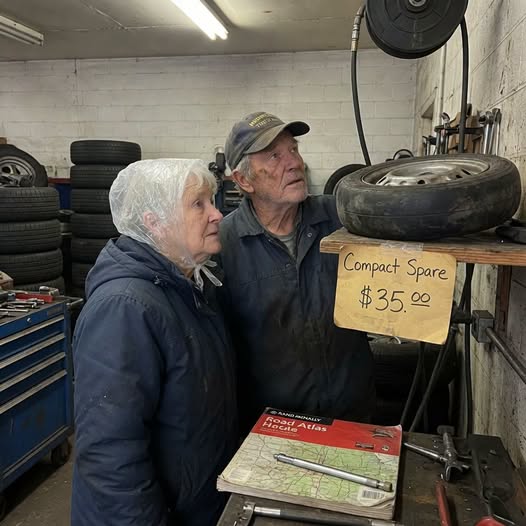
“We got a shelf in the back,” he said.
I looked at him.
“We do?”
He ignored me.
“Not for storage. For teaching.”
The woman blinked.
“Teaching?”
Marco nodded.
“New kids come in here and don’t know what a spare’s supposed to look like. Half the cars now don’t even have one. We’ll keep Gene’s back there and show them what prepared looks like.”
The woman pressed her lips together.
“That would be useful?”
“Ma’am,” Marco said, “a properly kept spare is more useful than half the stuff people keep in their garages.”
That did it.
Her eyes filled, but she smiled.
“What do I owe you?”
“Nothing.”
“No. I don’t like that.”
Marco looked at the tire.
“Then tell me one thing Gene would say if he saw me letting air out of a tire too fast.”
She laughed before she could stop herself.
“He’d say, ‘You trying to fix it or kill it?’”
Marco grinned.
“Payment accepted.”
We carried the spare to the back.
She followed us into the shop, stepping carefully around hoses and floor jacks. The techs looked up, curious, then quieted when they saw her face.
Marco cleared a spot on the top shelf near the alignment rack.
He set the spare there.
Then he took a piece of masking tape and wrote with a marker:
GENE’S SPARE
NOT STUCK, JUST DELAYED
The woman stared at it.
For a moment, the shop noise seemed to soften around the hum of compressors and impact wrenches.
“Could I take a picture?” she asked.
“Of course.”
She took one with a phone she had to hold far from her face to see.
Then she touched two fingers to the tire.
“Behave yourself,” she whispered.
I looked away.
So did Marco.
**PART 2: GENE’S SHELF**
The next week, the woman came back.
Her name was Dorothy.
She brought a Ziploc bag with something inside.
A tire pressure gauge.
Old-fashioned. Silver. The kind with the little white stick that pops out.
“This was Gene’s,” she said. “Found it in his coat pocket.”
Marco took it like she was handing him a medal.
“We’ll put it with the spare.”
So we did.
Then she brought his road atlas.
Then a flashlight.
Then the note he had taped inside the Buick’s glove box, written in block letters:
CHECK AIR BEFORE LONG TRIPS.
DON’T TRUST GAS STATION GAUGES.
Marco taped that note under the shelf.
At first, it was just Gene’s little corner.
Then customers started noticing.
A young guy getting new tires asked what it was.
Marco told him, “That’s what love looks like if it wears a ball cap and checks pressure.”
The guy laughed.
Then he asked if someone could show him how to check his own spare.
Another woman overheard and said she had never looked under the cargo mat in her SUV.
One of our techs checked.
No spare.
Just a compressor kit that expired six years ago.
She stood there shocked, like the car had betrayed her personally.
By spring, we had a handwritten sign in the waiting room:
FREE SPARE TIRE CHECKS
IN MEMORY OF GENE
“NOT STUCK, JUST DELAYED”
People came in for it.
Not hundreds.
But enough.
A college student driving home to Ohio.
A single dad taking his kids to Florida.
An older woman who said her husband used to handle “all that car stuff” and she was tired of feeling helpless.
Marco showed them.
Slowly.
No shame.
Where the spare was.
How to check pressure.
Where the jack went.
Why the tiny donut tire was not meant for highway heroics.
Dorothy started coming in on Sunday afternoons after church.
Not every week.
Just when she felt up to it.
She sat in the waiting room with a coffee she never finished and watched Marco teach people how not to get stranded.
Sometimes she corrected him.
“Gene said valve caps matter.”
Marco would roll his eyes.
“Dorothy, I am begging you not to supervise my valve caps.”
But he put them back on tighter.
One Sunday, a teenage girl came in with her mother.
The girl had just gotten her license. Her mother wanted her spare checked before a school trip.
Marco walked them through it.
The girl listened at first the way teenagers listen to adults, which is to say, with only the smallest visible proof of life.
Then Dorothy leaned forward from her chair.
“Honey, do you know why my husband checked my tires?”
The girl shrugged.
“So you wouldn’t get stuck?”
Dorothy nodded.
“But also because he wanted me to know I could leave whenever I needed to and come home safe when I wanted to.”
The girl looked at her then.
Really looked.
Dorothy smiled.
“Independence needs air too.”
The girl laughed.
But she checked all four tires herself.
Before she left, she took a picture of Gene’s shelf.
A month later, someone mailed us a postcard from Nashville.
No return address.
Just a picture of the skyline and a note:
Made it to my internship. Checked the spare before I left. Tell Gene thanks.
Dorothy read it in the shop three times.
Then she tucked it behind the pressure gauge on the shelf.
After that, postcards started appearing.
Cincinnati.
St. Louis.
Savannah.
Denver.
Somebody sent one from a rest stop in Nebraska and wrote, “Spare was low. Fixed it before it mattered.”
Gene’s shelf got crowded.
Marco grumbled about clutter but never moved a single card.
On the first anniversary of Gene’s passing, Dorothy came in with a small envelope.
Inside was a photo of Gene standing beside the Buick in their driveway, one hand on the trunk, wearing a faded Colts sweatshirt and the expression of a man who believed the entire world could be improved with proper maintenance.
We framed it and hung it above the shelf.
Underneath, Marco replaced the masking tape with a real label.
GENE WALTERS
1939–2026
HE KEPT PEOPLE READY
Dorothy stood there with one hand over her mouth.
“He would hate all this attention,” she whispered.
Marco nodded.
“Most useful men do.”
That made her laugh and cry at the same time.
A few months later, Dorothy bought a car.
Not new.
Not fancy.
A small silver Honda her daughter helped her find.
She drove it to the shop herself, parked crooked, and walked in holding the keys like a dare.
“I need you to check something,” she said.
Marco smiled.
“The spare?”
She nodded.
We all went outside.
Dorothy opened the trunk.
There was a spare.
Clean.
Full-size, even.
Marco checked the pressure.
“A little low.”
Dorothy held out Gene’s old gauge.
“Teach me.”
So he did.
She knelt on the pavement in her church shoes, pressed the gauge to the valve stem, and jumped when the air hissed.
“Did I break it?”
“No,” Marco said. “You measured it.”
She checked it again.
Then she checked all four tires.
Slow.
Careful.
Determined.
When she finished, she looked at the gauge in her hand.
“I think Gene would be insufferable right now.”
“Absolutely,” I said.
She smiled.
For the first time since she carried that spare tire through our door, Dorothy looked less like a woman trying to keep her husband from leaving and more like a woman carrying what he taught her forward.
Before she drove away, she rolled down the window.
“I put a map in the glove box,” she said.
Marco nodded approvingly.
“Good.”
“And bottled water.”
“Good.”
“And peppermint candies.”
He frowned.
“For emergencies?”
“For me.”
Then she drove off.
Not stuck.
Just delayed.
Gene’s spare is still on the shelf.
The rubber has aged. The label has curled at one corner. The old gauge sometimes sticks, but Marco refuses to replace it because, as he says, “That thing has seniority.”
People still ask about it.
We still check spares for free.
And every once in a while, a widow, a college kid, a nervous new driver, or a man who thought he knew everything about cars stands in our shop and learns that preparedness is not fear.
Sometimes it is love with a pressure gauge in its pocket.
Because sometimes a spare tire is not just a spare tire.
Sometimes it is a husband saying, “You’ll be okay if I’m not there.”
And sometimes the kindest thing you can do with what someone left behind is put it on a shelf where it can keep helping people get home.