THE RED PLASTIC HELMET IN THE FIRE STATION CASE THAT STILL KNEW A LITTLE BOY’S NAME AFTER HIS DAD WAS GONE
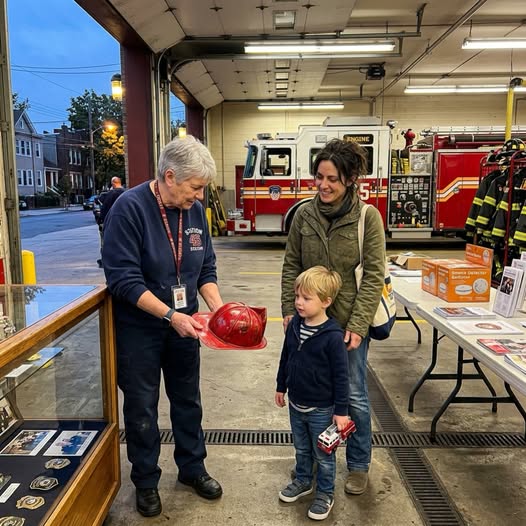
The woman at the fire station refused to take the old red plastic helmet out of the display case, and I didn’t understand why until the little boy asked if Engine 4 could still honk twice at 7:05.
I was at Station 4 on a Saturday morning because the city was giving out free smoke detector batteries, and apparently adulthood is mostly realizing you have ignored a chirping ceiling for three days out of pride.
The fire station sat on the corner of Maple and 9th, all brick and big glass doors, with the fire trucks parked inside so clean they looked like they had never met actual smoke.
Inside, it smelled like coffee, rubber, floor wax, and that faint metal smell old buildings get when they’ve held a lot of emergency.
There were folding tables set up in the bay.
Coloring sheets for kids.
Free batteries.
A tray of grocery-store donuts.
A firefighter showing children how to stop, drop, and roll while one little girl took it as an invitation to roll under a chair.
Behind the front desk was a woman named Mrs. Vicky.
At least that’s what the firefighters called her.
She looked about seventy. Maybe older. Short gray hair, navy station sweatshirt, reading glasses on a chain, and the kind of voice that could calm a room without becoming soft.
Near her desk was a glass display case.
Old patches.
Retired helmets.
A black-and-white photo of the first crew.
A bent nozzle from some fire back in the seventies.
And on the bottom shelf, a child’s red plastic fire helmet.
The cheap kind they give out at school visits.
It was scratched across the front, and someone had written SAM in black marker on the inside brim.
A young firefighter opened the case and reached for it.
“Mrs. Vicky, this kid wants to try one on. Can I use this?”
Her hand landed on the glass.
“No.”
He froze.
“I just meant—”
“I know what you meant.”
He shut the case like it had suddenly become a safe.
I noticed.
Of course I noticed.
Because I am nosy and apparently incapable of getting batteries without stepping into somebody’s heartbreak.
Mrs. Vicky caught me looking.
“Some helmets are not for playing,” she said.
That was all she gave me.
Then the front doors opened.
A woman came in holding a little boy’s hand.
The woman looked maybe mid-thirties. Jeans. Black jacket. Hair pulled back. Face tired in a way makeup could not argue with.
The boy was maybe seven.
Small, serious, wearing sneakers that lit up when he walked and a jacket zipped all the way to his chin. In one hand, he carried a folded piece of notebook paper. In the other, he held a toy fire truck missing one ladder.
Mrs. Vicky stood up before they reached the desk.
Her whole face changed.
Not happy exactly.
Softer.
Like a door opening in a room nobody used anymore.
“Well,” she said. “There’s our Sammy.”
The little boy stopped.
“My name is Sam.”
“I know.”
“My dad called me Sammy.”
Mrs. Vicky nodded slowly.
“He did.”
The woman closed her eyes for half a second.
Sam looked at the display case.
Then he saw the plastic helmet.
His little body went still.
“That’s mine.”
Mrs. Vicky looked at the case.
“Yes, baby.”
“You kept it?”
“Yes.”
“Why?”
She came around the desk and crouched in front of him, which took some effort.
“Because your dad put it there.”
Sam looked at his mother.
She covered her mouth.
Mrs. Vicky looked up at her.
“Hi, Lauren.”
“Hi, Vicky.”
No one asked how she was.
Some questions are not fair when the answer is standing right there in a child’s eyes.
Sam pressed his hand to the glass.
“My dad wrote my name in it.”
“He did,” Mrs. Vicky said. “He said you wore it to bed for two weeks.”
“I had to.”
“Why?”
Sam looked at her like this was obvious.
“In case there was a fire.”
Mrs. Vicky smiled.
“Smart planning.”
Lauren laughed once.
It broke before it finished.
The fire station got quieter around us.
Not silent.
A firefighter was still teaching kids about exits. Someone’s radio crackled. A coffee pot hissed in the kitchen.
But near that display case, everything narrowed.
Sam looked toward the big red truck parked in the bay.
“Is that Engine 4?”
“Yes,” Mrs. Vicky said.
“Did Dad drive it?”
“Sometimes.”
“He said he was the best driver.”
A firefighter nearby snorted.
Mrs. Vicky turned her head.
“Do not ruin a child’s memory, Torres.”
Torres lifted both hands.
“He was the second-best driver.”
Sam smiled.
Small.
Careful.
Hungry for anything about his father.
Lauren saw that smile and had to look away.
Sam unfolded the notebook paper.
“My mom said we could ask.”
Mrs. Vicky looked at Lauren.
Lauren nodded, barely.
“What are we asking?” Mrs. Vicky said.
Sam looked at the truck.
“Can Engine 4 honk twice at 7:05?”
The whole station changed.
Not loudly.
But every firefighter in that bay heard it.
Torres stopped moving.
The man at the smoke detector table looked down.
Mrs. Vicky’s eyes filled before she could stop them.
“Why 7:05, baby?”
Sam looked confused, like adults should have known.
“That’s when Dad left for work.”
Lauren pressed one hand to her chest.
“He’d honk twice if Sam was at the window,” she said quietly.
Sam nodded.
“Beep-beep.”
Mrs. Vicky closed her eyes.
Just for a second.
“He did that here too.”
Sam looked up.
“He honked here?”
“If he saw me carrying coffee and thought I was moving too slow.”
Torres said, “He honked at everybody.”
Another firefighter said, “He honked at a squirrel once.”
Sam giggled.
“My dad honked at a squirrel?”
“Your dad said the squirrel had no traffic awareness,” Torres said.
The boy laughed.
A real one.
Small, but bright enough to change the room.
Then it faded.
“Today is his birthday,” Sam said.
Lauren’s face folded.
“He would’ve been thirty-nine.”
Mrs. Vicky nodded.
“I know.”
Sam looked back at the truck.
“I wanted to hear it.”
Mrs. Vicky put one hand on his shoulder.
“We can do that.”
Lauren took a shaky breath.
“Only if it’s not a problem.”
Mrs. Vicky looked almost offended.
“Lauren.”
“I know. I just don’t want to make the station stop for us.”
At that, Torres stepped forward.
“This station stopped for Mike plenty of times when he burned popcorn.”
Another firefighter said, “Twice.”
“Three times,” Mrs. Vicky corrected.
Lauren laughed through tears.
“He blamed the microwave.”
“The microwave has never recovered its reputation,” Torres said.
Sam looked around.
“My dad burned popcorn?”
“Your dad believed extra time meant extra flavor,” Mrs. Vicky said.
“That’s wrong.”
“Very.”
Sam looked proud of knowing something true.
Then he touched the glass again.
“Can I hold my helmet?”
Mrs. Vicky hesitated.
That hesitation told me the helmet was more than plastic.
Lauren saw it too.
“Sam,” she said gently. “Maybe we should leave it there.”
“But it’s mine.”
“It is.”
“Then why can’t I hold it?”
Mrs. Vicky unlocked the case slowly.
She took out the little red helmet with both hands and placed it on the desk.
Not in Sam’s hands.
On the desk.
“This helmet has been here since the funeral.”
Sam stared at it.
“Why?”
“Because your dad brought it to work the week before he died.”
Lauren looked at her sharply.
“What?”
Mrs. Vicky nodded.
“He brought it in and put it on that shelf himself.”
Lauren covered her mouth.
“He didn’t tell me.”
“He said Sam had outgrown it but wouldn’t let it go. Said maybe if it lived at the station, he could visit it.”
Sam whispered, “I didn’t outgrow it.”
Mrs. Vicky smiled softly.
“No?”
“My head got bigger.”
“That is different.”
He almost smiled.
Mrs. Vicky turned the helmet over.
Inside, under Sam’s name, there was another line written in smaller marker.
MIKE’S BOY
Sam read it.
Then read it again.
His face changed.
Like the words had gone somewhere deep.
“He wrote that?”
“Yes.”
“Why?”
Mrs. Vicky’s voice got quieter.
“Because he liked saying it.”
Lauren sat down hard in the chair beside the desk.
Sam touched the words with one finger.
“I’m still his boy?”
Every adult in that room broke a little.
Mrs. Vicky crouched again.
“You will always be his boy.”
Sam cried then.
Not loud.
Not dramatic.
Just tears spilling down a seven-year-old face while he stood beside a fire truck and a plastic helmet that still knew who he belonged to.
Lauren reached for him.
He climbed into her lap even though he was almost too big for it.
She wrapped both arms around him and rocked once, like her body remembered doing that from when he was smaller.
“I forgot his voice,” Sam whispered.
Lauren shut her eyes.
“No, baby.”
“I did.”
Mrs. Vicky stayed low in front of him.
“What do you remember?”
Sam wiped his nose on his sleeve.
Lauren didn’t stop him.
Good mother.
“He called pancakes flat tires.”
Mrs. Vicky smiled.
“What else?”
“He put ketchup on eggs.”
“Crime.”
Torres nodded seriously.
“Federal.”
Sam sniffed.
“He said my shoes made me run faster because of the lights.”
“They do,” Torres said.
“He sang in the truck.”
Lauren laughed through tears.
“Badly.”
“Really badly,” Sam said.
Mrs. Vicky touched the little helmet.
“Then his voice is still in there somewhere.”
Sam looked at her.
“Where?”
“In the things he said enough times to stay.”
That sentence sat in the air with the diesel and coffee and donuts.
Lauren’s shoulders shook.
Sam looked at the helmet.
Then at Engine 4.
“Can we do the honk now?”
Mrs. Vicky looked at the clock.
It was 7:01.
“We wait four minutes.”
So we waited.
Nobody announced it.
Nobody made a speech.
The firefighters just moved quietly.
At 7:03, Torres opened the bay door.
Cold evening air rolled in.
At 7:04, someone turned off the radio in the kitchen.
At 7:05, Mrs. Vicky nodded.
Torres climbed into Engine 4.
Sam stood beside Lauren, holding the red plastic helmet against his chest.
Torres pressed the horn.
Beep.
Beep.
Two short honks.
Not too loud.
Not showy.
Exactly enough.
Sam made a sound like the world had answered him.
Lauren bent forward and cried into both hands.
Mrs. Vicky put an arm around her.
The rest of us stood there not knowing what to do with our own faces.
Then Sam lifted the toy fire truck in his hand and honked it back.
It made a tiny squeak.
Pathetic.
Perfect.
Everyone laughed.
Even Lauren.
Especially Lauren.
**THE FIRE TRUCK THAT HONKED TWICE AT 7:05 EVERY YEAR SO A BOY COULD STILL HEAR HIS DAD SAY BEEP-BEEP**
Afterward, Mrs. Vicky took the helmet back.
Sam hesitated, but he handed it over.
“Can it stay here?”
“Where do you want it?”
He pointed to the display case.
“Next to Dad’s picture.”
Mrs. Vicky looked at Lauren.
Lauren nodded.
So Mrs. Vicky moved things around.
A patch.
A brass nozzle.
An old photo.
Then she placed the red plastic helmet beneath a framed picture of Mike in uniform, grinning with one arm around Engine 4.
Under it, she added a handwritten card.
MIKE’S BOY WAS HERE
7:05
Sam read it.
Then he nodded like that was correct.
Before they left, Torres brought him a new plastic helmet.
Not red.
Yellow.
Sam looked at it.
“This one is for now,” Torres said. “The red one is for remembering.”
Sam put the yellow helmet on.
It sat crooked.
His mother fixed it.
Then he looked at Engine 4.
“Can we come back next year?”
Mrs. Vicky’s voice shook.
“You better.”
A week later, I went back to Station 4.
Not for batteries.
I had enough batteries to power a small village.
I went because I couldn’t stop thinking about that helmet.
Mrs. Vicky was at the desk.
She saw me and said, “Smoke detector still chirping?”
“No.”
“Then you’re nosy.”
“Yes.”
She smiled and pointed toward the display case.
There was a new photo inside now.
Sam wearing the yellow helmet, standing beside Engine 4 with Lauren behind him, her hands on his shoulders.
On the back, written in a child’s uneven handwriting, were the words:
I heard Dad.
Mrs. Vicky caught me reading it.
“They came by Wednesday too,” she said.
“How are they?”
She looked at the photo.
“Sad.”
Then, after a second:
“Breathing.”
That felt honest.
Over the next few months, Sam and Lauren came by more often.
Not every day.
Not in some neat healing montage.
Some weeks they didn’t come at all.
Some weeks they dropped off cookies because Lauren said Mike used to eat everything in the station kitchen and she felt the need to continue the damage.
The firefighters taught Sam things.
How to coil a hose.
How heavy turnout gear really was.
Why you never hide in a closet during a fire.
Why burned popcorn is not a food group.
Mrs. Vicky let him sit at her desk and stamp old forms with a red stamp that said COPY until he decided paperwork was boring.
“Smart boy,” she said.
On Mike’s next birthday, the station didn’t wait for Sam to ask.
At 7:05, Engine 4 honked twice.
Sam honked back with his toy truck, which still sounded like a sick duck.
Then Lauren handed Mrs. Vicky a small envelope.
Inside was a note Mike had written years earlier and tucked into Sam’s baby book.
Lauren found it while cleaning the hall closet.
It said:
If this kid ever doubts it, tell him being his dad was the best thing I ever got called to.
Mrs. Vicky read it once.
Then again.
Then she took off her glasses and cried like a person who had been holding the whole station together too long.
Sam asked what it meant.
Lauren knelt in front of him and said, “It means you were his favorite emergency.”
Sam thought about that.
Then smiled.
“I was a good emergency.”
“The best,” she said.
Now Station 4 has a little tradition.
Nothing official.
Nothing on the city website.
But every year on Mike’s birthday, whoever is in the bay at 7:05 honks twice.
Not for a show.
Not for attention.
For a boy at a window.
For a firefighter who burned popcorn.
For a widow learning that returning to the station does not mean getting stuck in the past.
It means bringing love somewhere it is still recognized.
I still pass Station 4 sometimes.
If the doors are open, I look for the display case.
The red plastic helmet is still there.
Scratched.
Too small.
Cheap.
Sacred.
Right under Mike’s picture.
And every time I see it, I think about how children are always trying to make the dead answer.
With letters.
With toys.
With clocks.
With birthdays.
With one sound at the right time.
And maybe we cannot give them everything they want.
We cannot give them the voice back.
Or the footsteps.
Or the parent walking through the door at 7:05 with tired eyes and a bad joke about pancakes.
But sometimes we can give them a honk.
Two short sounds from an engine that remembers.
A helmet in a case.
A room full of people willing to say the name.
Sometimes that is enough for one breath.
And sometimes one breath is the beginning of learning how to live with the missing.
So if you ever hear a fire truck honk when there isn’t an emergency, don’t be too quick to complain.
Maybe it is answering someone.
Maybe it is a birthday.
Maybe it is a little boy standing beside his mother, holding a toy truck and trying to remember a voice.
And maybe somewhere in the sound is a father saying what love always says when it has to leave too soon:
I’m still here.
You’re still mine.
Beep-beep.