Health and Awareness: The Moving Story of the Assam Boy and the Challenge to Superstition
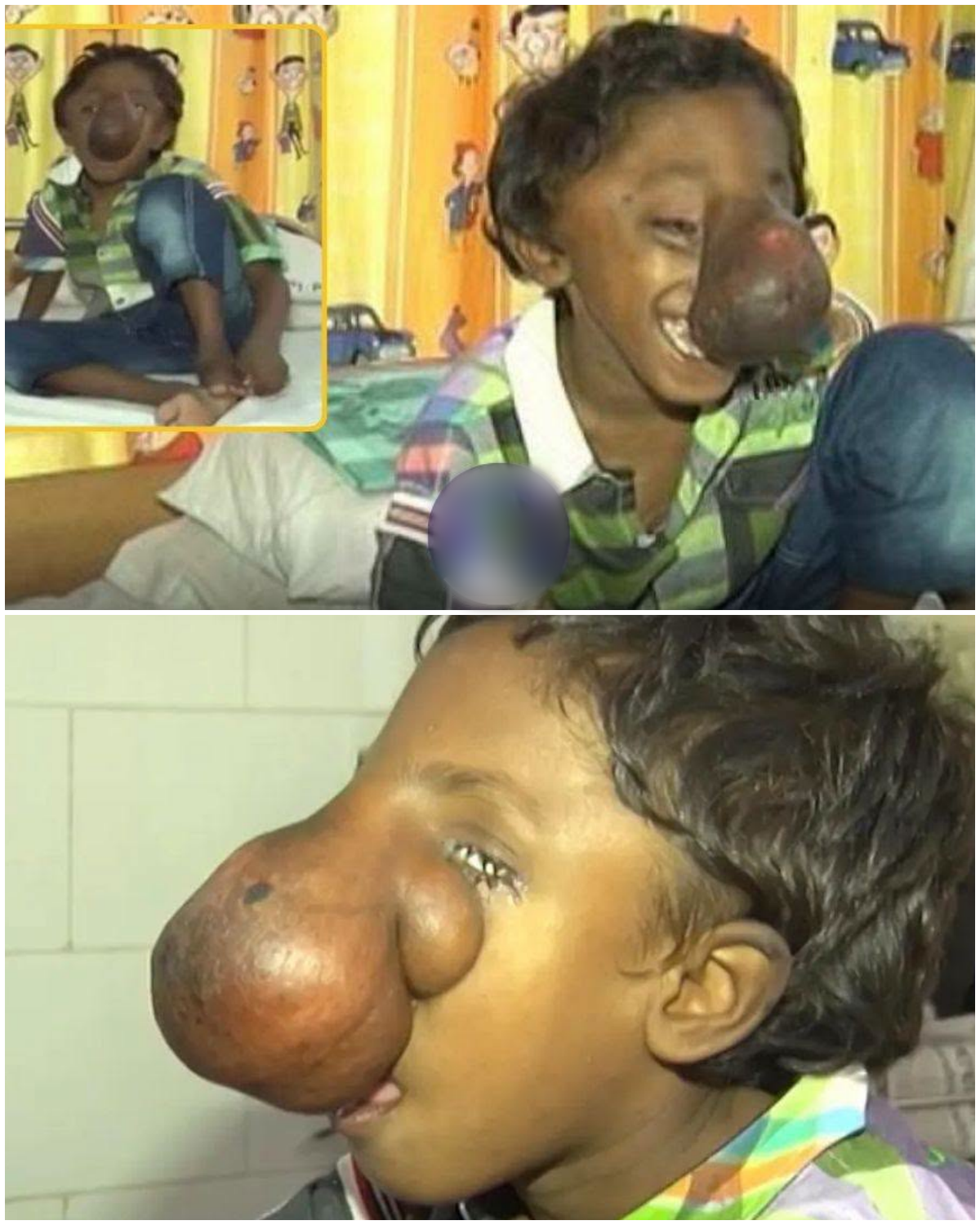
In the northeastern Indian state of Assam, a nine-year-old orphan boy lived with a striking facial deformity that led local residents to regard him as a divine figure. Diagnosed with frontonasal encephalocele—an extremely rare neural tube defect—he had a portion of brain tissue protruding through an opening in the skull, forming a large, trunk-like swelling over his nose and forehead.
The unusual appearance, resembling the elephant trunk associated with the Hindu deity Ganesha, prompted villagers to worship the child as a reincarnation of the god. They named him Ganesh and treated him with reverence. This cultural response, however, delayed access to essential medical care. The heavy protrusion severely restricted his ability to speak, eat independently, and see properly, while also causing significant pain and slowing aspects of his development.
Police discovered the boy wandering alone and in distress on a remote road. Unable to communicate his identity due to the speech impairment caused by the mass, he was identified as an orphan and placed in the care of a local child welfare committee and then an NGO, Bakakhat Nirman Gut. Volunteers provided daily support, feeding him and addressing his immediate needs while arrangements were made for specialized treatment.
Medical experts, including senior neurosurgeon Dr. Shibu Pillai, emphasized that the condition was a serious congenital defect requiring urgent intervention rather than a supernatural phenomenon. Frontonasal encephalocele involves incomplete skull development, allowing brain tissue and membranes to herniate outward. Left untreated for years, it posed risks to airway function, vision, and overall neurological health.
In mid-2017, a surgical team at Narayana Multi-specialty Hospital in Bangalore performed a complex reconstructive procedure lasting approximately six hours. The operation focused on reducing the swelling by carefully managing the herniated tissue, sealing the cranial defect, and reconstructing the nose and facial contours. The surgery was successful. Afterward, the boy was able to smile freely for the first time in years and gained the prospect of a more normal childhood free from constant pain and social isolation.
This case illustrates the intersection of rare congenital conditions, limited healthcare access in rural areas, and the power of community superstition. By prioritizing medical science over myth, the intervention restored dignity and opportunity to a child who had been both celebrated and constrained by his appearance. It also underscores the importance of early diagnosis and specialized neurosurgical and reconstructive care for neural tube defects, which, though uncommon in many regions, occur with higher frequency in certain parts of South and Southeast Asia.
Sources
- India Today, India.com, and Deccan Chronicle reports on the Assam boy’s condition, local worship, and diagnosis (June 2017).
- The Mirror and Caters News Agency coverage of the successful surgery at Narayana Multi-specialty Hospital and postoperative recovery.
- Statements from Dr. Shibu Pillai detailing the frontonasal encephalocele and surgical approach.