A Little Girl, a Big Smile, and a Teddy Bear in a Halo Brace
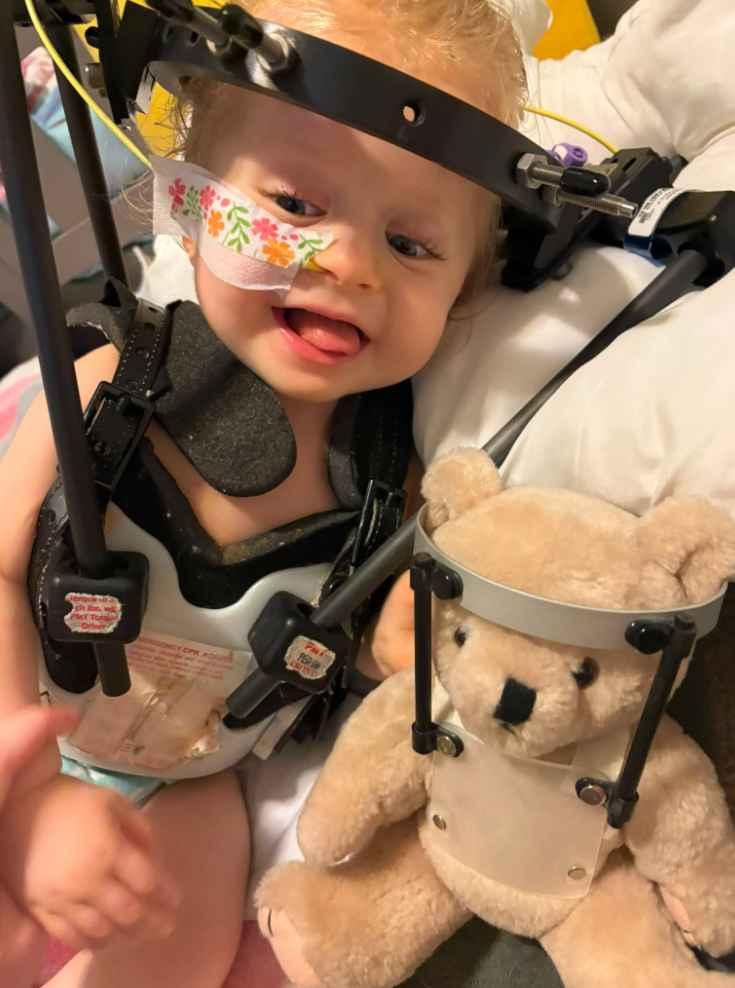
A joyful smile can sometimes tell a story more powerfully than words.
The accompanying story describes young Eleanor Faith Butler, a child living with osteogenesis imperfecta (OI), a rare genetic condition commonly known as brittle bone disease. OI causes bones to be unusually fragile and prone to fractures, sometimes after very little trauma. The condition can also affect the spine, joints, muscles and other connective tissues.
After undergoing a complex cervical spinal fusion procedure, Eleanor was reportedly placed in a halo brace to help keep her neck and cervical spine stable during recovery. In the photograph, she appears to be smiling brightly from her hospital bed, while a teddy bear beside her wears a miniature version of the same device.
What Is a Halo Brace?
A halo brace, also called a halo-vest, is an orthopedic device designed to immobilize and protect the cervical spine following certain injuries or surgeries. According to Johns Hopkins Pediatric Orthopaedics, the device consists of three main components: a rigid ring surrounding the head, pins that secure the ring to the skull, and rigid rods connecting the ring to a vest worn around the torso.
By limiting movement of the head and neck, the device helps protect the cervical spine while it heals. The length of time a patient remains in a halo is determined by the treating surgical team and depends on factors such as the type of surgery, the patient’s condition and the healing process.
For children with particularly fragile bones, recovery can require careful monitoring and specialized orthopedic care. In OI, abnormalities in collagen production can weaken the skeleton, and spinal problems—including vertebral compression and spinal curvature—can occur in some forms of the condition.
The Teddy Bear That Became a Little Companion
Perhaps the most striking detail in the photograph is not the medical equipment itself, but the teddy bear wearing a matching miniature halo brace.
This is an example of the idea behind medical play: using dolls, stuffed animals and realistic medical toys to help children explore and process unfamiliar medical experiences.
The Butterfly Pig, a company founded by a pediatric nurse, produces miniature medical devices designed for dolls and stuffed animals. Its Mini Halo Neck Brace is specifically made to fit dolls and plush toys. The company says its medical-play products are intended to help children understand medical devices in a child-friendly way, promote healthy coping and self-advocacy, and provide representation for children living with complex medical needs.
The idea is simple but meaningful: when a child sees a favorite toy wearing the same kind of device, something frightening and unfamiliar can become a little more understandable.
Instead of being the only one wearing a strange medical apparatus, the child can imagine that a beloved friend is going through the experience alongside them.
Why Medical Play Matters
Hospitalization can be stressful for children. Medical procedures, unfamiliar surroundings and restrictions on movement can create fear and anxiety.
Research suggests that medical play can be helpful in giving children opportunities to explore healthcare experiences in a more familiar and playful setting. A systematic review of pretend medical play found that many studies reported positive outcomes, including reduced anxiety and improved healthcare knowledge, although the researchers also emphasized that the evidence remains mixed and that more rigorous research is needed.
Children’s hospitals also encourage medical play as a way for children to explore medical supplies, express feelings and gain a greater sense of control over experiences that may otherwise feel frightening or confusing.
More recent research continues to examine the role of teddy-bear-based medical play. A 2026 study of a Teddy Bear Bash reported that many participating parents observed improvements in their children’s medical anxiety following the event, although the researchers noted the need for further research.
More Than a Toy
For a child recovering from a major spinal procedure, a halo brace can represent weeks or months of restricted movement, medical appointments and careful rehabilitation.
Beside that child, however, a teddy bear wearing a tiny matching brace can transform the meaning of the device.
The bear cannot make the surgery disappear. It cannot make recovery painless. But it can become a familiar face in an unfamiliar situation—a small reminder that the child is not alone.
The photograph therefore captures more than a moment of a smiling child in a hospital bed. It illustrates how pediatric care can combine medical treatment with empathy, imagination and play.
For children facing complex medical journeys, sometimes having a teddy bear that looks just like them is a small thing that makes a very big difference.
Sources: People