Bentley Yoder: The Baby Whose Extraordinary Brain Surgery Defied the Odds
By Staff Writer
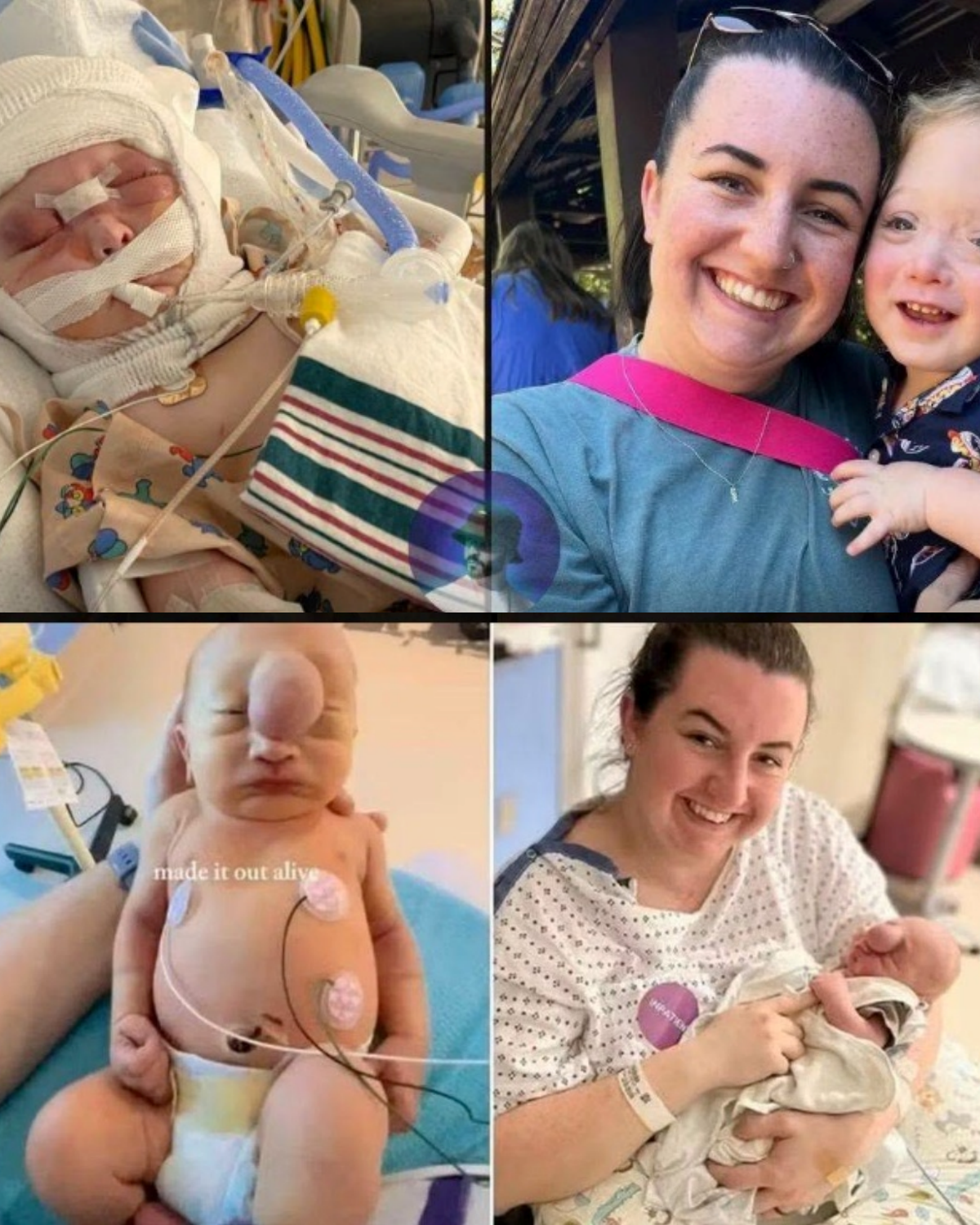
When Bentley Yoder was born in Ohio in 2015, his family had been warned that he might not survive for long. Before his birth, doctors had diagnosed him with encephalocele, a rare congenital condition in which part of the brain and its surrounding membranes protrude through an opening in the skull.
In Bentley’s case, the condition was exceptionally severe. A significant amount of brain tissue had developed outside his skull, creating an enormous medical challenge for the doctors who would eventually treat him.
A Diagnosis That Offered Little Hope
Bentley’s parents, Sierra and Dustin Yoder, learned during pregnancy that their son had a serious brain and skull abnormality. According to reports from the family and medical team, they were initially told that he might not survive after birth.
Yet Bentley continued to grow and eventually arrived at full term. Despite the severity of his condition, he survived and continued to show signs of development.
Doctors faced a difficult question: was the brain tissue inside the encephalocele functioning?
In many encephalocele cases, tissue outside the skull may be severely damaged or nonfunctional. But Bentley appeared to be using at least some of the tissue. Medical imaging suggested that a substantial portion of his extracranial brain tissue could be functional, making simply removing it an unacceptable option.
A Complex Challenge at Boston Children’s Hospital
When Bentley was about five months old, his family traveled to Boston Children’s Hospital, where he was evaluated by a multidisciplinary team that included neurosurgeon Mark Proctor and plastic surgeon John Meara.
The problem was extraordinary. Bentley had a very small skull, while a large portion of his brain was located outside the normal cranial cavity. The surgeons needed to find a way to create enough space inside his skull to accommodate the tissue without sacrificing potentially functioning brain.
The team turned to advanced technology.
Using Bentley’s medical scans, specialists created detailed digital and three-dimensional printed models of his skull and brain. The models allowed the surgeons to study his unusual anatomy and rehearse the proposed operation before entering the operating room.
A later peer-reviewed report in Plastic and Reconstructive Surgery – Global Open described the case as one in which simulation-based planning and 3D-printed models helped make possible the treatment of an otherwise extremely difficult case.
Making Room for His Brain
The surgical strategy was remarkably complex.
Instead of simply removing the tissue protruding from Bentley’s skull, surgeons planned to enlarge the cranial cavity so that the brain could be returned inside.
The team created carefully planned openings in the skull to expand the available space. The surgeons then repositioned the brain tissue and reconstructed the skull around it.
The operation was performed on May 24, 2016, when Bentley was nearly seven months old. Reports described the procedure as a major success, although his doctors emphasized that the surgery could not guarantee a completely normal neurological future.
The goal was to give Bentley the best possible chance while preserving as much functioning brain tissue as possible.
From an Uncertain Future to a New Beginning
Following surgery, Bentley recovered at Boston Children’s Hospital and was eventually able to return home with his family.
His case became widely known because of the combination of an extremely rare medical condition and an innovative surgical approach. The doctors did not simply rely on conventional imaging. They used three-dimensional models to understand Bentley’s individual anatomy and rehearse the procedure before attempting the real operation.
The approach later became the subject of a scientific publication documenting the use of multimodal 3D simulation and surgical rehearsal in Bentley’s treatment. The authors concluded that the technology played an important role in planning and successfully completing a procedure that had initially appeared nearly impossible.
A Story of Medicine, Technology and Determination
Bentley’s story is more than the story of a rare birth defect. It illustrates how modern medicine can combine neurosurgery, reconstructive surgery, medical imaging, computer modeling and 3D printing to tackle highly individualized medical problems.
His case also demonstrates why doctors sometimes need to look beyond conventional expectations. Because Bentley appeared to be using brain tissue that was outside his skull, the medical team chose to explore an alternative to simply removing it.
The decision required extensive planning and carried significant risks, but it ultimately gave Bentley an opportunity to return home and continue growing with his family.
His journey remains a remarkable example of the intersection between medical innovation and human resilience — and a reminder that, in extraordinary cases, new technology can help physicians attempt procedures that once seemed impossible.
Sources
- PubMed / Plastic and Reconstructive Surgery – Global Open: Multi-modal 3D Simulation Makes the Impossible Possible — a peer-reviewed report describing Bentley’s encephalocele, surgical planning and the use of digital and 3D-printed models.
- Boston Magazine: Baby Born with Brain Outside Skull Treated at Boston Children’s — reporting on Bentley’s surgery and recovery.
- ABC News: Baby Thriving Despite Condition Thought Incompatible With Life — reporting on Bentley’s diagnosis, family and treatment at Boston Children’s Hospital.
- The Washington Post: The amazing story of the baby born with his brain outside his skull — background on Bentley’s condition and the surgical strategy.
- STAT: Saving Bentley’s brain: Daring surgery aims to fix a gaping hole in baby’s skull — detailed reporting on the 3D-printed surgical planning and reconstruction.
Note: Reliable sources identify the child as Bentley Yoder, not “Bentley Yanko.” The medical and news reports cited above consistently use the surname Yoder. The article therefore uses the verified name.