An Extra Arm on the Back: Thoracomelia, Imaging, and a Careful Amputation
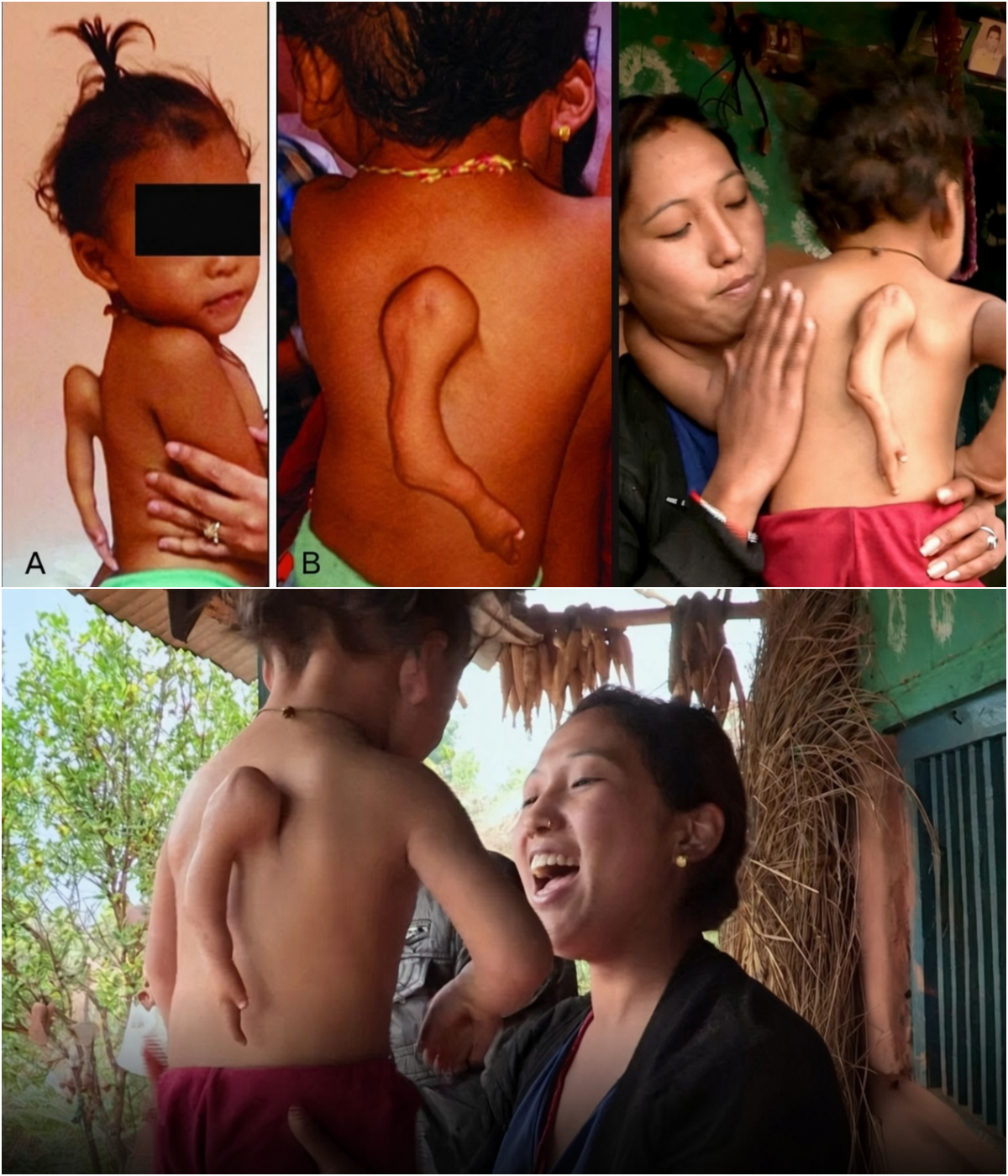
Polymelia is the presence of a supernumerary limb. When that limb grows from the chest wall it is called thoracomelia; when it grows from the spine, notomelia. Both are vanishingly rare. The usual explanation is an incomplete twin that never formed a body of its own and remained attached as a parasitic limb — bone, cartilage, sometimes a joint, often little or no useful muscle. The extra part may look like an arm hanging from the back. It can pull the spine, snag clothing, and, if it shares a split in the neural tube, threaten the cord. Incidence is estimated well below one in 100,000 births.
Photographs circulated with the Spanish caption match published images of a Nepalese toddler who had an undeveloped extra upper limb fixed to the posterior thorax. In one well-documented case, a boy of about one and a half years was otherwise developing normally. The accessory limb had a scapula-like bone articulating with an incomplete humerus and almost no muscle. After imaging confirmed the attachment and the absence of other major malformations, surgeons amputated it. Histology showed age-appropriate bone growth in the discarded limb. The child recovered without new deformity.
A separate Nepalese case that reached television, Gaurab Garum, showed why the operation is not a simple snip. His third arm rose from a split in the spinal column — remnants of an undeveloped twin. Orthopedic surgeons in Kathmandu warned that the extra limb itself was less dangerous than the dysraphism underneath: leave the spinal problem, and the child might lose function as he grew; cut too close to the cord, and he might be paralyzed in the operating room. That is why these cases are planned by orthopedics and neurosurgery together, with CT angiography to map the blood supply and MRI to see whether the cord or a lipomyelocele is involved. Removal is then a single-stage resection: protect the cord, ligate the vessels that feed the parasite, take the limb, and close the defect.
The caption’s claim that the extra arm was “completely formed” and that recovery left “no physical limits” is the language of a viral post, not of a discharge note. A well-planned amputation can leave a child who walks and plays. It cannot promise that a spine which once hosted a second limb will never need watching. What the surgery does achieve is simpler and enough: the back is a back again, and the child is no longer carrying someone else’s unfinished arm.
Sources: Case report of thoracomelia in a Nepalese child (PMC / Radiology Case Reports lineage); classification of polymelia (thoracomelia, notomelia, pyromelia); contemporaneous reporting on Gaurab Garum (The Sun / TLC, 2016); related series on polymelia with spinal dysraphism. The labeled “A/B” panels in the viral collage resemble published clinical photographs of posterior thoracic accessory limbs.