The Boy Who Got His Face Back: Manikandan’s Nasoethmoidal Encephalocele
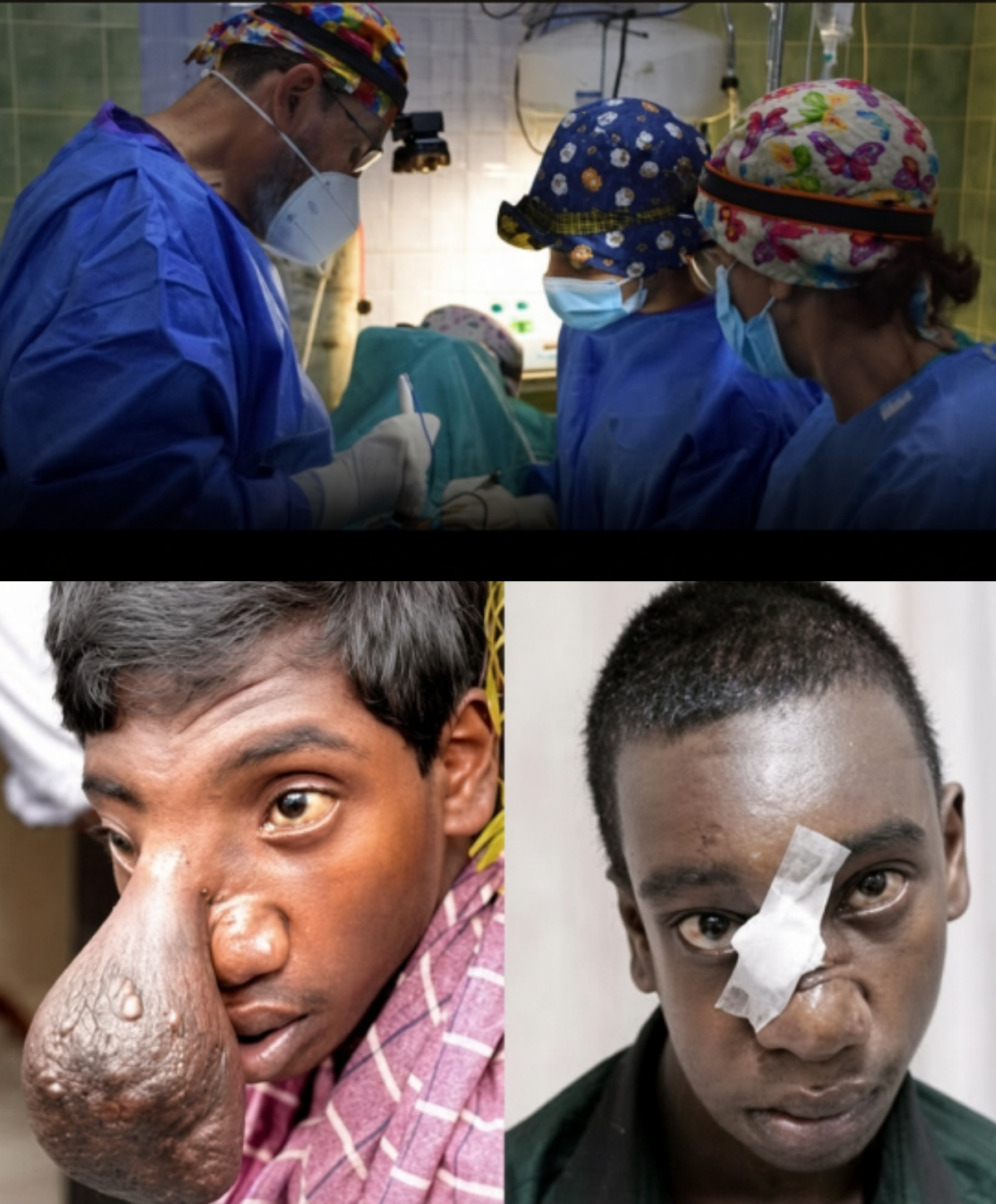
From birth, a fist-sized sac hung from Manikandan’s nose like a pendulum. It was not a tumor. It was an encephalocele: brain tissue and meninges that had pushed through a gap in the skull that never closed in the womb. The mass sat over the nasoethmoidal region, shoved his right eye socket outward, blocked vision on that side and warped the nose. Classmates mocked him. He did not go to school. His parents, Selvan and Ramata, plantation workers from the Malasar community in Parambikulam, Palakkad district, Kerala, had four other healthy children and no money for craniofacial surgery.
Encephalocele is a neural-tube defect. Anterior (sincipital) forms — nasofrontal, nasoethmoidal, naso-orbital — are more common in parts of South and Southeast Asia than in the West. The herniated tissue is usually non-functioning gliotic brain. The danger is the hole: cerebrospinal fluid can leak, infection can reach the meninges, and the face grows around a mass that should not be there.
In 2017 a team at Amrita Institute of Medical Sciences in Kochi operated. The cost was covered by Kerala government schemes. Plastic and reconstructive surgeon Dr. Subramania Iyer led a group that included cranio-maxillofacial surgeons Dr. Suhas Udayakumaran and Dr. Pramod Subhash, pediatric neurosurgeons and neuro-anesthetists — more than ten people in the room, about 11 hours on the table.
They opened the skull, separated living brain from the dead sac hanging on the face, closed the dura, and rebuilt the bony defect. The right orbit was moved back into line. The nose was reshaped. When the dressings came off, the pendulum was gone. Manikandan recovered and was discharged ready, his father said, to start school and make friends.
The operation did not invent a new face from nothing. It sealed a congenital skull-base fistula and put the remaining bones where they belonged. That is enough to turn a child who hid from other children into a child who can sit in a classroom. Anterior encephalocele repair remains teamwork: neurosurgery for the leak, craniofacial surgery for the orbit and nose. When the state pays and the team shows up, the rare defect stops being a life sentence.
Sources
- Amrita Institute of Medical Sciences / Amrita Vishwa Vidyapeetham statement, July 2017.
- Hindustan Times, “Kerala surgeons remove fist-sized ball of brain matter hanging from the nose of a 13-yr-old tribal boy,” 30 June 2017.
- Medical Dialogues / Deccan Chronicle / Daily Mail reporting of the same Amrita case.
- Comments by Dr. Subramania Iyer, Head of Plastic & Reconstructive Surgery, AIMS Kochi.