🚨 SCIENCE, DIGNITY, AND LIFE: THE EXTRAORDINARY CASE OF MANIKANDAN AFTER OVERCOMING A NASOETHMOIDAL ENCEPHALOCELE
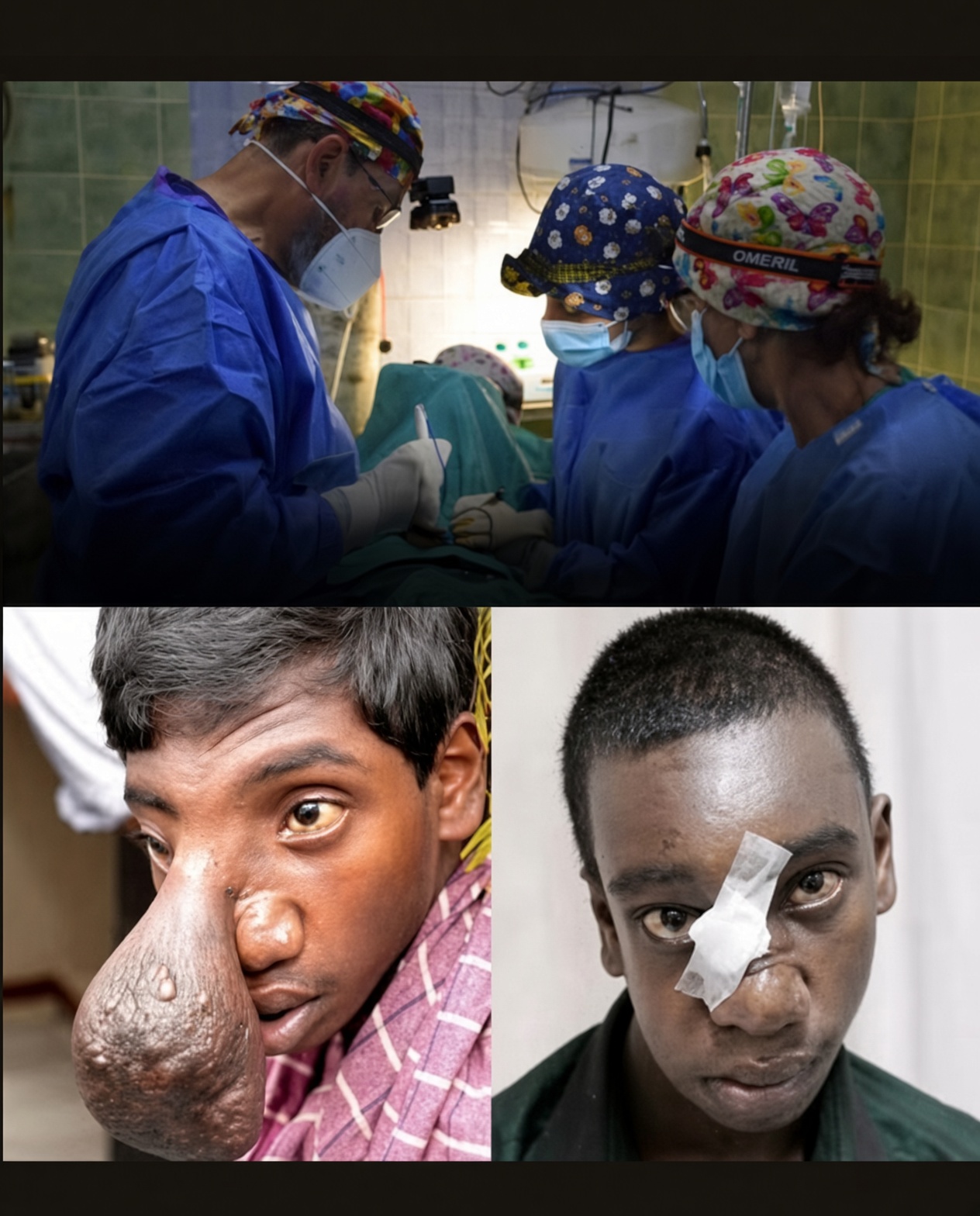
Kerala Surgeons Remove Fist-Sized Encephalocele From 13-Year-Old Manikandan
Manikandan, a 13-year-old from a Marasar tribal family of plantation workers in Parambikulam, Palakkad, was born with a nasoethmoidal-type encephalocele: brain tissue and fluid had pushed through a gap in the skull into a sac that hung from the bridge of his nose like a pendulum. The mass blocked his vision, deformed his nose and right eye socket, and made eating and mixing with other children hard. His father, Selvan, said the boy never went to school because people mocked his face.
In 2017 a multidisciplinary team at Amrita Institute of Medical Sciences in Kochi operated for about 11 hours. Led by plastic and reconstructive surgeon Dr. Subramania Iyer with craniofacial and pediatric neurosurgeons including Dr. Suhas Udayakumar and Dr. Pramod Subhash, they opened the skull, separated functioning brain from the non-working sac, closed the defect into the cranial cavity, rebuilt part of the skull, repositioned the eye sockets and remodeled the nose. Kerala government agencies paid the bill.
Doctors said he recovered and was ready for discharge. His father said he was eager to start school and make friends. Encephalocele is uncommon — on the order of one in several thousand births — and large frontonasal sacs of this kind are a major reconstructive challenge.
Source: Amrita Institute of Medical Sciences statements and contemporaneous coverage in Hindustan Times, Medical Dialogues and Deccan Chronicle, June–July 2017.