Ischiopagus on Paper: What the Dove Case Reports Actually Show
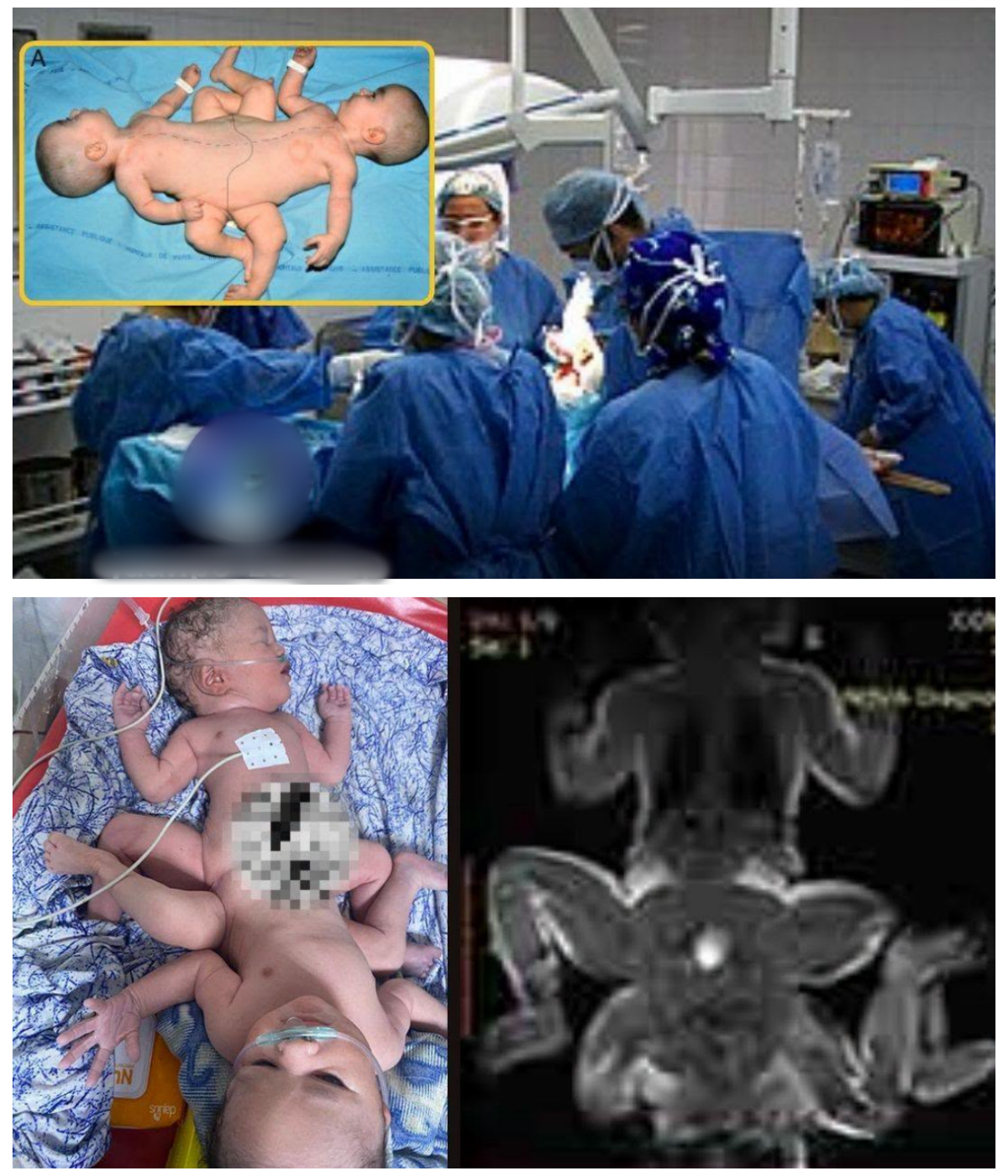
The caption points to the International Medical Case Reports Journal (Dove Medical Press). That journal has published more than one ischiopagus report. Neither is a story of twins already living apart after a landmark separation.
The 2025 Mogadishu report (Abdi Shakur, Halane, Farah) describes dicephalus tetrabrachius ischiopagus twins: two heads, four arms, a shared pelvis, one umbilical cord. The mother was 34, gravida 9, diabetic, referred from Somali Sudanese Specialized Hospital. MRI showed separate hearts, lungs, kidneys (one with severe hydronephrosis), stomachs, livers, spleens and anal canals, but shared bowel loops and a single placenta. The newborns passed meconium and urine through a shared cloacal opening, were treated for early sepsis, discharged in stable condition, and referred to a centre in Saudi Arabia for possible separation. The paper maps anatomy. It does not record that the operation has been done.
The 2022 Dessie, Ethiopia, report (Alene and Abebe), also in IMCRJ, is similar morphology—dicephalus, tetrabrachius, bipus—with a shared liver, spleen, stomach and intestine, one penis and an imperforate anus. Those twins died after 36 hours in the neonatal ICU.
Ischiopagus twins are joined at the pelvis and account for about 6–11 percent of conjoined births (themselves about 1 in 50,000–200,000 live births). They often share hindgut and genitourinary structures. Separation, when it is attempted, needs CT angiography, MRI, and months of planning; successful tetrapus separations exist in Vietnam, the United States and elsewhere, but they are individual operations, not a single “global precedent” created by one African case report.
3D CT and vascular maps are standard tools, not a new invention in these papers. What the Dove articles contribute is documentation from settings where such twins are usually stillborn or die unoperated: honest anatomy, limited resources, and referral rather than a finished reconstruction. That is the clinical record. The caption’s language of an already-completed, world-changing separation is ahead of what those pages contain.
Sources
- Abdi Shakur AE, Halane SA, Farah FY. Ischiopagus Conjoint Twins: A Case Report. Int Med Case Rep J. 2025;18:985–990.
- Alene TD, Abebe MS. A Case of Ischiopagus Dicephalus Conjoined Twins with Tetrabrachius Bipus from Dessie, Ethiopia. Int Med Case Rep J. 2022;15:425–429.
- Reviews of ischiopagus incidence and separation series (American Journal of Case Reports; Radiology Case Reports Vietnam tetrapus separation)