Ulrich: Dislocated Knees, Quadriceps Contracture, and Standing Tall on the Africa Mercy
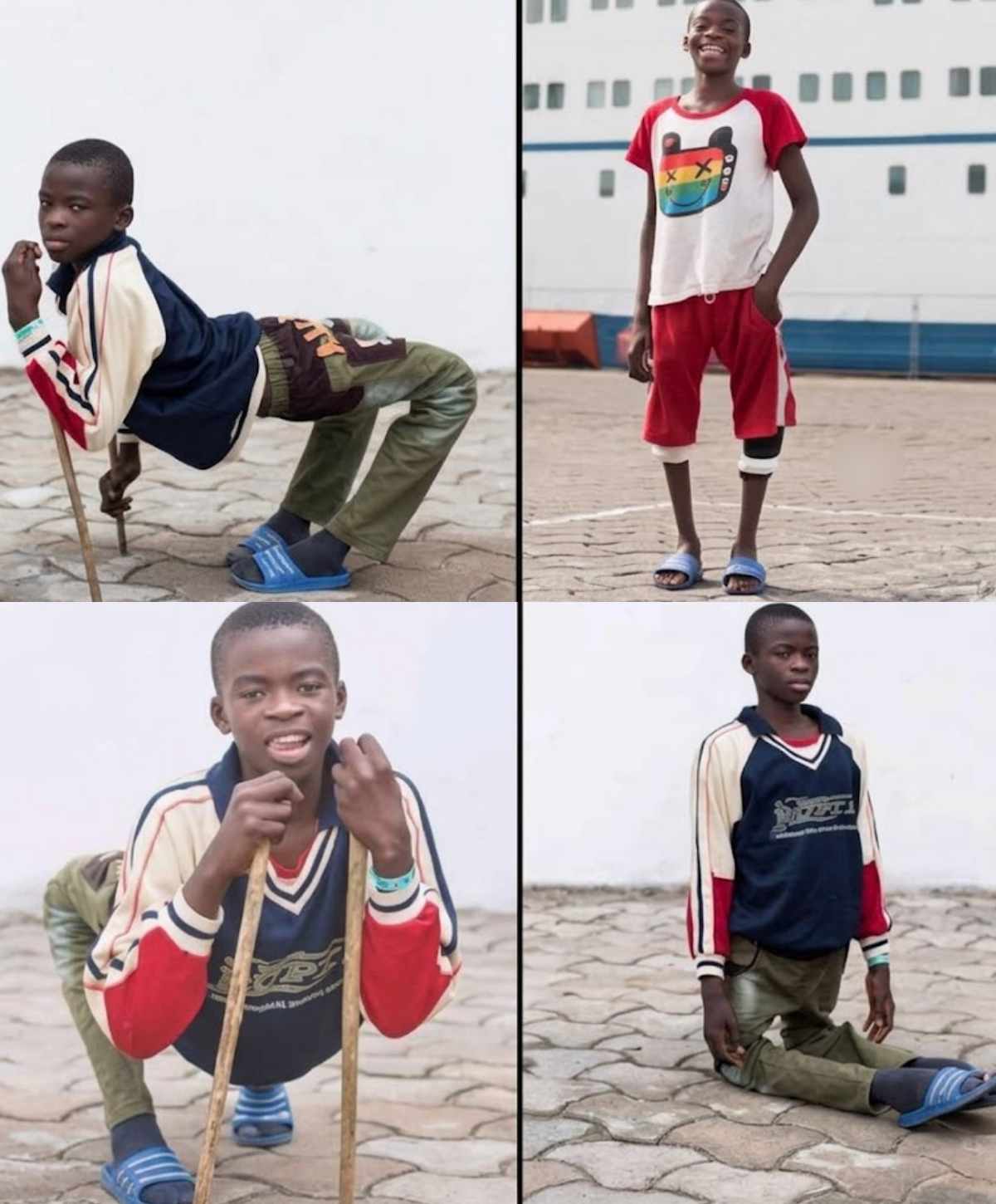
At twelve, Ulrich of Cameroon moved on wooden sticks with his legs bent sharply backward. Mercy Ships described the anatomy as congenital dislocation of the knees plus quadriceps contracture: the thigh muscles had not lengthened with the bones, so the joints folded the wrong way. He was not a genetic “mutation” in the popular sense. He was a child whose soft tissue had lost the race with growth. Local surgeons, his mother Georgette said, would not operate. The cost and the severity closed every door she tried.
Walking on sticks spared him total immobility and wrecked his hands and other joints. People stared. He told volunteers he was afraid that this gait would be the rest of his life. Asked what he wanted to be when he grew up, he said he wanted to be tall like his friends.
The Africa Mercy, a hospital ship staffed by unpaid specialists, took the case. American volunteer orthopaedic surgeon Frank Haydon said he had never seen anything quite like it; he compared Ulrich’s gait to a cricket. Several operations followed. When Ulrich woke, both legs were straight and in plaster. He did not at first believe they were his. The first time he stood, he reached for the ceiling. The first time he walked, nurse Kirsten Murphy said, he went into his mother’s arms—the first upright hug of his life. Rehabilitation continued on deck and at a shore Hope Center. At discharge he gave Dr Haydon the old crutches. He would not need them.
Public photos from Mercy Ships show the before-and-after that charity campaigns use: a boy crouched on cobbles, then the same boy upright in shorts beside the white hull. The medicine underneath is more ordinary than the Spanish caption’s “revolution.” Contracted quadriceps and chronic knee dislocation are corrected by staged release, realignment and immobilisation, then months of physiotherapy so the child learns a gait the brain never practised. External frames appear in many African deformity programmes; Mercy Ships’ own write-ups of Ulrich emphasise casts after complex surgery rather than naming a specific frame system.
What changed was access. The same operation is textbook in a high-income children’s hospital. In a setting where families cannot pay and local teams decline the risk, a docked ship and a volunteer roster are the difference between kneeling on stone and standing in a school doorway. Ulrich’s line after treatment was the one the charity printed: before, people stared and called him handicapped; now they will look again.
Sources
- Mercy Ships: “Meet Ulrich”; UK and Swiss country pages
- Mercy Ships Germany orthopaedics patient profile
- Mercy Ships social posts, November 2017 (Africa Mercy)
- Contemporary summaries in The Sun / Lenta citing Mercy Ships photography by Shawn Thompson