Zion Harvey: The First Child to Receive a Bilateral Hand Transplant
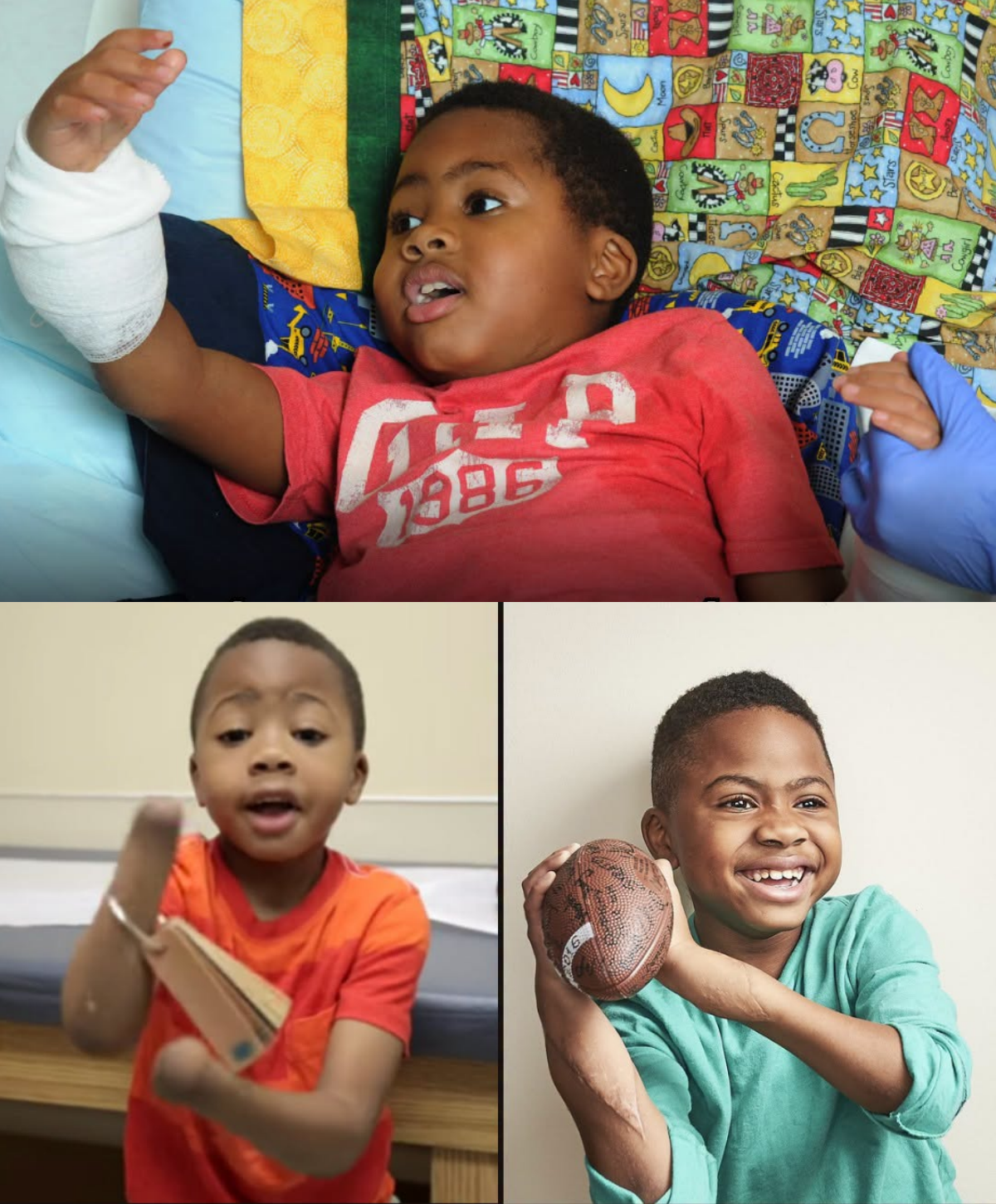
Zion Harvey of Owings Mills, Maryland, was two when sepsis destroyed the tissue of his hands and feet. Surgeons amputated all four distal limbs. The same infection wrecked his kidneys. Two years later his mother, Pattie Ray, donated a kidney. He learned to eat, write and play games with residual forearms, and he walked and ran on prosthetic feet. He was already on immunosuppressants—the fact that later made a vascularized composite allograft ethically easier to justify.
In July 2015, at age eight, a 40-person team at Children’s Hospital of Philadelphia and Penn Medicine transplanted donor hands and forearms in a procedure of about 10 to 11 hours. L. Scott Levin and Benjamin Chang led the work. Ten attending surgeons joined plastic, orthopaedic, anaesthesia and radiology staff. Bones, arteries, veins, tendons and nerves were joined so growth plates would stay open and the hands could lengthen with the child. Gift of Life Donor Program supplied the graft. Shriners Hospital in Philadelphia had referred the family.
The first weeks were small motions: a thumb twitch, a finger flex. He stayed more than a month at CHOP, then months of occupational therapy at Kennedy Krieger in Baltimore—sometimes many hours a day—so a brain that had mapped stumps for six years could learn palms and fingertips. At one year he could throw a football, swing a bat, zip a jacket, pick up pizza. At 18 months a team paper in The Lancet Child & Adolescent Health reported that he fed, dressed, toileted and wrote more independently than he had with residual limbs. He had already thrown an opening pitch for the Baltimore Orioles. Growth of the transplanted hands tracked his own skeleton.
It was not a clean miracle. The same paper recorded eight rejection episodes in the first year and a half, including serious ones around months four and seven. All were reversed with drugs. Those drugs also protect the kidney graft and carry lifelong infection and cancer risk. Function returned because of therapy as much as sutures. Zion put it without romance: he was still the same kid; he just had two hands.
The Spanish caption calls the operation a historic gift of a second life. That is fair as headline and incomplete as medicine. Bilateral pediatric hand transplant remains rare precisely because the recipient must accept immunosuppression for life, reject episodes are expected, and a child who already manages well with prostheses must gain more function than the cost of the drugs. Zion was chosen because he was already immunosuppressed, psychologically sturdy, and surrounded by a transplant infrastructure that could follow him for decades. The football in the photographs is real. So is the pharmacy list that keeps the hands on his arms.
Sources
- Children’s Hospital of Philadelphia news releases and “Zion’s Story” / one-year video
- Penn Medicine / University of Pennsylvania Almanac
- The Lancet Child & Adolescent Health 18-month outcomes (2017); CNN and The Guardian coverage of that paper
- WHYY; CBS News; Baltimore Sun (2015 surgery)