Deepak Paswan: A Parasitic Twin, Village Worship, and a Four-Hour Separation in Bangalore
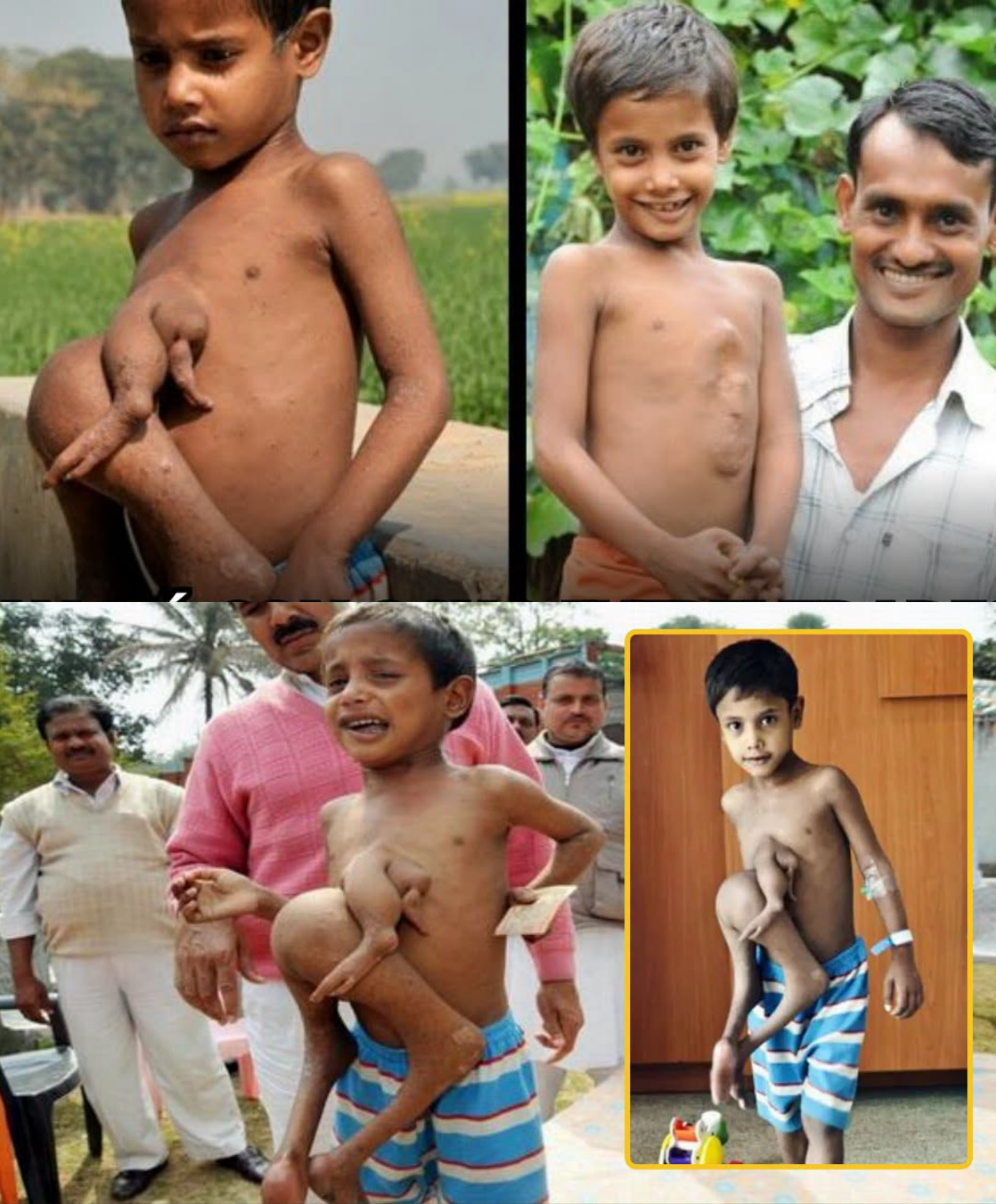
Deepak Paswan was born in Belahari (also spelled Bhelhari or Belhari), a village in Bihar, India, with four arms and four legs. The extra pair belonged to a parasitic twin attached to his chest and abdomen: two reasonably formed legs, two smaller arms, buttocks and part of a genital mass, one head—his. His mother, Indu, had no prenatal scan. Labour was long and shocking. His father, Viresh (Biresh/Veeresh) Paswan, a construction worker earning about a pound a day, remembered that no one in the room knew what to do.
A parasitic twin is an incomplete monozygotic twin that remains attached and is fed by the host’s circulation. It is not a child with eight independently working limbs. Deepak’s heart supplied a major artery into the mass; MRI later showed shared or closely applied intestine and an enlarged liver. The extra legs grew with him and added kilograms he could not spare. He was underweight and malnourished. Some neighbours brought flowers and cash and treated him as a form of Vishnu or Lakshmi. Others threw stones and called him a devil. He named the extra body his “little brother.” His father wanted the opposite of pilgrimage: school and cricket with his brothers.
Local doctors in Bihar told the family there was no safe operation, or that the child would not live long. In March 2010 the family appealed publicly. Fortis Hospital in Bangalore offered the surgery at no charge. A team of about 15 doctors, led by surgical gastroenterologist Ramcharan Thiagarajan, mapped vessels and bowel, then operated in early June 2010 (reports also cite late May). The case was shorter than Lakshmi Tatma’s 27-hour pelvic separation in 2007: about four hours to clip the feeding artery, peel parasite bowel off Deepak’s liver, and close the chest-abdominal wall. The surgeon said Deepak was lucky the twins did not share more organs, and that few such infants survive infancy at all. Days later the boy was walking and playing with his sister. Thiagarajan called him fit, with the remaining uncertainty being long-term bowel function and the psychological residue of years of mockery.
The story is often filed next to Lakshmi Tatma because both children came from poor Bihar households, both were turned into religious exhibits, and both needed a private tertiary hospital far from home. Deepak’s operation was not “impossible” once imaging showed a separable vascular pedicle. It was unavailable where he was born. After discharge his father said the point of the surgery was to stop people treating the child as an object. That is a more precise claim than the caption’s “modern medicine can transform any life.” Medicine separated a parasite from a boy who already had a working brain and four of his own limbs. What it could not do, from Bangalore, was rewrite how a village looks at a body that no longer matches a god.
Sources
- India Today; Deccan Herald
- Dawn; The Times; The Telegraph; AFP / National Post
- Fortis Bangalore comments via Ramcharan Thiagarajan (2010)