PART 2 — FULL ENDING: THE WOMAN THEY LAUGHED AT BECAME THE HEART OF WHITLOCK RANCH
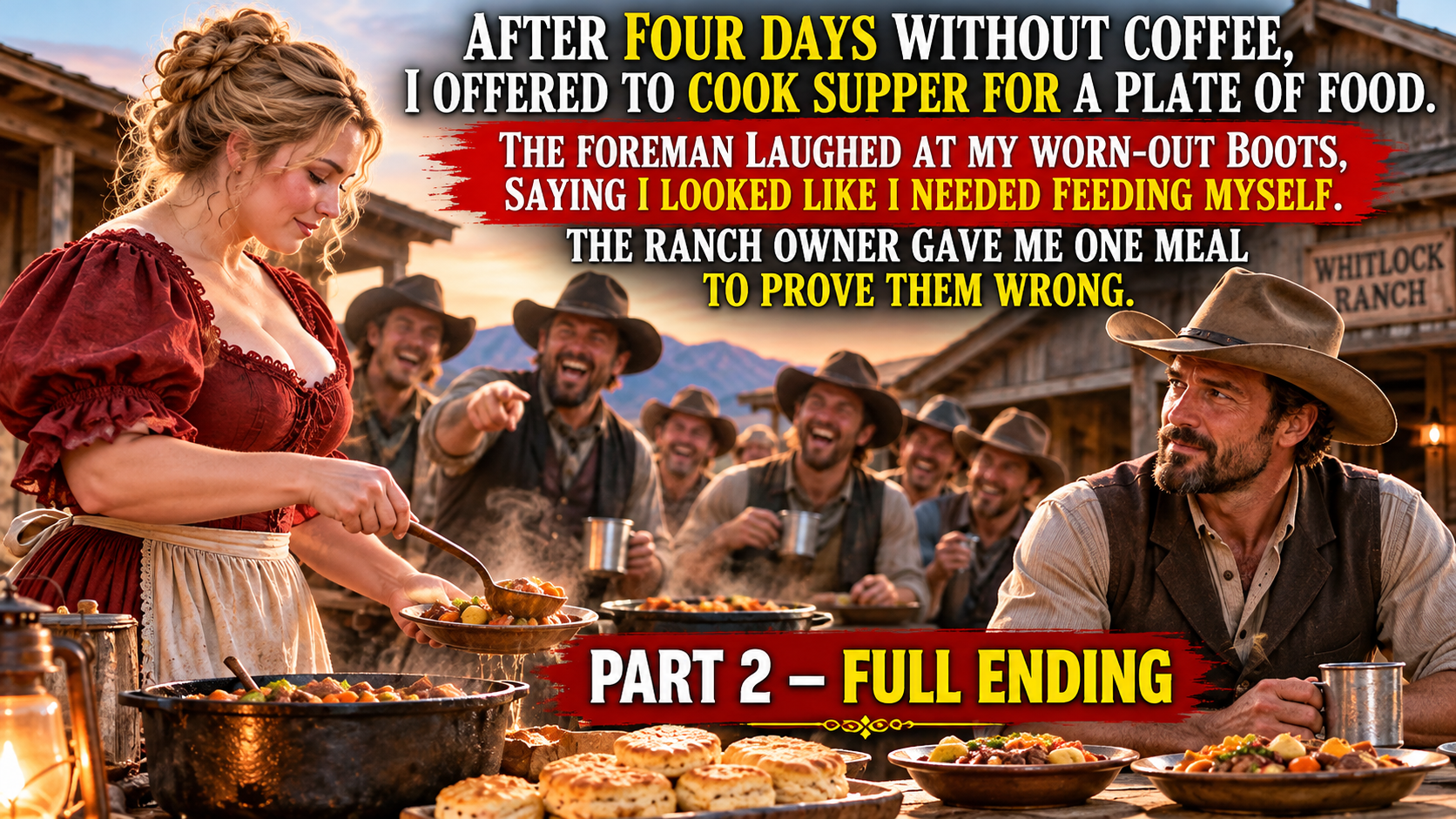
AFTER FOUR DAYS WITHOUT COFFEE, SHE OFFERED TO COOK FOR A PLATE OF FOOD—BUT THE RANCH OWNER DISCOVERED SHE WAS WORTH MORE THAN HIS ENTIRE CREW
The first thing I did was throw away the coffee.
Not the grounds. Not the pot.
The coffee itself.
It sat in a blackened kettle beside the stove, a miserable brown liquid that smelled like burnt fence posts and old leather.
Behind me, Gideon Cole let out a whistle.
“Well, boys, she’s already wasting supplies.”
I did not turn around.
“If you call that coffee, Mr. Cole, I understand why your men look so unhappy.”
A few cowhands laughed.
Not at me this time.
At him.
Gideon’s smile disappeared.
Silas Whitlock stood in the doorway with his arms folded.
“You planning to make something better?”
“Eventually,” I answered. “But first, I intend to make sure these men remember what supper is supposed to taste like.”
I examined the kitchen carefully.
The flour was stale but usable. The cornmeal had been stored badly, though the bottom of the barrel remained dry. There were onions hanging from the rafters, several pounds of salt pork, a sack of beans, dried apples, a crock of sorghum, and a small amount of lard.
There was also a bucket of potatoes hidden beneath an old blanket.
I lifted the blanket.
“Who put these here?”
Ezra Tull appeared behind Silas.
“Old Emmett. Said they were going soft.”
I picked one up and pressed my thumb against it.
“Not yet.”
Gideon leaned against the doorframe.
“Lady, you planning on feeding twenty men with six potatoes?”
“No.”
I looked straight at him.
“I’m planning on feeding twenty men with everything you’ve been too careless to notice.”
That quieted him.
For the next three hours, I worked harder than I had worked in weeks.
I soaked the beans in hot water to soften them, then simmered them with onions, salt pork, and a little sorghum to balance the bitterness.
I scraped the usable meat from the pork rinds and browned it in a skillet.
I peeled the potatoes, cut away the spoiled portions, and cooked the good pieces with wild onions until their edges turned golden.
I mixed cornmeal with flour, warm water, and lard, making skillet bread that rose just enough to become tender inside and crisp beneath.
The dried apples went into a separate pot with water, cinnamon I discovered in the back of a cupboard, and a spoonful of sorghum.
By the time the sun dropped behind the Montana hills, the cookhouse smelled like a place where people were meant to live.
Not merely survive.
Ezra came inside carrying another armful of wood.
He stopped so suddenly that one log slipped from his arms.
“Miss Finn?”
“Yes?”
“What’s that smell?”
“Supper.”
He swallowed.
“Smells like Christmas.”
I smiled for the first time in several days.
“Then you’d better wash your hands before Christmas gets cold.”
At six o’clock, I rang the iron triangle hanging beside the cookhouse.
Twenty hungry men came toward the building.
Most wore expressions of amused suspicion.
Gideon entered first.
He glanced at the table.
Then he stopped.
Three enormous iron pots sat beside baskets of golden skillet bread. A platter held browned potatoes and onions. A smaller dish contained warm stewed apples.
There was no burnt smell.
No blackened biscuits.
No watery beans.
Boyd stared at the food.
“Good Lord.”
Gideon frowned.
“Don’t mean it tastes good.”
“Then don’t eat it,” I said.
Boyd reached for a plate.
“That leaves more for me.”
The men sat.
For a moment, there was only the scraping of chairs and the clatter of spoons.
Then Boyd took his first bite.
He froze.
I watched him carefully.
He chewed.
Swallowed.
Looked down at his plate.
Then he took another enormous bite.
Ezra tried the bread.
His eyes widened.
“Miss Finn…”
“Yes?”
“This is the best bread I’ve had since my mother was alive.”
Something tightened in my chest.
I had not expected those words.
I had expected criticism, perhaps another round of laughter.
Not a nineteen-year-old boy looking at a piece of bread as though it had carried him home.
Across the table, another cowhand began eating faster.
Then another.
Soon the entire room had fallen silent.
The kind of silence that comes when hungry people finally have something worth eating.
Gideon took a spoonful of beans.
His expression changed.
He looked irritated by it.
He tried the potatoes.
Then the bread.
Then the apples.
Finally, he set down his fork.
“Needs more salt.”
Boyd snorted.
“You’ve already eaten three helpings, Gideon.”
“Didn’t say it wasn’t edible.”
“You practically licked your plate.”
The men burst into laughter.
Gideon’s face reddened.
Silas Whitlock had been eating quietly at the far end of the table.
When he finished, he placed his fork beside his plate and looked at me.
“Miss Finn.”
“Yes, sir?”
“How much would you expect to be paid for cooking here?”
The room grew quiet.
I had rehearsed this moment during my walk to the ranch.
I had imagined asking for wages, a bed, perhaps enough coffee to make the mornings bearable.
But standing there, with my hands smelling of onions and woodsmoke, I found myself afraid to ask for too much.
“Ten dollars a month,” I said. “Room and board included.”
Gideon made a noise in his throat.
Silas ignored him.
“Fifteen.”
I blinked.
“Sir?”
“Fifteen dollars a month. A room in the house. Sundays after breakfast are yours, except when there’s an emergency.”
I stared at him.
He continued.
“And I expect the men fed properly. No waste. No stealing from the stores. No unnecessary expenses.”
“Of course.”
“Can you manage that?”
I looked around the table.
Every plate was empty.
“Yes, Mr. Whitlock.”
He stood.
“Then welcome to Whitlock Ranch.”
And for the first time since my father’s funeral, I had somewhere to sleep that did not depend on another person’s pity.
I did not know then that the hardest part of earning my place had only just begun.
***
The first week changed everything.
By the third morning, the cowhands had stopped complaining about breakfast.
By the fourth, they were arriving early.
By the fifth, Boyd had gained enough confidence to ask whether I could make apple biscuits like his grandmother used to prepare.
I told him I would try.
He looked so pleased that he offered to repair the loose step outside the cookhouse.
By Saturday, three men had volunteered to haul water, Ezra had cleaned the storage cellar, and someone had quietly sharpened every knife in my kitchen.
Gideon Cole did none of those things.
He watched.
He criticized.
He counted how much flour I used.
He complained when I moved the coffee supplies.
He insisted the men were becoming soft because they wanted supper served at a reasonable hour.
One afternoon, he found me kneading dough.
“You’re making them lazy,” he said.
I pressed the dough beneath my palms.
“How?”
“They spend half their time talking about food.”
“Perhaps that’s because they’re finally getting some.”
His jaw tightened.
“You’re getting mighty comfortable for a woman who arrived begging for scraps.”
I stopped kneading.
Slowly, I lifted my eyes.
“Mr. Cole, I arrived asking for work.”
“Same difference.”
“No,” I said. “It isn’t.”
For a long moment, we stared at each other.
Then he stepped closer.
“You remember who’s in charge of these men.”
“I know exactly who’s in charge of them.”
“Good.”
“But this kitchen is my responsibility. If you have a complaint about my work, take it to Mr. Whitlock.”
He leaned forward.
“You think he’ll choose some wandering woman over the foreman who’s worked for him twelve years?”
I said nothing.
Gideon smiled.
“That’s what I thought.”
He left.
But I had seen something in his expression.
Something colder than wounded pride.
And I knew he had not finished with me.
***
Silas Whitlock was not an easy man to understand.
He spoke little.
Worked constantly.
Ate whatever I placed before him without complaint.
He had the habit of standing near the kitchen door at night, as though he wanted to say something but had forgotten how.
One evening, after the men had gone to their bunks, I found him sitting alone at the long table.
His supper remained untouched.
“Something wrong with the food?” I asked.
He looked up.
“No.”
“Then why aren’t you eating?”
He glanced at the plate.
“Been a long day.”
I set a fresh cup of coffee beside him.
Real coffee.
I had purchased a small sack with part of my first wages when a supply wagon came through.
The smell filled the room.
Silas stared at the cup.
“Where’d you get that?”
“Miles City.”
“You spent your own wages?”
“Some of them.”
“On coffee for the ranch?”
“On coffee for myself,” I answered. “But I suppose you may have a cup.”
His mouth twitched.
It was the closest thing to a smile I had seen from him.
He tasted it.
Then closed his eyes.
“Lord Almighty.”
“That bad?”
“That good.”
I sat across from him.
For a while, we listened to the wind pushing against the walls.
Then he said, “My wife used to make coffee like this.”
I looked at him.
He had never mentioned a wife.
“She died?”
“Seven years ago.”
“I’m sorry.”
He nodded.
“Her name was Margaret.”
The name seemed to hang between us.
“She was a good woman,” he continued. “Better than this place deserved.”
I said nothing.
Sometimes people need silence more than sympathy.
Silas looked toward the dark window.
“Fever took her. Our little boy went three days later.”
My heart tightened.
“How old was he?”
“Four.”
I lowered my eyes.
There are griefs too large for ordinary words.
After a moment, Silas spoke again.
“After that, I kept the ranch running because I didn’t know what else to do.”
He gave a tired laugh.
“Turns out a man can own eight hundred acres and still have nowhere he wants to go at the end of the day.”
I understood that better than he knew.
“My father used to say a house isn’t a home because it has walls,” I told him.
Silas looked at me.
“What makes it one?”
“Someone who notices when you haven’t come inside.”
He was quiet for a long time.
Then he looked down at his supper.
And began to eat.
***
September arrived with colder mornings and trouble in the northern pasture.
A section of fence had been cut.
Twenty-three cattle had wandered into rough country.
Gideon blamed the weather.
Silas blamed negligence.
The men spent two days recovering the herd.
On the third morning, I discovered that three sacks of flour were missing from the storehouse.
At first, I thought someone had moved them.
I searched the pantry.
The cellar.
The wagon shed.
Nothing.
I checked my inventory book.
I had counted the supplies myself four days earlier.
Three sacks.
Gone.
When I asked Gideon about them, he shrugged.
“Rats.”
I looked at him.
“Rats carried away three hundred pounds of flour?”
“Maybe you counted wrong.”
“I didn’t.”
His eyes narrowed.
“Careful, Adelaide.”
I had never told him he could use my first name.
That bothered me almost as much as his answer.
That afternoon, I checked the rest of the stores.
Two sides of bacon were missing.
A crate of coffee.
Several pounds of sugar.
And one unopened barrel of molasses.
Someone had been taking supplies.
Not enough at once to attract attention.
But steadily.
Deliberately.
I took my inventory book to Silas.
He listened without interrupting.
When I finished, he rubbed his forehead.
“Gideon handles the supply orders.”
“I know.”
“He’s been with me twelve years.”
“I know that too.”
Silas looked at the figures.
“You’re certain?”
“Every missing item is recorded. Every delivery is recorded. Every meal I prepare is accounted for.”
He turned another page.
I had written everything neatly, including the dates, quantities, and names of the men who collected supplies.
Silas stared at the book.
“You’ve been keeping all this?”
“Of course.”
“Why?”
“Because food costs money, Mr. Whitlock. And wasted food costs twice as much when men go hungry afterward.”
He sat back.
For a moment, he looked almost ashamed.
Then he closed the book.
“Leave this with me.”
I did.
But that night, as I crossed the yard toward the house, I saw Gideon standing beside the barn.
He was speaking to a stranger.
A broad-shouldered man with a gray beard and a dark coat.
When the stranger noticed me, he turned away.
Gideon followed his gaze.
Our eyes met.
And I knew immediately that he had seen me watching.
***
The next morning, the cookhouse was ruined.
I opened the door before sunrise and found flour scattered across the floor.
The dough I had prepared the previous night had been dumped into the ashes.
The milk had been overturned.
Every jar of preserved fruit had been smashed.
And across the long wooden table, someone had scratched three words with a knife.
GO HOME, WOMAN.
For a moment, I could not move.
Not because of the mess.
I had cleaned worse.
Not because of the lost supplies.
I could replace those eventually.
It was the words.
Go home.
I had no home to return to.
The station was gone.
My father was buried beneath a cottonwood tree hundreds of miles away.
And the last place I had rented a room had put my belongings outside when I could no longer pay.
I stood in the doorway holding my apron.
Then I heard footsteps.
Ezra appeared behind me.
“Miss Finn?”
He looked past my shoulder.
His face went pale.
“Who did this?”
“I don’t know.”
He stepped inside.
“Don’t touch anything. I’m getting Mr. Whitlock.”
Within minutes, half the ranch had gathered outside.
Boyd stared at the broken jars.
Another man cursed.
Gideon arrived last.
He looked around.
Then shook his head.
“Well, that’s unfortunate.”
I turned toward him.
“Unfortunate?”
“Could’ve been some drunk hand playing a joke.”
Boyd rounded on him.
“That ain’t a joke.”
Gideon ignored him.
“Maybe she ought to pack up. Seems somebody doesn’t want her here.”
The yard fell silent.
Silas Whitlock had just arrived.
He looked at the ruined kitchen.
Then at the words carved into the table.
Finally, he looked at Gideon.
“Who had access to this building last night?”
Gideon shrugged.
“Everybody.”
“No,” Ezra said quietly.
Every head turned.
The boy swallowed.
“I saw Mr. Cole come out of the cookhouse after supper.”
Gideon’s face darkened.
“I was checking the stores.”
“With a knife?” Boyd asked.
Gideon took a step toward him.
“Watch your mouth.”
Silas raised one hand.
“Enough.”
He turned to me.
“Adelaide, can you make breakfast?”
I looked around.
The floor was covered with flour and broken glass.
The stove was cold.
The bread was destroyed.
But there were eggs.
A little cornmeal.
Some bacon.
And a few potatoes left in the cellar.
“Yes,” I said.
“How long?”
“An hour.”
Silas nodded.
Then he faced the men.
“Everybody who isn’t working cattle is helping clean this kitchen.”
Gideon opened his mouth.
Silas stopped him with a look.
“And Gideon?”
“Yes?”
“You’ll stay out of Miss Finn’s way until I say otherwise.”
The foreman went rigid.
But he said nothing.
That morning, nineteen men scrubbed floors, carried water, repaired shelves, and swept broken glass.
Boyd sanded the knife marks from the table.
Ezra brought me fresh eggs.
And Silas Whitlock stood beside the stove, peeling potatoes with the clumsy determination of a man who had never been trusted with kitchen work.
At one point, he cut a potato into such uneven pieces that I began laughing.
He looked offended.
“What’s funny?”
“Nothing.”
“You’re laughing.”
“Mr. Whitlock, that potato looks like it lost a fight with a mountain lion.”
For the first time since I arrived, he laughed openly.
The sound surprised us both.
And somehow, standing in that wrecked kitchen with flour on the floor and smoke in my hair, I felt something I had not felt in years.
Safe.
***
Three days later, Silas asked me to ride into Miles City with him.
He needed supplies.
I needed flour.
And he said there was something he wanted me to see.
We left shortly after dawn.
The Montana prairie stretched around us, golden beneath the autumn sky.
For the first hour, we spoke little.
Then Silas asked, “Why did you leave Fort Laramie?”
I watched the road ahead.
“The drought took the station. My father borrowed money to keep it open. When he died, the lender came for everything.”
“Everything?”
“The building. The horses. The wagons. Even Mother’s old sewing machine.”
Silas tightened his grip on the reins.
“Who was the lender?”
“A man named Harlan Voss.”
Silas turned toward me so sharply that the wagon jolted.
“What did you say?”
“Harlan Voss.”
His face changed.
“Gray beard? Scar beside his left eye?”
I stared at him.
“Yes.”
Silas said nothing for several seconds.
Then he looked ahead.
“I know him.”
“How?”
“He buys cattle. Sometimes land. He’s been trying to purchase the northern section of my ranch for three years.”
A cold feeling settled in my stomach.
I remembered the stranger standing beside Gideon near the barn.
The gray beard.
The dark coat.
“Mr. Whitlock…”
Silas looked at me.
“I think I saw him here.”
The wagon rolled another few yards.
Then Silas pulled the horses to a stop.
“Where?”
“Beside the barn. Speaking with Gideon.”
His expression hardened.
“When?”
“The night before the cookhouse was destroyed.”
For a long moment, neither of us spoke.
Then Silas said something I would remember for the rest of my life.
“Adelaide, I think you walked into more trouble than either of us understood.”
***
In Miles City, we visited the mercantile first.
Silas purchased flour, coffee, sugar, salt, dried fruit, and enough bacon to last through the next cattle drive.
I bought thread and a small piece of blue ribbon.
Then we went to the bank.
Silas asked me to wait outside.
I sat on a bench beneath the awning, watching wagons roll past.
Twenty minutes later, he came out looking ten years older.
“What’s wrong?” I asked.
He held a folded paper.
“Someone’s been borrowing against the ranch.”
I stared at him.
“What?”
“Using my name.”
He handed me the document.
I read slowly.
There were three loans.
Each secured against cattle and portions of the northern property.
Each bearing Silas Whitlock’s signature.
But the handwriting was wrong.
I knew because I had seen him sign supply receipts.
“That’s not your signature.”
“No.”
“Who had access to your papers?”
Silas looked toward the street.
“Gideon.”
The world seemed to narrow.
The missing supplies.
The cut fence.
The stranger beside the barn.
The destroyed kitchen.
It was all connected.
Silas folded the paper.
“Harlan Voss owns the debt now.”
I felt the blood drain from my face.
“What happens if you can’t pay?”
“The bank can seize the secured property when the notes come due.”
“When?”
Silas looked at me.
“Thirty days.”
I gripped the edge of the bench.
Thirty days.
The ranch that had given me food when I was starving.
The kitchen that had become my refuge.
The men who had begun to feel like family.
All of it could disappear.
And the man behind it was the same man who had taken my father’s station.
I looked at Silas.
“What are you going to do?”
He stared down the dusty street.
“Find out exactly how deep this goes.”
***
We returned to the ranch after dark.
Gideon was waiting beside the barn.
He watched Silas unload the supplies.
Then he looked at me.
“Have a nice trip?”
I met his gaze.
“Very educational.”
Something flickered across his face.
Silas stepped between us.
“Gideon. My office. Now.”
The foreman hesitated.
Then followed him inside.
I did not hear the beginning of their conversation.
But I heard the end.
“You’ve got no proof!” Gideon shouted.
Silas’s voice came back like thunder.
“I’ve got enough to know you’ve been lying to me!”
A chair crashed against the floor.
Then the office door flew open.
Gideon stormed out.
He stopped when he saw me.
For a moment, his expression was almost frightening.
“You,” he whispered.
I stood still.
He pointed one thick finger at my face.
“You should’ve kept walking that first day.”
Then he disappeared into the darkness.
Silas came out a moment later.
“He’s gone.”
“For good?”
“I fired him.”
I looked toward the barn.
“Do you think he’ll leave quietly?”
Silas’s face was grim.
“No.”
***
The next morning, Ezra found Gideon’s bunk empty.
His horse was gone.
So were two rifles from the tack room.
By noon, three more hands had disappeared.
Men Gideon had hired himself.
Boyd came to the cookhouse looking troubled.
“Miss Finn, you ought to know something.”
“What is it?”
“There’s talk in town that Whitlock Ranch is going under.”
My stomach tightened.
“Who started it?”
“Don’t know. But a cattle buyer came through yesterday offering half price for the herd.”
I set down my spoon.
“Half price?”
Boyd nodded.
“Said Mr. Whitlock would be desperate enough to take it by winter.”
I knew then what Harlan Voss wanted.
Not merely the northern pasture.
The entire ranch.
And he intended to starve Silas into selling it.
That evening, I went to Silas’s office.
He sat surrounded by papers.
His face was drawn.
“Come in, Adelaide.”
I closed the door.
“How much do you owe?”
He looked up.
“That’s not your concern.”
“It is if this ranch closes and twenty men lose their work.”
He sighed.
“Nearly four thousand dollars.”
The number struck me like a blow.
I had never held four thousand dollars in my life.
“How much time?”
“Twenty-six days.”
“And the cattle?”
“Enough to cover most of it, if I could get a fair price.”
I thought for a moment.
Then asked, “When is the next cattle shipment to Miles City?”
“Two weeks.”
“Can you sell directly to the railroad buyers?”
“Possibly. But Voss has been spreading word that my herd is diseased.”
“Is it?”
“No.”
“Then prove it.”
Silas stared at me.
“How?”
“Have a livestock inspector examine them. Get a written certificate. Send word to buyers outside Miles City.”
He leaned back.
“That costs money.”
“So does losing everything.”
He looked at me for a long time.
Then he gave a slow nod.
“You’re right.”
I stood to leave.
“Adelaide?”
I turned.
“Why are you doing all this?”
I looked at the papers covering his desk.
Then at the man who had offered me supper when everyone else had laughed.
“Because you gave me a chance when I had nothing.”
My voice softened.
“And I don’t intend to watch someone take your home the way they took mine.”
***
The next ten days were the hardest of my life.
The ranch operated with fewer hands.
The men worked from sunrise until after dark.
I cooked before dawn, packed meals for the range, cleaned the kitchen, and helped organize supplies.
Silas sent letters to three cattle buyers.
Ezra rode to find a livestock inspector.
Boyd repaired the northern fence.
And every evening, I sat with Silas over the accounts.
We discovered more missing supplies.
More false receipts.
More evidence that Gideon had been stealing from the ranch for months.
But evidence alone would not pay the debt.
Then, on the eleventh night, disaster came.
I woke to shouting.
Outside my window, the sky glowed orange.
Fire.
I ran downstairs.
The hay barn was burning.
Flames climbed the dry boards.
Men raced across the yard carrying buckets.
Horses screamed inside the stable next door.
Silas was already running toward them.
“Get the horses out!” he shouted.
I grabbed a blanket, soaked it in the water trough, and hurried toward the stable.
Smoke rolled beneath the roof.
Ezra struggled with a frightened mare.
Boyd was cutting ropes.
Then I heard a scream.
Not from a horse.
From a man.
Silas had gone inside the burning barn.
A beam had fallen near the doorway.
And he was trapped.
I did not think.
I ran.
Boyd shouted my name.
Someone grabbed my arm.
I pulled free.
The heat struck like an open furnace.
Through the smoke, I saw Silas on one knee, trying to drag an unconscious ranch hand away from the fallen timber.
It was Thomas Bell, a quiet man who had been sleeping in the loft.
“Silas!”
He looked up.
“Get out!”
I ignored him.
I grabbed Thomas beneath one arm.
Silas took the other.
Together, we dragged him toward the doorway.
A burning board crashed behind us.
The roof groaned.
We stumbled into the yard just as part of the barn collapsed.
Men rushed forward.
Someone pulled Thomas away.
Someone threw a wet blanket over Silas.
I dropped to my knees in the dirt.
My lungs burned.
My hands shook.
And then Silas was beside me.
“Adelaide!”
I tried to answer.
Could not.
He took my face between his hands.
“Look at me.”
I did.
His eyes were wild with fear.
“Don’t you ever do that again.”
I managed a weak smile.
“Then don’t go into burning barns.”
For one terrible second, he looked as though he might shout.
Instead, he pulled me against him.
Right there.
In front of every man on the ranch.
He held me so tightly I could feel his heart pounding.
And he whispered into my hair.
“I thought I’d lost you.”
I closed my eyes.
For the first time, I understood that the fear in his voice was not the fear of a rancher losing his cook.
It was something far deeper.
***
The fire destroyed the hay barn.
But it did not destroy the stable.
The horses survived.
Thomas Bell recovered.
And the men found something in the ashes that changed everything.
A broken glass bottle.
A rag soaked in lamp oil.
And boot prints leading away from the rear fence.
The fire had been set deliberately.
Silas rode into Miles City the following morning.
He returned with the sheriff.
And with news.
Harlan Voss had been seen drinking with Gideon Cole the night before the fire.
The sheriff questioned witnesses.
He collected the forged loan documents.
He examined the supply records I had kept.
And for the first time, Silas had more than suspicion.
He had a trail.
Still, the debt remained.
The bank had already transferred the notes to Voss.
Until a court ruled otherwise, the documents remained a threat hanging over the ranch.
We had less than two weeks.
***
The turning point came from the person nobody expected.
Old Emmett Doyle.
The cook whose shaking hands had forced him to retire.
He had been living in a small cabin behind the south pasture.
One afternoon, he arrived at the cookhouse carrying a battered tin box.
His hands trembled as he placed it on the table.
“Miss Finn,” he said, “I reckon there’s something you ought to see.”
I opened the box.
Inside were receipts.
Dozens of them.
Some dated back more than a year.
All signed by Gideon Cole.
I looked up.
“Where did you get these?”
Emmett lowered himself into a chair.
“Kept copies whenever Gideon took supplies. Said I was an old fool for counting everything.”
He gave a tired smile.
“Maybe I am. But my daddy taught me never to trust a man who gets angry when you ask where the flour went.”
I began sorting the papers.
There were records of stolen food.
Tools.
Leather.
Ammunition.
Even cattle feed.
And at the bottom of the box lay a folded letter.
Addressed to Gideon Cole.
Signed by Harlan Voss.
I opened it.
My hands began to shake.
The letter promised Gideon a share of the northern land once Silas Whitlock defaulted on the loans.
It also referred to a plan to weaken the ranch’s finances before the autumn cattle sale.
I read it twice.
Then a third time.
Emmett watched me.
“That help?”
I looked at him.
“Emmett, I believe you just saved this ranch.”
The old man’s eyes filled with tears.
“Well,” he said softly, “it’s about time these shaking hands did something useful.”
I reached across the table and took them in mine.
“They already have.”
***
The sheriff moved quickly.
Two days later, Gideon Cole was arrested outside a gambling house in Miles City.
One of the men who had helped him set the barn fire confessed after learning that Thomas Bell had nearly died.
He admitted Gideon had ordered the sabotage.
He also described how Voss had financed the scheme.
The sheriff arrested Voss the following morning.
But the real battle came at the courthouse.
Voss hired an attorney.
He denied everything.
He claimed Gideon had acted alone.
He insisted the loan documents were valid.
And he accused me of fabricating the inventory records out of revenge.
I stood in the courtroom wearing my best calico dress.
The same dress I had worn when I arrived at Whitlock Ranch.
The judge looked down at me.
“Miss Finn, are you familiar with bookkeeping?”
“Yes, Your Honor.”
“Where did you learn?”
“My father ran a way station for fourteen years. I kept his accounts after my mother died.”
Voss’s attorney stood.
“Isn’t it true, Miss Finn, that Mr. Voss once foreclosed on your father’s property?”
“Yes.”
“And isn’t it also true that you resent him for it?”
I looked toward Harlan Voss.
He sat at the defense table wearing an expensive suit.
His expression was smug.
“I resent what he did,” I answered.
The attorney smiled.
“So you admit you have a personal grievance.”
“I do.”
He turned toward the judge.
“Then her testimony is clearly biased.”
I raised my voice.
“But numbers don’t have feelings, sir.”
The courtroom went quiet.
The attorney looked back at me.
I continued.
“Three hundred pounds of flour cannot disappear into a rat hole. Twelve sides of bacon cannot be eaten by men who never received them. And a ranch owner cannot sign papers in Miles City on a day when twenty witnesses saw him branding cattle forty miles away.”
A murmur spread through the room.
The judge leaned forward.
“Do you have documentation?”
“Yes, Your Honor.”
I lifted the account book.
“And I have witnesses.”
The judge examined the records.
Then Emmett’s receipts.
Then the letter from Voss.
By the end of the hearing, the forged notes had been exposed.
The judge ordered enforcement of the disputed debts suspended and directed that the evidence be entered into the criminal investigation.
Weeks later, after handwriting testimony and the confessions of Gideon’s accomplices, the forged obligations were declared invalid.
The genuine debts Silas had incurred remained his responsibility.
But the false loans that had threatened to destroy the ranch were gone.
Voss and Gideon faced criminal proceedings for their roles in the fraud, theft, and arson.
When we stepped outside the courthouse, Silas stood beside me in the afternoon sunlight.
For a moment, neither of us spoke.
Then he said, “You saved my ranch.”
I shook my head.
“Your men helped save it. Emmett kept the receipts. Ezra found the inspector. Boyd held everyone together.”
Silas looked at me.
“And who held me together?”
I had no answer.
He took my hand.
“Adelaide, I have spent seven years believing that everything good in my life was buried beside Margaret and my boy.”
My throat tightened.
He continued quietly.
“Then a woman walked three miles in ruined boots and asked for one plate of food.”
I looked down.
“I was hungry.”
“I know.”
His fingers closed gently around mine.
“And I didn’t understand then that I was hungry too.”
Tears blurred my vision.
Silas stepped closer.
“I don’t mean for food.”
***
By the time October arrived, the ranch had begun to recover.
The cattle sale brought a fair price.
The repaired fences held.
The men worked with a determination I had never seen before.
Silas paid the legitimate outstanding bills.
The bank released the remaining property from its liens.
And the first snow fell over the Montana hills.
But something else had changed.
Silas no longer ate alone.
Every evening, after the men finished supper, he came into the kitchen.
Sometimes he helped dry dishes.
Sometimes he carried firewood.
Sometimes he simply sat at the table with a cup of coffee while I prepared the next morning’s bread.
We talked about ordinary things.
The weather.
The cattle.
The men.
The price of flour.
And slowly, we began talking about things that mattered more.
He told me about Margaret.
I told him about my father.
He showed me a little wooden horse his son had carved with a pocketknife.
I showed him the only photograph I possessed of my parents.
There was no jealousy between the memories.
No competition.
We understood that love does not become smaller because it has existed before.
One evening, Silas found me mending my old boots beside the stove.
He sat across from me.
“Those things still holding together?”
“Barely.”
“Why don’t you buy new ones?”
“I intend to.”
“When?”
“When these finally give up.”
He shook his head.
“Stubborn woman.”
“Stubborn rancher.”
He smiled.
Then he placed a small package on the table.
I stared at it.
“What’s that?”
“Open it.”
Inside was a pair of new leather boots.
Strong soles.
Soft lining.
Beautiful stitching.
I touched them with trembling fingers.
“Silas…”
“They’re not wages,” he said quickly. “And they’re not charity.”
I looked up.
“Then what are they?”
He hesitated.
“A thank-you.”
“For what?”
“For staying.”
I swallowed hard.
“Silas, you gave me a place to stay.”
He shook his head.
“No, Adelaide. You gave me a reason to want to come home.”
I began to cry.
Not loudly.
Not dramatically.
Just quiet tears that slipped down my cheeks while I held those boots.
Silas moved beside me.
He did not ask me to stop.
He simply put his arm around my shoulders.
And I leaned into him.
***
Winter came early that year.
The snow buried the northern fence.
The creek froze.
The men spent long days hauling feed and keeping the cattle alive.
Inside the cookhouse, the stove burned from before dawn until well after supper.
And something remarkable happened.
The men began bringing their troubles to my kitchen.
Ezra confessed that he wanted to save enough money to buy land of his own.
Boyd admitted he had not written to his mother in two years because he was ashamed of how little he had accomplished.
Thomas Bell asked whether I could teach him to make bread before he married his sweetheart in the spring.
I listened.
I advised when asked.
And I fed them.
One Sunday, Boyd stood awkwardly beside the table.
“Miss Finn?”
“Yes?”
He twisted his hat between his hands.
“I owe you something.”
I looked at him.
“What?”
“An apology.”
I stopped wiping the table.
He swallowed.
“That first day, I laughed when Gideon made fun of you.”
“I remember.”
His face reddened.
“I was wrong.”
I waited.
He continued.
“My ma raised six children on almost nothing. She cooked every meal herself. And I stood there laughing at a woman who’d walked three miles just asking for honest work.”
His voice cracked.
“I reckon she’d be ashamed of me.”
I looked at the big man standing before me.
“Boyd, your mother would probably be proud that you learned something.”
He wiped his eyes with the back of his hand.
“You’re a good woman, Miss Finn.”
I smiled.
“Then perhaps you’ll stop stealing biscuits before supper.”
He looked horrified.
“You knew?”
“Boyd, you leave flour on your mustache.”
He burst out laughing.
And so did I.
***
Christmas Eve arrived beneath a sky full of stars.
The ranch house glowed with lamplight.
The men had decorated the cookhouse with pine branches.
Ezra had made a little wooden star for the window.
Boyd had somehow found a bag of oranges in Miles City.
And old Emmett arrived wearing a clean shirt and carrying a jar of preserves he had saved since summer.
I prepared the largest meal the ranch had seen in years.
Roast beef.
Potatoes.
Cornbread.
Beans.
Apple pudding.
Hot coffee.
And biscuits brushed with butter.
When everyone sat down, Silas stood at the head of the table.
He looked around at the men.
Then at me.
“I’ve owned this ranch nearly fifteen years,” he said.
The room grew quiet.
“I’ve seen good seasons and bad ones. I’ve buried friends. I’ve lost cattle. I’ve made mistakes I thought would finish me.”
He paused.
“This year came close.”
Several men nodded.
“But we’re still here.”
He looked toward Emmett.
“Because some people kept records when others weren’t paying attention.”
Emmett lowered his head.
Silas looked at Ezra.
“Because some rode farther than anyone asked them to.”
Ezra smiled shyly.
Then Boyd.
“Because some learned to be better men.”
Boyd cleared his throat.
Finally, Silas turned toward me.
“And because one woman walked into this yard with worn-out boots and refused to let a room full of fools tell her what she was worth.”
The men laughed.
I felt my face grow warm.
Silas lifted his coffee cup.
“To Adelaide Finn.”
Every man stood.
“To Adelaide!”
Their voices filled the cookhouse.
I pressed a hand against my mouth.
For years, I had been invisible.
A poor woman.
A hungry woman.
A woman with nothing worth taking.
And now twenty men were standing in a room I had filled with food, raising their cups in my honor.
I could barely speak.
“Thank you,” I whispered.
Silas smiled.
But he was not finished.
He reached into his coat pocket.
And the room fell silent again.
***
“Adelaide,” he said, “there’s something I’ve been meaning to ask you.”
My heart began to pound.
He stepped around the table.
The men watched.
Even Boyd stopped chewing.
Silas stood before me.
“I know I can’t promise you an easy life.”
His voice was steady, but his hands trembled slightly.
“This ranch will always need work. There’ll be hard winters, sick cattle, broken fences, and mornings when the coffee burns.”
A few men chuckled.
Silas smiled faintly.
“But I can promise you something else.”
He took my hand.
“You’ll never have to walk three miles hungry looking for a place to belong again.”
Tears filled my eyes.
He lowered himself onto one knee.
And from his pocket, he took a small gold ring.
It was simple.
Worn smooth by years.
“Adelaide Finn, would you do me the honor of becoming my wife?”
I could not breathe.
The room blurred.
I looked at the man kneeling before me.
The man who had fed me when I had nothing.
Who had trusted me when others mocked me.
Who had stood beside me in a courtroom.
Who had held me after the fire.
Who had given me boots and never once asked me to become someone other than myself.
“Silas,” I whispered.
His eyes searched mine.
“Yes?”
I began laughing through my tears.
“You’re going to ruin Christmas supper.”
The room exploded with laughter.
Silas looked startled.
Then I knelt beside him.
“Yes,” I said.
His expression changed.
“Yes?”
“Yes, Silas Whitlock. I will marry you.”
He pulled me into his arms.
The men cheered.
Boyd shouted loud enough to wake the cattle.
Ezra began clapping.
Emmett wiped his eyes.
And somewhere in the confusion, Silas kissed me.
Not like a man claiming something he owned.
Like a man who had finally found something he had stopped believing he deserved.
***
We married the following spring.
April of 1885.
The prairie was turning green.
Wildflowers covered the hills.
The creek ran high with melted snow.
And the entire Whitlock crew attended the ceremony.
I wore a simple cream-colored dress that I had sewn myself.
Silas wore a dark suit that Boyd insisted made him look like a banker.
Ezra stood beside him as best man.
Emmett gave me away.
Before the ceremony, the old cook took my hand.
“Your daddy would be proud,” he said.
My eyes filled.
“You didn’t know him.”
Emmett smiled.
“Didn’t need to. A man who raised a daughter like you must’ve done something right.”
I hugged him.
Then the church doors opened.
Silas stood at the altar.
Waiting.
When he saw me, his expression softened.
And I knew that whatever happened after that day, I would never again be the woman standing alone outside a cookhouse, waiting for strangers to decide whether I deserved supper.
I walked toward him.
And I went home.
***
Marriage did not turn our lives into a fairy tale.
The ranch still demanded long hours.
There were storms.
There were difficult cattle seasons.
There were nights when Silas came home exhausted and mornings when I burned the biscuits because I had stayed up too late helping with the accounts.
We argued sometimes.
About money.
About work.
About whether Silas needed to hire another hand.
And once, quite seriously, about his insistence that he could repair the kitchen roof without assistance.
He could not.
The roof leaked for three days.
I made him sleep beneath the drip until he admitted defeat.
He laughed about it for years.
But there was happiness too.
Quiet happiness.
The kind that does not announce itself.
A hand reaching across the table.
A cup of coffee waiting beside the stove.
A coat placed around my shoulders when the evening turned cold.
A man coming through the door and calling my name simply because he was glad to be home.
And slowly, the ranch became something more than a place where men worked.
It became a family.
***
Two years after our wedding, Ezra married a schoolteacher named Rose.
They held their reception in our cookhouse.
Boyd married a widow with three children and discovered that fatherhood suited him better than bachelorhood ever had.
Thomas Bell bought a small piece of land near the creek.
Emmett remained with us until his final years, sitting beside the stove and teaching the younger hands how to sharpen knives and judge the weather by the wind.
He never cooked another full supper.
But every Sunday, he was given the place of honor at our table.
And when his hands shook too badly to hold his coffee, Silas quietly found him a cup with two handles.
Nobody laughed.
Nobody made him feel small.
Because we had all learned what kindness could accomplish when it was offered without making someone earn the right to receive it.
***
In the autumn of 1887, a stagecoach stopped at Whitlock Ranch.
I was standing outside the cookhouse when a young woman climbed down.
She could not have been more than twenty.
Her dress was dusty.
Her shoes were split.
She carried a small bundle tied in a faded shawl.
Her cheeks were hollow.
And when she looked at me, I recognized something immediately.
Hunger.
Not only for food.
For dignity.
For someone to see her as a person instead of a burden.
She approached slowly.
“Ma’am?”
“Yes?”
“I heard you sometimes hire help.”
I studied her.
“What kind of work can you do?”
She swallowed.
“I can wash dishes. Scrub floors. Peel potatoes. I don’t know much cooking, but I’m willing to learn.”
Her voice trembled.
“I haven’t eaten since yesterday morning.”
For a moment, I was back in August of 1884.
Standing in the yard.
Holding my tin cup.
Listening to Gideon Cole laugh.
I looked at the young woman’s worn shoes.
Then at her frightened face.
And I knew exactly what I needed to do.
“Come inside,” I said.
She hesitated.
“Do you have work?”
“We’ll discuss that after you’ve eaten.”
Her eyes widened.
“Really?”
“Really.”
I led her into the kitchen.
The stove was warm.
Bread was cooling on the table.
A pot of stew simmered beside the fire.
I filled a plate.
Then another.
I poured her coffee.
Real coffee.
Strong and hot.
She stared at the food.
“How much do I owe you?”
“Nothing.”
She looked confused.
“But I haven’t worked yet.”
I sat across from her.
“Then consider this your first lesson.”
“What lesson?”
I smiled.
“A hungry person shouldn’t have to prove they’re useful before someone feeds them.”
She began to cry.
And I remembered the woman I had once been.
***
That evening, Silas came into the kitchen and found the young woman washing dishes beside me.
He raised an eyebrow.
“Who’s this?”
“Her name is Ruth.”
He nodded.
“Hello, Ruth.”
She looked nervous.
“Sir.”
Silas glanced at me.
“New help?”
“Possibly.”
He smiled.
“Does she know what she’s getting into?”
Ruth looked alarmed.
I laughed.
“Don’t mind him. He’s still recovering from the day I first arrived.”
Silas leaned against the doorway.
“Best supper I ever ate.”
I smiled at him.
“Your foreman didn’t think so.”
His expression grew thoughtful.
“No.”
Then he looked at Ruth.
“Let me tell you something, young lady.”
She stopped washing.
Silas gestured toward me.
“When this woman arrived, half the ranch laughed at her.”
Ruth stared.
“At Mrs. Whitlock?”
“Every one of them.”
I folded my arms.
“Not every one.”
Silas smiled.
“Most of them.”
He continued.
“They thought she was too poor, too tired, and too hungry to be worth hiring.”
Ruth looked at me with astonishment.
“What happened?”
Silas walked over and kissed my forehead.
“She proved that every fool in the yard was wrong.”
I shook my head.
“That’s not quite what happened.”
He looked at me.
“Then what did?”
I thought for a moment.
Then answered.
“I learned that I never needed to prove I deserved kindness. I only needed someone willing to give me a chance.”
Silas took my hand.
“And I learned that the best thing I ever did was open a cookhouse door.”
***
Years passed.
The ranch grew.
We built a larger cookhouse with two iron stoves and enough table space for thirty men.
We planted an orchard.
We repaired the old bunkhouse.
And every winter, Silas and I set aside money to help travelers who came through hungry or stranded.
Some stayed for a meal.
Some stayed for a night.
Some found work.
A few found entirely new lives.
Ruth eventually became our head cook.
She married a carpenter from Miles City and raised two children in a cottage near the south pasture.
Whenever someone asked how she had come to Whitlock Ranch, she always told the same story.
“I arrived with broken shoes and an empty stomach. Mrs. Whitlock fed me before she asked what I could do.”
She said it proudly.
And every time I heard her, I thought of my father.
He used to tell me that a person’s true wealth was measured by how much good they could do with what little they possessed.
I had not understood him fully when I was young.
I understood him now.
***
On our twentieth wedding anniversary, Silas took me for a walk beyond the northern pasture.
The sun was setting.
The hills glowed gold.
The wind smelled of dry grass and distant rain.
We walked slowly.
Our hair had begun to gray.
Silas’s knees troubled him in cold weather.
My hands were no longer as smooth as they had once been.
But he still held my hand the same way he had outside the courthouse.
Firmly.
Gently.
As though he had no intention of letting go.
We stopped beneath a cottonwood tree overlooking the ranch.
From there, we could see the house.
The barns.
The cookhouse.
Smoke rising from the chimney.
Men returning from the pasture.
And beyond them, the wide Montana sky.
Silas reached into his coat.
“I have something for you.”
I laughed.
“After twenty years, you still haven’t learned to stop buying me presents.”
He smiled.
“Not this time.”
He handed me a small wooden box.
Inside lay a tin cup.
Old.
Dented.
Its handle slightly bent.
I recognized it instantly.
My breath caught.
“Silas…”
It was the cup I had carried into the ranch that first day.
The one that had held no coffee for four days.
I had thought it lost years earlier.
“Where did you find this?”
He smiled.
“I kept it.”
I stared at him.
“All these years?”
“All these years.”
“Why?”
He looked toward the ranch.
“Because that cup reminds me of the day my life changed.”
I touched the worn metal.
“I was so frightened that day.”
“I know.”
“I thought if you turned me away, I might not make it to the next ranch.”
Silas’s eyes filled.
“I didn’t know how close you were to giving up.”
I shook my head.
“Neither did I.”
He took the cup from my hands and turned it over.
On the bottom, he had engraved a few words.
I read them slowly.
ONE MEAL.
ONE CHANCE.
ONE LIFETIME.
Tears slipped down my face.
Silas placed his arm around me.
“I’ve been thinking about something,” he said.
“What?”
“That first evening, I told you I’d give you one meal to prove yourself.”
I nodded.
He looked at me.
“But the truth is, Adelaide, you were never the one who needed proving.”
I turned toward him.
He smiled gently.
“I was.”
I stared at him.
“You?”
“I had forgotten how to welcome someone into my life. Forgotten how to trust. Forgotten how to hope.”
His voice softened.
“And you walked through my door carrying nothing but courage.”
I pressed my forehead against his.
“Silas Whitlock, you gave me supper.”
He kissed my hand.
“And you gave me the rest of my life.”
***
I kept that tin cup on the kitchen shelf until the day I could no longer climb the little wooden stool to reach it.
Then Ruth moved it to the mantel.
Visitors often asked why such an ugly old thing occupied a place of honor in the finest room of the house.
Silas always answered before I could.
“That cup is worth more than the ranch.”
People laughed.
They thought he was joking.
He never was.
Because the land could be bought.
The cattle could be sold.
The buildings could burn and be rebuilt.
But what began with that empty cup could never be purchased.
It was the simple decision to treat a stranger with dignity.
A decision that changed two lives.
Then twenty.
Then hundreds.
And long after the men who had laughed at me were gone, the story remained.
They told it at weddings.
At Christmas suppers.
Around campfires.
To children who had never known hunger.
They told how a woman arrived at Whitlock Ranch with worn-out boots and an empty stomach.
How the foreman mocked her.
How the men laughed.
How the ranch owner offered her one meal to prove herself.
And how she turned that one chance into a lifetime of love, belonging, and kindness.
But whenever I heard the story, I always corrected one part.
I did not save Whitlock Ranch by cooking a good supper.
I did not become worthy because twenty hungry men enjoyed my beans and cornbread.
I had been worthy before I walked through that gate.
Before Silas offered me work.
Before anyone tasted my food.
What changed my life was not that I finally proved my value.
It was that someone gave me the opportunity to show what had been there all along.
And what changed Silas’s life was not that he found a woman who could cook.
It was that he discovered a home could be built again, even after grief had convinced him that all its doors were closed.
***
One quiet evening, many years later, I sat beside Silas on the porch.
The sun was sinking behind the Montana hills.
Inside, the cookhouse was full of laughter.
Our family and the ranch hands were gathering for supper.
Ruth’s grandchildren were running across the yard.
The smell of fresh bread drifted through the open windows.
Silas reached for my hand.
“Adelaide?”
“Yes, dear?”
“Do you remember what Gideon said when you first arrived?”
I smiled.
“That I looked like I needed feeding myself?”
He nodded.
“And what did you think?”
I looked out across the ranch.
I remembered the dust.
The laughter.
The hunger.
The terrible uncertainty.
Then I remembered the first warm plate of food.
The first safe bed.
The first morning I woke without fearing where I would sleep that night.
And the man beside me, who had become my husband, my friend, and the great love of my life.
“I thought,” I said slowly, “that I only needed enough strength to survive one more day.”
Silas squeezed my hand.
“And now?”
I leaned against his shoulder.
“Now I know that sometimes one more day is all it takes for your whole life to begin again.”
He kissed the top of my head.
We sat together as the evening bells rang from the cookhouse.
And when Ruth called us in for supper, Silas stood and offered me his arm.
Just as he had done for twenty years.
I took it.
Together, we walked toward the warm light spilling through the doorway.
Toward the voices of people we loved.
Toward the smell of coffee and fresh bread.
Toward home.
THE END.
Sometimes the person everyone overlooks is the very person who can change everything.
Never judge someone’s worth by their clothes, their hunger, their poverty, or the burdens they carry.
A person who has nothing left may still have extraordinary gifts to offer.
And a single act of kindness, given at the right moment, can become the beginning of a beautiful life.
Adelaide Finn walked three miles asking for one plate of food.
She found a husband, a family, and a home.
But more importantly, she made sure that every hungry stranger who came after her would find an open door.
Because the greatest kindness is not simply helping someone survive today.
It is giving them hope that tomorrow can be different.