The Last Heir — Part 5 (Full Ending)
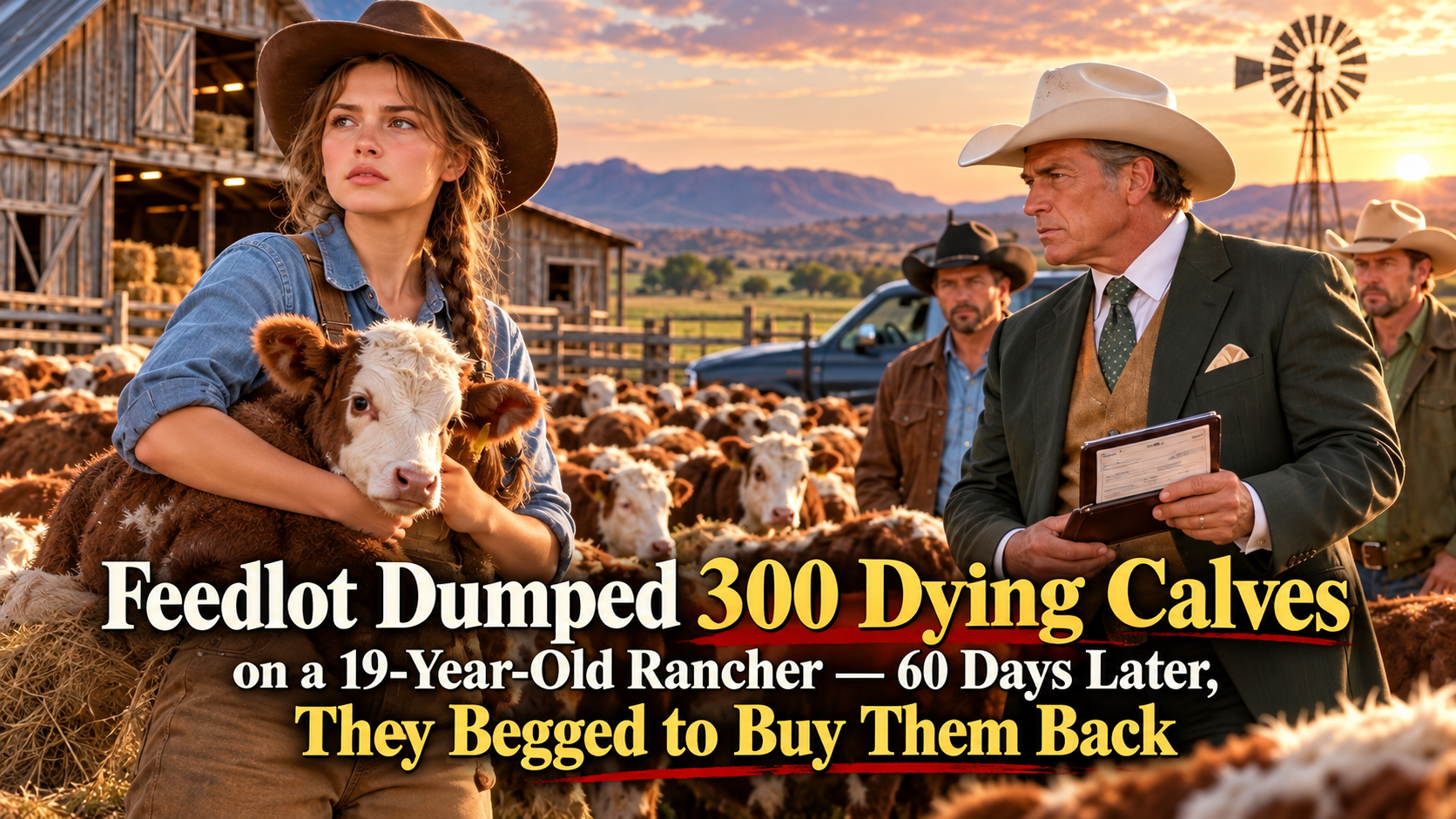
By the time Emma reached the Whitaker ranch, the eastern sky was glowing orange.
Flames climbed the roof of the old barn.
Smoke rolled across the pasture.
And three hundred Hereford calves were trapped behind a burning fence.
Emma jumped from Thomas Bell’s truck before it stopped.
“Open the north gate!” she shouted.
The volunteer firefighters were already arriving.
Neighbors raced across the yard with buckets and hoses.
Walter Briggs had come from the feedlot with two ranch hands.
Even Raymond Dorsey was there.
For one terrible moment, Emma forgot every secret, every lie, and every dollar.
All she could see were the animals she had fought to save.
“Get them moving!” she yelled.
The first calves crowded against the gate.
A frightened heifer stumbled.
Emma ran toward her.
“Come on, girl. Get up.”
Smoke stung her eyes.
The heifer struggled to stand.
Emma pulled the gate wide.
One calf moved.
Then another.
Then dozens.
Soon the herd was flowing toward the open pasture.
Thomas and Walter guided the animals away from the smoke.
Raymond helped cut through a damaged fence.
For the first time in sixty days, the powerful feedlot owner was working beside the teenage girl he had mocked.
Not as her superior.
Not as her enemy.
But as a man trying to repair something he had helped destroy.
By dawn, the fire was contained.
The barn was badly damaged.
The cattle had survived, though several required veterinary attention.
Emma stood in the blackened yard, her clothes covered in soot.
The ranch looked broken.
But it was still hers.
And so were the animals.
The sheriff approached.
“We found evidence the fire was deliberately started.”
Emma looked toward Raymond.
He immediately shook his head.
“I had nothing to do with it.”
Walter stepped forward.
“I believe him.”
The sheriff continued.
“We also detained a man leaving the property. He worked for the livestock investment company that financed Dorsey’s expansion.”
Emma remembered the old agreement.
The false ownership records.
The missing documents.
The company had more to lose than Raymond.
The sheriff explained that the suspect had been carrying copies of the trust documents and had apparently been searching the ranch for additional records.
The investigation would take time.
But the immediate danger had passed.
That afternoon, Emma sat in the farmhouse with Elizabeth, Thomas, Eleanor Finch, and the sheriff.
The truth finally emerged.
Elizabeth was not Emma’s mother.
She was Emma’s aunt.
Margaret Dorsey and Samuel Whitaker had married secretly.
Their daughter Elizabeth was born in 1973.
But Emma’s father was Samuel’s younger brother, Daniel Whitaker.
Daniel and his wife, Rose, had died in an accident when Emma was an infant.
Emma’s grandfather raised her.
After Samuel disappeared, Margaret fled Kansas with Elizabeth because she feared the powerful investors trying to seize her breeding program.
Margaret had survived.
She had spent years living under another name while attempting to recover the records proving her ownership.
The telephone call Emma received had come from Margaret herself.
But the greatest surprise was still waiting.
Elizabeth opened her suitcase.
Inside was a second ledger.
This one contained Margaret’s personal notes.
Letters.
Breeding calculations.
Photographs.
And a document signed by Emma’s grandfather only weeks before his death.
Eleanor read it aloud.
The Whitaker Heritage Trust had been amended.
The breeding program would belong jointly to Emma and Elizabeth.
But there was a condition.
Neither could sell the foundation herd to a commercial feedlot without the other’s consent.
Emma looked at Elizabeth.
“Grandpa planned this?”
Elizabeth nodded.
“He knew you would find the cattle eventually.”
Emma shook her head.
“How could he know?”
Elizabeth smiled through her tears.
“Because he arranged for them to come home.”
The room fell silent.
Thomas Bell leaned forward.
“Your grandfather had been watching Dorsey’s operation for years. He knew those bloodlines were still there. Before he died, he made arrangements with an independent livestock broker to alert me if the animals were ever scheduled for disposal.”
Emma stared.
“The broker contacted you?”
Thomas nodded.
“And I made certain you heard about the sale.”
Emma thought back to the day Raymond arrived.
The desperate calves.
The laughter.
The impossible decision.
She had believed she was taking a chance on three hundred unwanted animals.
But her grandfather had left behind a path that might lead her to the truth.
There was one final letter.
It was addressed to Emma.
Her hands trembled as she opened it.
“My dearest Emma,
If you’re reading this, then the herd has found its way home.
I cannot promise you an easy life.
I cannot promise that people will treat you fairly.
But I can promise you this: the world will always underestimate someone who refuses to measure worth in dollars.
I did not leave you a wealthy ranch.
I left you something harder to build.
A reason to keep going.
The seventeen foundation animals are not merely valuable cattle. They are the living work of people who believed that careful breeding, honest records, and respect for animals mattered more than quick profit.
If you choose to continue that work, do it your own way.
And remember, sweetheart, you never have to become powerful by making someone else feel small.
Love,
Grandpa.”
Emma pressed the letter against her chest.
For the first time since his funeral, she cried without trying to hide it.
Three weeks later, Raymond Dorsey returned.
This time, he arrived alone.
No managers.
No polished entourage.
No checkbook.
He stood at Emma’s repaired corral gate and removed his hat.
“I owe you an apology.”
Emma waited.
Raymond looked across the pasture.
“I thought you were a foolish girl who couldn’t recognize a bad investment.”
“You weren’t alone.”
“I was wrong.”
Emma said nothing.
Raymond continued.
“I’ve cooperated with the investigation. I’ve turned over the financial records I kept. And I’ve agreed to surrender any disputed breeding claims.”
“Why?”
Raymond looked at the herd.
“Because my sister spent her life trying to build something good, and I spent mine trying to own it.”
Emma studied him.
“That doesn’t erase what happened.”
“I know.”
He reached into his coat.
For a moment, Emma remembered the checkbook.
But this time he produced a folded document.
It was a release of claims to the seventeen foundation bloodlines, accompanied by a proposal to contribute toward repairing the damaged barn.
Emma read it carefully.
“I’ll have Eleanor examine this.”
Raymond nodded.
“You should.”
He turned to leave.
Then Emma spoke.
“Mr. Dorsey.”
He stopped.
“Those calves weren’t worthless.”
Raymond looked back.
“I know that now.”
“No,” Emma said quietly. “You knew they were worth something when you came back with your checkbook.”
She looked toward the pasture.
“What you didn’t know was that they were worth saving before they could make you money.”
Raymond lowered his eyes.
And for once, he had no answer.
Over the following months, the investigation into the old financial records continued.
The livestock company faced legal scrutiny.
Raymond’s disputed claims were withdrawn.
The trust’s ownership was formally confirmed through surviving documents and additional testimony.
Margaret returned to Kansas.
She arrived on a cool October morning, carrying a battered suitcase and a photograph of Samuel.
She was older now.
Her hair was silver.
But when she saw the seventeen foundation animals grazing beneath the cottonwoods, she fell to her knees.
Emma hurried toward her.
“Are you all right?”
Margaret reached out and touched the nearest calf.
“Your grandfather promised me they would come home.”
Emma knelt beside her.
“They did.”
Margaret began to cry.
And Emma finally understood why the old man had spent so many years protecting a herd that no longer appeared to belong to him.
He had not been guarding money.
He had been guarding a promise.
By the following spring, the Whitaker ranch had changed.
The burned barn had been rebuilt.
The bank agreed to restructure the debt after the ranch secured a legitimate breeding partnership.
Elizabeth took charge of the records and business operations.
Margaret supervised the foundation breeding program.
Thomas Bell remained their trusted veterinarian.
And Emma managed the daily work.
Not every calf became a prize animal.
Not every investment succeeded.
There were difficult winters, costly repairs, and exhausting nights.
But the ranch was growing stronger.
Then came the annual Kansas livestock exhibition.
Emma entered a small group of carefully selected Herefords.
She did not expect to win.
She wanted to show what patient care and responsible breeding could accomplish.
When the judges announced that the Whitaker Heritage Ranch had earned the exhibition’s outstanding breeding program award, Emma stood frozen.
The crowd applauded.
Elizabeth embraced her.
Margaret wiped tears from her cheeks.
And at the back of the audience, Raymond Dorsey stood quietly with his hat in his hands.
After the ceremony, a reporter approached Emma.
“Miss Whitaker, people say you turned three hundred dying calves into a fortune. Is that true?”
Emma smiled.
“Not exactly.”
The reporter looked puzzled.
“Then what did you do?”
Emma glanced toward the cattle.
“I gave them a chance.”
The reporter scribbled in his notebook.
“And what was the biggest surprise?”
Emma thought about the hidden tags.
The red ledger.
The missing relatives.
The burning barn.
The grandfather who had arranged one final act of faith.
Then she smiled again.
“The biggest surprise wasn’t what those calves were worth.”
“What was it?”
“That the man who sold them to me thought he was getting rid of his past.”
She looked toward Margaret and Elizabeth.
“But he was actually sending my family back home.”
The reporter lowered his notebook.
For a moment, nobody spoke.
Then Margaret stepped forward.
She placed an old brass tag in Emma’s hand.
W.H.R.
017.
The same tag that had terrified Raymond sixty days after the sale.
Emma closed her fingers around it.
What had begun as a desperate gamble had become a new beginning.
And the final twist was something even Raymond Dorsey could never have predicted.
The seventeen foundation calves had not merely saved the Whitaker ranch.
They had reunited the family that had created it.
Years later, when Emma was asked why she never sold the herd despite offers that could have made her wealthy, she always gave the same answer.
“Because some things become valuable when you refuse to give up on them.”
And above the entrance to the rebuilt barn hung a wooden sign.
WHITAKER HERITAGE RANCH
ESTABLISHED ON FAITH.
BUILT ON SECOND CHANCES.
Beneath it, Emma had added one final sentence in memory of her grandfather.
“Nothing worth saving is ever truly worthless.”
THE END.