Mamoudou Gassama: The Young Migrant Who Climbed Four Floors to Save a Child and Became a Symbol of Humanity
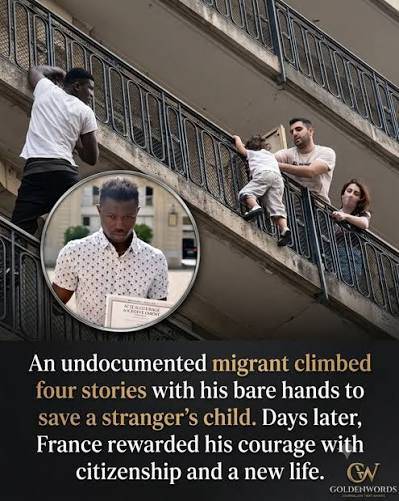
On the evening of May 26, 2018, a crowd gathered beneath an apartment building in northern Paris. People were shouting, pointing upward and calling for help.
Four floors above the street, a four-year-old boy was hanging outside a balcony railing.
His body was suspended over the pavement, and his small hands appeared to be losing their grip. A neighbor standing on an adjoining balcony was trying to reach him, but the distance made it nearly impossible to pull the child to safety.
Among the frightened witnesses was Mamoudou Gassama, a 22-year-old migrant from Mali. Until that evening, almost nobody in France knew his name. Within minutes, however, his actions would be seen around the world.
A Decision Made in Seconds
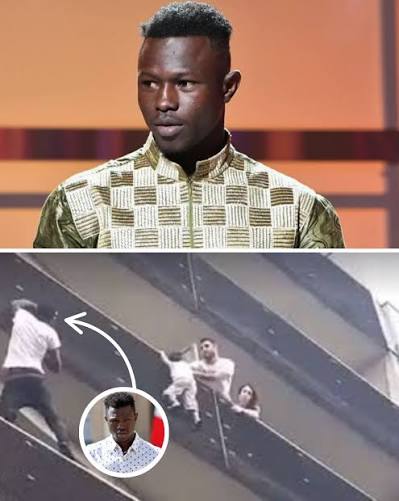
Gassama had been walking through Paris’s 18th arrondissement when he noticed the commotion. He followed the crowd’s gaze and immediately understood the danger.
There was no time to wait for professional rescuers to arrive.
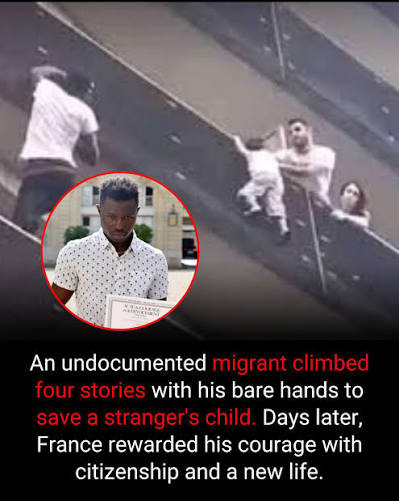
Instead of remaining on the pavement, Gassama moved toward the building. He approached the first balcony, grabbed its railing and began pulling himself upward.
He had no rope, helmet or safety equipment. The balconies were several feet apart, and a single mistake could have sent him falling to the street below.
Still, he continued.
Using the strength of his arms, Gassama climbed from one level to the next. Each time he reached a balcony, he briefly steadied himself before launching toward the floor above.
People watching from below recorded the extraordinary scene on their phones. In the footage, Gassama can be seen moving rapidly along the outside of the building as the crowd cries out beneath him.
Reports said the climb took less than a minute.
Reaching the Fourth Floor
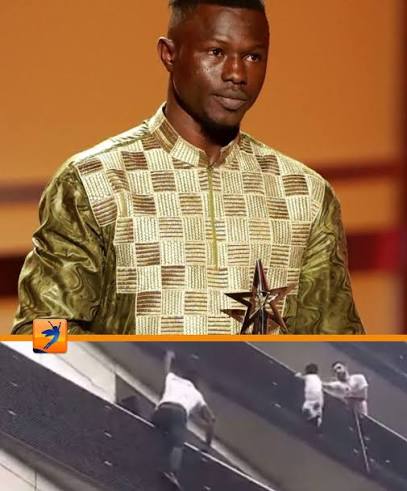
When Gassama reached the fourth-floor balcony, the child was still clinging to the railing.
Balancing on the narrow ledge, the young man stretched one arm toward the boy. He then secured his grip, lifted the child and pulled him back across the barrier.
The danger was over.
The crowd below erupted with relief as Gassama carried the boy away from the edge. Emergency workers arrived shortly afterward, but the most urgent part of the rescue had already been completed by a passerby who had refused to stand still.
Speaking later about his decision, Gassama explained that he acted because a child needed help. He had not stopped to consider the attention, recognition or personal consequences that might follow.
At that moment, only the boy mattered.
The Video Seen Around the World
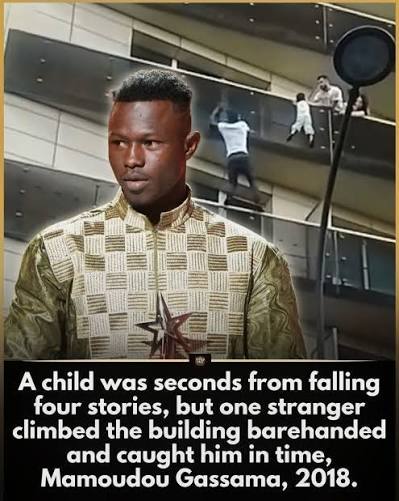
Footage of the rescue quickly spread across social media. Viewers watched in disbelief as Gassama climbed the building with little more than his hands, physical strength and determination.
French media began calling him the “Spider-Man of Paris.” International news organizations soon repeated the nickname, transforming an undocumented migrant who had been living quietly in France into an international symbol of courage.
The public response was immediate. Many people praised not only the physical difficulty of the climb but also Gassama’s willingness to place himself in danger for someone he had never met.
His legal status made the story even more striking.
Gassama had arrived in France after a long and dangerous journey from Mali. Like many undocumented migrants, he had lived with uncertainty, limited opportunities and the constant possibility that his future in the country could disappear.
Before the rescue, he was largely invisible to the wider public. Afterward, millions of people knew his face.
An Invitation to the Élysée Palace
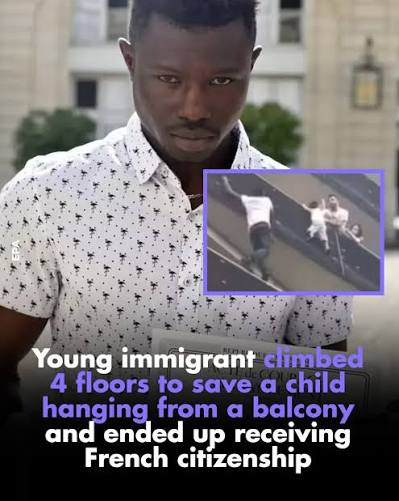
Two days after the rescue, French President Emmanuel Macron welcomed Gassama to the Élysée Palace.
During their meeting, Macron congratulated him for what he described as an exceptional act. The president announced that Gassama’s residency situation would be resolved and invited him to begin an accelerated naturalization process.
Gassama was also offered an opportunity to work with the Paris fire brigade through a civic-service position.
The contrast was remarkable. Only days earlier, he had been an undocumented young man attempting to build a stable life. Now he was sitting inside the presidential palace, being thanked by the leader of France.
Although some early reports suggested that citizenship had been granted immediately, the legal process took several months. Gassama officially became a French citizen later in 2018, fulfilling the promise made after the rescue.
More Than a Remarkable Climb
Gassama’s rescue became famous because it looked like a scene from a film. Yet the deeper meaning of the event went far beyond his athletic ability.
He did not know the child’s family. He had no responsibility to enter the building, and nobody had ordered him to act.
He simply recognized that another human being was in immediate danger.
His response demonstrated that courage is not always planned. Sometimes it appears without warning, during a moment when hesitation and action lead to completely different outcomes.
Gassama could have waited with everyone else. Instead, he made the decision to move forward despite the obvious risks.
That choice changed two lives: the life of the child he rescued and his own.
A Complicated Conversation About Migration
The celebration surrounding Gassama also inspired a wider debate.
Many people welcomed France’s decision to recognize his bravery and give him a path toward citizenship. Others argued that migrants should not have to perform extraordinary acts before society acknowledges their humanity or allows them to build secure lives.
Thousands of undocumented people live quietly, care for relatives, work difficult jobs and contribute to their communities without ever appearing in a viral video.
Gassama’s story therefore carried two messages at once.
It showed how one person’s courage could unite people across political and cultural divisions. At the same time, it raised questions about those whose struggles remain unseen because they never receive a dramatic opportunity to prove themselves.
A Symbol That Endured
Years after the rescue, the images remain unforgettable.
A young man climbs the side of a Paris apartment building. A child waits above him. A frightened crowd watches from below, unable to predict whether he will make it.
Then Gassama reaches the balcony and pulls the boy to safety.
The nickname “Spider-Man of Paris” captured the spectacular nature of the moment, but it never fully explained why the story touched so many people.
Gassama was not a fictional superhero. He had no special equipment or guarantee of success. He was an ordinary person confronted with an extraordinary emergency.
His instinct was not to ask where the child came from, who his parents were or whether anyone would reward him.
He saw someone who needed help—and he climbed.
That simple decision transformed Mamoudou Gassama from an unknown migrant into a lasting symbol of courage, compassion and the human capacity to act when every second matters.