A Surgical Turning Point: How 12-Year-Old Ulrich Stood Up After Legs Bent Backward
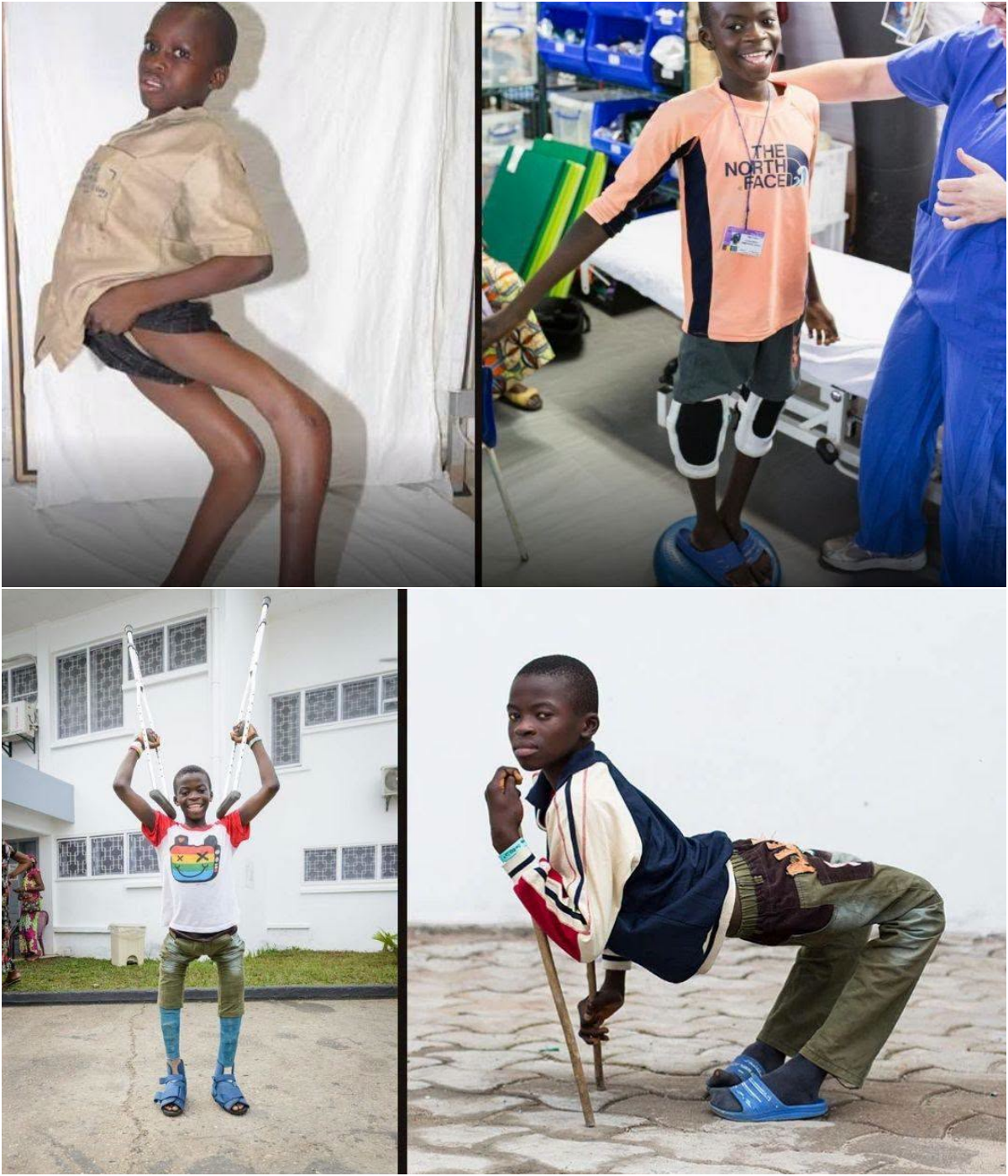
Ulrich was 12 when volunteer nurses on the hospital ship *Africa Mercy* said they had never seen a case like his. He was born in Cameroon with dislocated knees and a severe quadriceps contracture: the muscles in his thighs had not grown at the same pace as the bones. His legs folded drastically backward. To move, he balanced on his hands and used walking sticks cut from branches. The posture wrecked his hands and joints. People in the street stared and treated him as “just a handicapped person.” Local surgeons, his mother Georgette later said, would not touch him. “When he hurts, I hurt.” Ulrich himself put it more simply: “I was scared to grow up like that. I didn’t want this to be all my life was ever going to be.” Asked what he wanted to be when he grew up, he answered, “I want to be tall like my friends.”
Mercy Ships took him aboard for free care. American volunteer orthopedic surgeon Dr. Frank Haydon, who had already spent years on the ship, was stunned. “He moved like an insect … like a cricket. I’d never seen anything quite like it.” Several operations followed — bone realignment, release of contracted tissues, then long-leg casts. When Ulrich woke and saw two straight legs, he had trouble believing they were his. The first time he stood, he reached up to see whether he could touch the ceiling. The first time he walked, volunteer nurse Kirsten Murphy recalled, he went straight into his mother’s arms. It was the first hug he had been able to give her from a standing height. After weeks of rehabilitation at the ship’s Hope Center, he handed his wooden sticks to the surgeon. He would not need them anymore.
“Before, when I would walk in the street, people would stare at me,” Ulrich said afterward. “Now they will look again.”
Quadriceps contracture and neglected pediatric deformity are not mysteries of modern orthopedics. They are conditions that become lifelong when there is no surgeon, no implant, and no months of physiotherapy. Hospital ships exist for that gap. Ulrich’s photographs — bent almost double, then upright in blue sandals and knee braces — are not a miracle in the supernatural sense. They are what happens when a child who had been written off finally meets a team that will operate.
—
**Sources:** Mercy Ships patient story “Meet Ulrich” / “Standing Tall” (Cameroon, *Africa Mercy*); Mercy Ships UK and Switzerland patient pages; contemporaneous Mercy Ships posts (2017) quoting Ulrich and Dr. Frank Haydon; related orthopedic program descriptions. Photographs associated with the original posts are credited to Mercy Ships.