Who Is the Monster? A Close Reading of The Mother’s Monster
The Mother’s Monster is not a large movie. It does not have a studio battle, a chosen-one prophecy, or a map of rival kingdoms. It has a hut, a winter, a woman, and a child the world refuses to name as a child. That limitation is the source of its force.
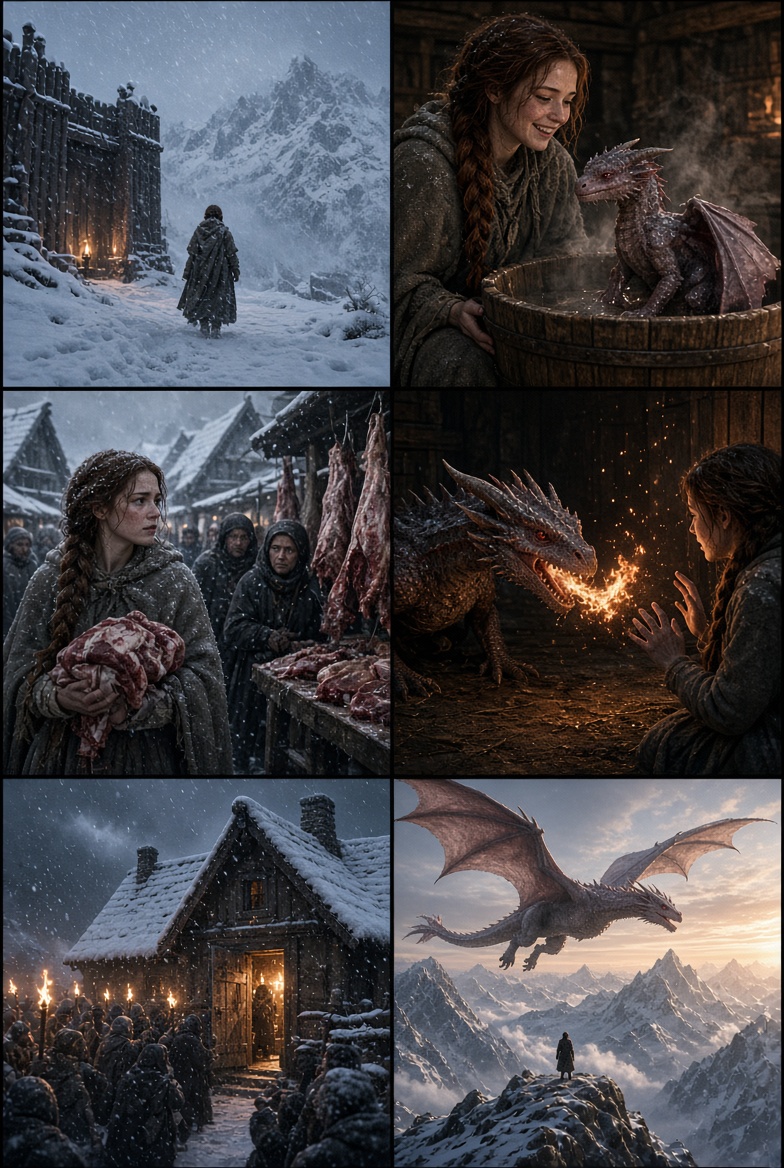
The story opens in the body, not in lore. Elara cannot believe what she has delivered. “This can’t be my baby” is the first moral fork. She could accept the village’s language and treat the hatchling as an omen to be destroyed. She does the opposite. She invents a burial in the mountains, tells neighbors the infant did not survive, and begins a secret life of hunger. Ember will not eat what a human baby eats. Meat becomes the plot’s ticking clock. Every trip to the stall is a confession waiting to happen.
The film understands that motherhood here is not soft. It is logistics. Elara sells what she can. She talks to the creature as if speech itself might make it human. She laughs when it outgrows a tub. Those domestic beats matter because the later violence only works if we have watched her choose the child in small ways, not only in a final stand. When Marda says something among them eats meat, she is not only accusing a dragon. She is accusing a woman of feeding the wrong mouth.
Fear in the village is not cartoon evil. Isolated mountain communities in folklore often treat the unusual birth as a verdict on the whole settlement. A sheep carcass is evidence enough. Religion enters through a priest who tells Marda to rest and wait for first light, then cannot stop the crowd once panic has a name. The film is sharpest when it shows how quickly “I saw something” becomes “she is a witch.” Elara’s house is searched. Objects are handled. Privacy collapses. The monster, when it appears, is almost secondary to the permission the villagers give themselves.
The confrontation sequence is the film’s thesis. Elara does not deny what Ember is. She denies what the crowd wants that fact to mean. She orders the dragon not to kill, even as stones and ropes come out. That is an important distinction. The movie is not arguing that Ember is harmless. It is arguing that harm is not the same as a death sentence, and that a mother can see a future the mob refuses to imagine. When she screams for Ember to fly, she is saving both the child and the village from the same fire.
Her death is deliberately ugly and small. There is no last-minute rescue. The crowd congratulates itself. They will not bury her with their dead. They throw her toward the valley, as if geography could finish a moral job. Then the film does the thing viewers remember. Ember comes back. The creature the village called a devourer becomes a mourner. The burial the humans refused is performed by the son.
That ending is why the short runtime feels complete. A longer epic might explain Ember’s origin, a curse, a bloodline, a war in the peaks. This version leaves the origin unexplained and makes the unexplained the point. We do not need to know why a dragon was born in a human bed. We need to watch what people do when they cannot stand not knowing.
Visually, the AI images serve the theme more than they distract from it. Snow erases detail. Faces look carved by weather. The dragon’s red eyes read as hunger and as grief depending on the cut. Synthetic voices sometimes flatten a line that a live actor would break. The emotion still lands because the structure is old: a parent, an outcast child, a town that would rather be certain than kind.
The Mother’s Monster asks a question older than its tools. If love recognizes a child where law recognizes a threat, which vocabulary should win? The film does not pretend the answer is easy. It only insists that the woman who answered with her body was not the monster in the frame.
Watch the full film below.