THE BOY WHO COUNTED TOMATOES FOR HIS MOM’S FIRST DINNER BACK
**PART 1: **
The little boy at the farmers market kept counting tomatoes.
Not buying them.
Counting them.
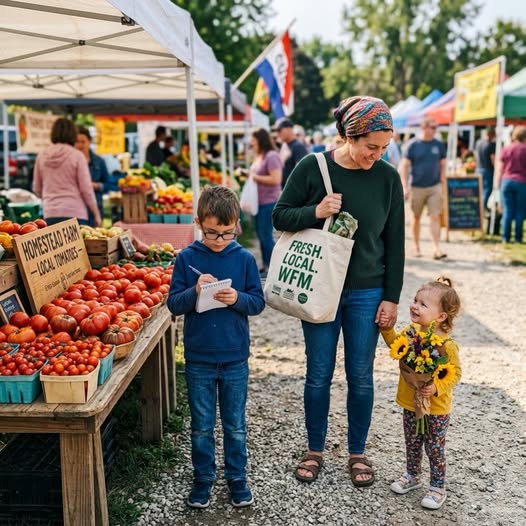
He stood in front of my stall every Saturday morning with a canvas bag folded under one arm and a small notebook in his hand. He couldn’t have been more than eight. Brown hair sticking up in the back, glasses sliding down his nose, sneakers with one lace always untied. He would point at the tomatoes one by one, whisper numbers under his breath, then write something in the notebook.
I sold produce at a weekend market outside Madison, Wisconsin. Mostly tomatoes, sweet corn, cucumbers, green beans, and whatever else my brother and I managed not to kill before harvest. The market had the same rhythm every week: stroller wheels on gravel, dogs sniffing things they shouldn’t, people asking if corn was sweet as if I would ever say no, and older ladies squeezing peaches like they were conducting interviews.
The boy came three Saturdays in a row.
He never touched anything.
Just counted.
On the fourth Saturday, I finally leaned over the table and said, “You keeping inventory for me?”
He looked startled and snapped the notebook shut.
“No, sir.”
“What’s your name?”
“Elliot.”
“Well, Elliot, you’ve counted those tomatoes more carefully than I have.”
He pushed his glasses up.
“I need twelve good ones.”
“For salsa?”
He shook his head.
“For my mom’s table.”
That was not the answer I expected.
Before I could ask, a woman came up behind him carrying two tote bags and wearing the tired smile of somebody trying to make twenty dollars do forty dollars’ worth of work. She had a little girl on her hip and a grocery list folded so many times it looked like cloth.
“Elliot,” she said gently, “we can’t stand here all morning.”
He looked at the tomatoes again.
“I’m almost done.”
The woman glanced at me, embarrassed.
“I’m sorry. He’s been a little focused on tomatoes lately.”
I smiled. “There are worse hobbies.”
She tried to laugh, but it didn’t quite land.
Elliot opened his notebook again and showed her a page. There were little boxes drawn on it, each one with a vegetable name inside.
**Tomatoes — 12**
**Corn — 6**
**Green beans — 1 bag**
**Yellow flowers — maybe**
At the top, in careful block letters, he had written:
**FIRST DINNER BACK**
The woman’s eyes went to the page, then away.
Something passed over her face so quickly I almost missed it.
Pain.
Hope.
Fear, maybe.
Elliot looked up at me and asked, “How much for twelve tomatoes that look happy?”
That was the first time I had ever been asked to judge tomato emotions.
I told him the price.
He looked at his mother.
She looked into her wallet.
There was a pause.
A small one.
But when you’ve sold food long enough, you learn the shape of that pause. It is the sound of milk being chosen over berries. Bus fare over flowers. Enough over almost.
“We can do six,” she said softly.
Elliot’s shoulders dropped.
“But the recipe says twelve.”
“I know.”
“She said twelve makes it taste like summer.”
His mother closed her eyes.
The little girl on her hip grabbed at her hair, and she barely noticed.
I started putting tomatoes into a paper bag.
“Twelve happy ones,” I said.
The woman looked up fast.
“No, please don’t. Six is fine.”
“Market special,” I said. “Six regular tomatoes come with six emotionally supportive tomatoes.”
Elliot stared at me.
“Is that real?”
“It is at this table.”
His mother’s eyes filled, but she blinked it back quickly.
“Thank you,” she whispered.
Elliot inspected every tomato before I bagged it.
“That one has a scar.”
“Most good tomatoes do,” I said.
He considered that and nodded like I had said something important.
While I added the corn and green beans, he told me why he needed the dinner.
His mother had been sick.
Not a cold sick. Not a stomach bug sick. The kind of sick adults lower their voices around.
“She had surgery,” he said. “Then medicine that made food taste like pennies. But yesterday she said she could maybe eat Grandma’s tomato pasta again.”
His mother went very still.
Elliot kept talking because kids often explain the thing adults cannot.
“My grandma used to make it when Mom was little. Grandma died before I was born, but Mom says when the tomatoes are right, the whole kitchen smells like her.”
He looked at the bag.
“So I need the right ones.”
**PART 2: THE TOMATO PEOPLE WHO HELPED A FAMILY COME BACK TO DINNER**
I understood then.
This wasn’t about dinner.
This was about a little boy trying to call his grandmother into the kitchen for his mother.
His mother shifted the little girl on her hip and said, “Elliot, honey, we don’t have to tell everybody everything.”
He looked confused.
“But he has the tomatoes.”
That made her laugh through the tears she was trying not to show.
She told me her name was Claire. The little girl was Rosie. She had spent most of the past year in treatment for breast cancer, and that week was the first time she had walked through the market without needing to sit down halfway.
“I thought bringing the kids here would feel normal,” she said. “Then he pulled out the notebook.”
Elliot looked offended.
“The notebook is necessary.”
“It is,” I said seriously.
Claire smiled at me, grateful and exhausted.
I could have left it there.
I probably should have.
But I asked, “Do you have basil?”
Elliot checked the list.
“No. Mom forgot.”
Claire sighed. “I did forget.”
I reached under the table and pulled out a bunch from the cooler. It was not our prettiest basil. A little bruised around the edges. Still good. Still fragrant.
“On the house,” I said. “Tomato pasta needs basil.”
Claire shook her head.
“You’ve already done too much.”
From the stall next to mine, Mrs. Donnelly, who sold eggs and had the hearing of a barn owl when kindness was happening without her, said, “Nonsense. Pasta needs eggs too.”
“It does not,” I said.
“For tomorrow’s breakfast,” she snapped, already placing half a dozen in Claire’s tote.
Across the aisle, Jamal from the bakery lifted a paper bag.
“Day-old bread,” he called. “Still better than most people’s fresh.”
The flower stand woman, who had been pretending to rearrange sunflowers while listening to every word, came over with a small bundle of yellow zinnias.
Elliot’s eyes widened.
“Flowers were only maybe.”
“They’re yes now,” she said.
Claire pressed one hand over her mouth.
“No, please. I can’t—”
Mrs. Donnelly put the eggs in the tote with finality.
“Then don’t. Just go home and make the pasta.”
That was how a farmers market became a conspiracy.
Nobody made a speech. Nobody announced anything. Nobody clapped. People simply added what they could.
A jar of sauce from the Italian couple at the corner, “just in case the tomatoes don’t behave.”
A little wedge of cheese from the dairy stand.
A small container of strawberries because Rosie had been pointing at them with serious baby determination.
By the time Claire stood there with both tote bags full, she looked like she might fall apart.
“I don’t even know what to say,” she whispered.
Elliot looked at her.
“Say thank you.”
Everybody laughed softly.
So she did.
“Thank you.”
But it came out like more than manners.
It came out like a woman who had spent a year being brave in hospital rooms and insurance phone calls and quiet bathrooms, suddenly realizing ordinary people could still surprise her.
Before they left, Elliot turned back to me.
“Do tomatoes get scared when they leave the market?”
I thought about that.
“No,” I said. “They’re going where they’re supposed to.”
He looked at the bag.
“Good.”
The next Saturday, I did not expect to see them.
But around ten, Elliot came running up to the stall with his shoelace untied, notebook in hand, and a grin so big it changed his whole face.
“My mom ate a whole bowl,” he announced.
Claire came behind him more slowly, Rosie toddling beside her holding one of the yellow zinnias, now wilted but beloved.
Claire looked different.
Still tired.
Still thin.
Still wearing a headscarf tied carefully at the back.
But her cheeks had more color.
She handed me a folded note.
“I wanted you to have this.”
Inside was a photo printed on regular paper. Their kitchen table. A big bowl of tomato pasta in the middle. Corn on a plate. Bread torn into pieces. The yellow zinnias in a glass jar. Elliot and Rosie sitting proudly on either side of Claire.
On the back, Claire had written:
**For the first time in months, our house smelled like dinner instead of medicine.**
I read it twice.
Then I had to look down at the tomato crates for a while.
Elliot tapped the table.
“I also have feedback.”
“Of course you do.”
“One tomato was only medium happy.”
“That happens.”
“But the basil was excellent.”
“I’ll tell it.”
He opened his notebook to a new page.
At the top, he had written:
**SECOND DINNER BACK**
This time the list was shorter.
**Tomatoes — 8**
**Corn — 4**
**Strawberries if Rosie behaves**
Rosie immediately threw the zinnia on the ground.
Elliot sighed.
“Strawberries maybe.”
From across the aisle, Jamal called, “Rosie gets strawberries.”
Elliot looked at him.
“She did not behave.”
“She is in training,” Jamal said.
And just like that, the market adopted them without saying the word.
Not in a way that made Claire feel like a project. That matters. Nobody crowded her. Nobody asked invasive questions. Nobody told her miracle stories or gave advice from some article they read online.
They just remembered.
Mrs. Donnelly saved eggs.
The flower woman saved one small bunch of whatever was bright.
Jamal saved bread.
I saved the happiest tomatoes.
Some weeks Claire came. Some weeks Elliot came with his aunt. Some weeks nobody came, and we all pretended not to worry until the next Saturday, when Elliot appeared and informed us that his mother had been “low battery” but was charging.
By September, Claire’s hair had started to come back in soft dark fuzz under her scarves.
By October, she came to the market wearing no scarf at all.
Nobody said anything at first.
That was the right thing.
Then Mrs. Donnelly looked over her glasses and said, “Well, there you are.”
Claire laughed.
“There I am.”
Elliot, meanwhile, had become dangerously confident in produce inspection. He once told a customer, “You want the ugly peppers. Pretty ones have no character,” and I had to admit he wasn’t wrong.
At the end of the season, when the last tomatoes were smaller and less perfect, Claire came by herself.
No kids.
Just her.
She stood in front of the table for a long moment.
“I had my scan,” she said.
I stopped stacking baskets.
She smiled, but her eyes filled.
“It was clear.”
I don’t remember exactly what I said.
Probably nothing useful.
I know I came around the table and hugged her because she opened her arms like she had been waiting for permission.
Mrs. Donnelly saw us and shouted, “Is it good news?”
Claire laughed and cried at the same time.
“Yes.”
The whole row heard.
The bakery. The flower stand. The dairy couple. The honey man. The college kids selling coffee.
People didn’t clap.
It wasn’t that kind of moment.
They just came over.
One by one.
A hand on her shoulder.
A squeeze of her fingers.
A quiet “thank God.”
A bag of bread she didn’t ask for.
A dozen eggs she tried to refuse.
A bouquet of yellow flowers, bigger this time.
Claire stood in the middle of the market holding all of it, and for the first time since I had met her, she looked less like she was bracing for the next hard thing.
That winter, the market moved indoors to the county fair building. Concrete floors, weak coffee, fluorescent lights, root vegetables everywhere. Not exactly charming, but warm.
One Saturday in December, Elliot showed up at my table carrying a gift bag.
Inside was a small framed photo.
The same kitchen table as before.
This time, Claire was standing at the stove, wooden spoon in hand, Rosie on a step stool beside her, Elliot holding a bowl of tomatoes from the freezer like a trophy.
Under the photo, Elliot had written in careful marker:
**THE TOMATO PEOPLE HELPED MOM COME BACK TO DINNER.**
I laughed when I read it.
Then I cried, which made Elliot deeply uncomfortable.
“It’s not sad,” he said.
“No,” I told him. “It’s not.”
He nodded, relieved.
“Also, Mom says to tell you the scarred tomatoes were best.”
I looked at the picture again.
Claire at the stove.
Rosie reaching for the spoon.
Elliot grinning.
Steam rising from the pot.
A family not fixed exactly, because life is not that simple, but gathered. Fed. Home around a table again.
I hung that photo inside our farm stand trailer, right beside the market permits and the calendar.
I still sell tomatoes every summer.
People still ask if they’re sweet.
Kids still poke them when their parents aren’t looking.
Someone always complains about the price of corn.
And every now and then, a person will pick up a scarred tomato and put it back because it isn’t perfect.
When they do, I think of Elliot.
I think of a little boy counting tomatoes like they were medicine.
I think of a mother trying to teach her children normal while quietly fighting to stay.
I think of yellow flowers that began as maybe and became yes.
And I think of how kindness doesn’t always arrive as a grand rescue.
Sometimes it is six extra tomatoes in a paper bag.
A bruised bunch of basil.
A loaf of bread.
A market full of people careful enough not to make someone’s pain a performance.
Sometimes healing smells like garlic and summer fruit on the stove.
Sometimes coming back to life begins with one bowl of pasta.
And sometimes the scarred tomatoes really are the best ones.