Everyone in the Hospital Was Terrified of the Wounded Navy Commander in Room 418—But When He Exploded in a Violent Night Terror, the Exhausted Nurse Who Walked In Didn’t Call Security, Didn’t Scream, and Became the Only Person He Allowed to Save Him
The first thing I heard was the metal tray hitting the floor.
The second was the roar.
Not a scream.
Not a cry.
A roar.
The kind that comes from a man who is not in a hospital anymore, not in a bed, not even in the same year as everyone else.
By then, half the trauma wing was already afraid of Commander Luke Callahan.
I was just too tired to be.
My name is Nora Bell.
I was thirty-four years old, working nights at St. Catherine’s Military Medical Center in Portsmouth, Virginia, and if you want the truth, I was not brave that week.
I was exhausted.
I had not slept more than four hours at a time in days. My car had started making a noise that sounded expensive. My student loans still followed me around like a ghost with a calculator. My lower back hurt so badly I had started bargaining with God every time I bent to pick something up.
So when Sarah Jenkins burst into the breakroom crying and threw a clipboard onto the counter, I did not leap up like some heroic nurse in a television show.
I just stared at my cold coffee and thought, Please, not again.
“I’m done,” Sarah said, wiping her face with the back of her hand. “I am absolutely done. He threw an entire pitcher of ice water at me.”
I rubbed my right eye with the heel of my palm.
“Room 418?”
“Who else?” she said. “Commander Callahan. The SEAL. The one they flew in from Germany.”
Everyone on the floor knew about him.
Commander Luke Callahan.
Decorated. Classified. Dangerous.
He had come in six days earlier after an explosion overseas, wrapped in bandages, silence, and military police. His left leg had been shattered and rebuilt with rods and pins. Burns covered his side and arm. Shrapnel had carved places in him no surgeon could make neat.
But the wounds everyone whispered about were not the ones under gauze.
He did not sleep.
He did not trust anyone.
He refused pain medication until his body shook.
He threatened three nurses, bit through an oxygen cannula, ripped out one IV, and told a resident he would break both his hands if he touched the dressing on his thigh.
The doctors called it agitation.
The psychiatrist called it acute combat trauma.
The younger nurses called him a monster.
I called him late for antibiotics.
“His cefepime was due an hour ago,” I said, reaching for the chart.
Sarah stared at me. “Nora, no. Let security handle it.”
“Security will make it worse.”
“He said he would break my fingers.”
“Did he break them?”
“No.”
“Then technically, he showed restraint.”
She looked at me like I had lost my mind.
Maybe I had.
Maybe the part of me that should have been afraid had been worn down by too many twelve-hour shifts, too many alarms, too many families asking me questions I could not answer.
I took the chart and stood.
Sarah grabbed my wrist.
“I’m serious. His eyes, Nora. He’s not here.”
That stopped me.
Because I knew what she meant.
I had seen patients trapped inside pain before. Men with open eyes staring at rooms nobody else could see. Women who begged me not to let someone hurt children who weren’t there. Veterans who came back from surgery still fighting battles the rest of us had never been drafted into.
I gently pulled free.
“Then someone needs to remind him where he is.”
The hallway outside the breakroom was cold enough to raise goosebumps on my arms. Monitors beeped behind closed doors. A resident hurried past with his head down. Farther down the hall, near the VIP rooms, an orderly stood against the wall holding a mop like a shield.
When he saw me, he shook his head.
I ignored him.
Room 418 sat at the end of the corridor with the heavy door half open. Inside, something glassy crunched under a boot. The smell hit me first.
Old blood.
Sweat.
Antiseptic.
Fear.
I stepped into the room and let the door click behind me.
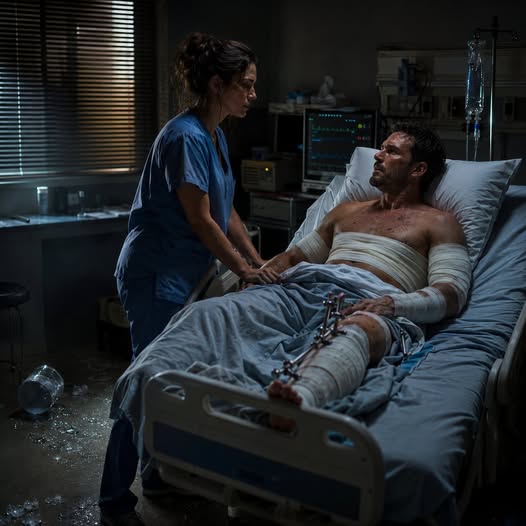
It was dark. Too dark. The blackout blinds were drawn tight, and the only light came from the green and blue glow of the monitors.
A shattered water pitcher lay near the foot of the bed. Ice melted across the floor in a widening puddle.
From the bed came a rough voice.
“Get out.”
I did not answer right away.
I walked to the sink, washed my hands, dried them, and pulled on gloves. Every movement was ordinary. Slow. Boring on purpose.
Only then did I look at him.
Luke Callahan was pressed back against the raised mattress like a trapped animal.
He was a large man made smaller by pain. His face was pale beneath dark stubble. A stitched cut ran along his jaw. One side of his body was wrapped in thick dressings. His left leg was held in an external frame that looked more like construction equipment than medicine.
But it was his eyes that made the staff afraid.
Gray.
Bloodshot.
Unblinking.
Not cruel.
Not exactly.
Assessing.
Like he was measuring the distance between my throat and his hand.
“I told you to get out,” he said.
“I heard you.”
“Then you’re bad at following orders.”
“I’m not in the Navy.”
His fingers tightened around the IV tubing taped to his right hand.
“One more step and I rip this out.”
I looked at the line.
Then at his face.
“If you rip it out, blood gets on the sheets,” I said. “Then I have to change the sheets. To change the sheets, I have to roll you onto your left side. Your left side is currently one big argument with God. It will hurt. You’ll probably vomit. Then I’ll have to clean that too.”
He blinked.
I continued.
“After that, I’ll need a new vein. You’re dehydrated, your veins are terrible, and I’ll have to dig around with a needle until we both hate each other more than we already do.”
The room went still.
“So,” I said, holding up the antibiotic bag, “please don’t make me dig.”
For a long moment, he stared at me.
I could feel my pulse in my throat.
I was afraid.
Of course I was.
Only fools and liars say they feel no fear around a wounded man who has forgotten he is safe.
But I did not show it.
Not much, anyway.
Slowly, his fingers loosened from the tubing.
He turned his face toward the wall, jaw clenched, arm extended in silent surrender.
I stepped forward.
“This may taste metallic,” I said, flushing the line.
He grimaced but stayed still.
I connected the antibiotic, adjusted the pump, gathered the wrappers, and stripped off my gloves.
No comforting pat.
No soft speech.
No “you’re okay.”
Men like him did not believe okay yet.
I was almost at the door when his voice stopped me.
“What’s your name?”
I looked back.
The monitor light cut across his face, leaving half of him in shadow.
“Nora.”
His eyes stayed on me.
“Nora what?”
“Bell.”
I opened the door.
Behind me, he said nothing else.
But for the first time all week, the man in room 418 had let someone treat him without a fight.
And by sunrise, everyone on the ward knew I was the only nurse he would allow through the door.
By Wednesday, room 418 had become mine.
Not officially.
Hospitals do not make honest assignments like that.
Officially, Commander Callahan was on the trauma service, under Dr. Levin, with consults from infectious disease, orthopedics, plastics, psychiatry, pain management, and enough military liaisons to form a small government.
Unofficially, if he needed medication, dressing changes, vitals, labs, or anyone to step within striking distance, they sent me.
The charge nurse said I had “a calming effect.”
That was a polite lie.
I had a paperwork effect.
I documented everything, spoke plainly, and refused to treat him like either a hero or a bomb. Apparently that made me qualified.
The first dressing change nearly broke both of us.
His burns ran along his left side in angry patches of red and white, healing in places, fighting infection in others. Cleaning them was necessary, but necessity does not make cruelty feel kinder.
I pulled the tape slowly at first.
He hissed through his teeth.
“Fast,” he said.
I paused.
“You sure?”
His eyes were fixed on the ceiling.
“Fast.”
So I did it fast.
The sound of adhesive tearing away from skin filled the room.
His right hand clamped around the bedrail so hard the metal squeaked. Sweat appeared at his hairline. His jaw worked, but he did not make a sound.
I hated that.
People think silence means strength.
Sometimes it just means a person learned long ago that nobody comes when they scream.
I cleaned the wound, applied medication, layered fresh gauze, and taped the edges down.
“You’re rough,” he rasped.
“I’m efficient.”
“Feels the same.”
“No,” I said. “Rough takes pleasure in it. Efficient wants it over.”
He turned his head slightly.
That was the first time he really looked at me.
Not through me.
At me.
“You don’t talk like the others.”
“I don’t have the energy.”
A sound moved in his chest.
Almost a laugh.
Almost pain.
Maybe both.
“My career is over,” he said suddenly.
The words sat there between the monitor beeps.
“My leg is held together by hardware. My team is dead. Half the people who come in here look at me like I’m some kind of war story they can tell over dinner.”
I held the used gauze in my gloved hand.
For one second, every training script I had ever heard lined up in my head.
You’re lucky to be alive.
They’d want you to keep fighting.
Everything happens for a reason.
All of it sounded cheap.
So I said the only true thing I had.
“That sucks.”
His eyes narrowed.
“It sucks,” I repeated. “It is awful, and unfair, and nothing I say will make it less awful. So I’m not going to decorate it.”
He stared at me for a long time.
Then his shoulders dropped half an inch.
“Can you get me another pillow?”
“No.”
He blinked.
“They all feel like gravel,” I said, pushing the cart toward the door. “This is a hospital, not a resort.”
This time, I was sure the sound he made was a laugh.
Dry.
Painful.
Real.
Over the next few days, he became less violent and more miserable, which counted as progress.
He still refused most visitors.
Still startled at sudden noises.
Still scanned every person who entered the room.
But he stopped threatening to break fingers.
He let me open the blinds two inches.
Then four.
Then, by Friday, enough for a stripe of sunlight to touch the foot of his bed.
He asked for black coffee even though he was not supposed to have any.
I brought him tea and told him to suffer.
He called me heartless.
I told him my cat disagreed.
He asked the cat’s name.
“Biscuit.”
“That’s a stupid name.”
“He’s a stupid cat.”
Another almost-laugh.
The night everything changed was Thursday, just after 3 a.m.
The emergency department had been drowning all evening. A pileup on I-64 sent patients spilling into every open bed. By the time the halls finally quieted, my feet throbbed in my shoes and my scrubs smelled like coffee, sweat, and antiseptic.
I was charting at the nurse’s station when the shout came from room 418.
Not anger.
Terror.
The chair behind me rolled backward as I stood.
Then came the crash of metal.
I ran.
When I pushed into the room, it was pitch black.
Callahan was thrashing in bed, one arm swinging, his injured leg jerking against the frame. The external fixator slammed against the rail with a sound that made my stomach lurch. If he kept going, he could tear the pins loose.
“Callahan!”
He did not hear me.
He was somewhere else.
“Get down!” he roared. “Get down!”
He reached across the bed as if covering a body that was not there.
I moved toward him, then stopped.
Do not grab a man waking inside a firefight.
Instead, I snatched the plastic cup from the bedside table and threw cold water into his face.
He gasped.
His eyes snapped open, wild and unfocused.
I slammed my palm flat on the tray table.
“Jack.”
The name cut through the dark.
He turned toward the sound.
“Look at me.”
His chest heaved.
“Name five things in this room.”
He stared at me like I had spoken nonsense.
“Now,” I said.
His lips parted.
“The… monitor.”
“One.”
“The door.”
“Two.”
His breathing hitched.
“The IV pole.”
“Three.”
“Your shoes.”
“Four.”
He swallowed hard, eyes searching through the shadows.
“You.”
“Five.”
I lowered my voice.
“You’re in a hospital in Virginia. It’s Thursday morning. You’re here. Not there.”
The fight left him so suddenly it was painful to watch.
The commander disappeared.
The dangerous patient disappeared.
All that remained was a broken man soaked in ice water, shaking in a bed he had almost torn apart.
He raised his hand over his face.
Not because he was hiding from me.
Because he was ashamed.
I turned my back.
Privacy can be medicine too.
I walked to the warmer, pulled out a blanket, grabbed a fresh gown, and placed both on the end of the bed without looking directly at him.
“Change your gown,” I said. “I’ll pretend I didn’t throw water on a Navy commander. You pretend you didn’t try to dismantle hospital furniture with your leg.”
Silence.
Then his voice came, stripped raw.
“You didn’t call security.”
“Too much paperwork.”
A pause.
“Nora.”
I stopped at the door.
“Thank you.”
I nodded once and left before either of us had to make the moment heavier.
After that night, something shifted.
Not dramatically.
Real healing rarely announces itself.
He still had bad days.
Some were terrible.
Some mornings he woke furious that he had woken at all. Some afternoons he stared out the window for hours without speaking. Once, during physical therapy, he threw a resistance band across the room and told everyone to get out.
I went in twenty minutes later with his antibiotics.
He glared at me.
“I’m not doing therapy.”
“I didn’t ask.”
“I’m not walking for their entertainment.”
“Good. They’re terrible entertainment.”
He looked away.
I put the medication into his line.
Then I said, “But if you don’t move that leg, it’s going to make decisions for you. And you seem like a man who hates not being in charge.”
He did the therapy the next day.
Two weeks later, he sat in a chair for twenty minutes.
Three weeks later, he stood between parallel bars with sweat running down his neck and rage in his eyes.
Four weeks later, he took three steps.
They were ugly steps.
Shaking.
Angry.
Expensive in pain.
But they were his.
The staff clapped.
He hated that.
I did not clap.
He looked at me.
I held up three fingers.
“Three.”
He looked annoyed.
Then proud.
Then annoyed that I had seen proud.
By the time he was transferred to inpatient rehabilitation, the whole ward had rewritten the story.
They said I had tamed him.
I hated that.
He was not an animal.
He was a man whose mind had dragged him back to the worst moment of his life and locked the door from the outside.
I did not tame him.
I knocked until he found the handle.
On his last morning in the trauma wing, I came in with discharge paperwork stacked under one arm.
He was sitting on the edge of the bed, dressed in a gray shirt and sweatpants, his injured leg braced, his face thinner but clearer.
A cane leaned against the chair.
“I hear you’re escaping,” I said.
“Transferred,” he corrected.
“Same thing with more forms.”
He took the folder from me.
His fingers brushed mine.
Neither of us commented on it.
“Nora,” he said.
I looked up.
“I remember that night.”
I knew which one.
“Most of it,” he continued. “Not all. But I remember your voice.”
I tried to make a joke.
He did not let me.
“I thought I was back on the road. I thought my corpsman was under me. I was trying to cover him.”
His eyes moved to the window.
“He died before the medevac landed.”
“I’m sorry.”
He nodded, but not like he was accepting comfort.
More like he was acknowledging a fact both of us had to stand beside.
“You were the first person who didn’t tell me I was safe like I was too stupid to know I wasn’t.”
I folded my arms.
“What did I say?”
“You told me where I was.”
“That’s different.”
“Yeah.”
He looked at me then.
“It mattered.”
My throat tightened.
So I did what nurses do when emotions become too large.
I checked the IV site he no longer had.
He noticed.
And smiled.
An actual smile this time.
Small, crooked, exhausted.
But real.
A year passed.
Then another.
I thought of him sometimes, usually when I passed room 418 or when a patient asked for a different pillow. I heard through hospital gossip that he had medically retired, then consulted for training programs, then disappeared into some veterans’ recovery nonprofit.
Life moved.
My car finally died.
Biscuit got diabetes.
Sarah transferred to pediatrics and claimed she liked children better because at least they admitted when they were scared.
Then, one rainy morning, a package arrived at the nurse’s station.
No return address.
Inside was a small wooden frame.
Behind the glass was a photograph of a cabin near a lake, with a ramp leading to the porch and a big black dog sitting by the door.
There was a note folded beneath it.
Nora,
I walked from the truck to that porch today without the cane. It was only thirty-six feet. It hurt like hell. I was angry the whole time. You would have called it inefficient.
I still count five things when the night gets bad. Monitor. Door. IV pole. Shoes. You.
There’s no monitor here. No IV pole. Different shoes. But the method works.
You once told me the truth without decorating it. So here is mine: I would not be alive if you had called security that night. I would still be trapped there if you had treated me like a monster.
You didn’t save me with kindness exactly. You saved me with honesty.
Thank you for knocking until I found the handle.
—Jack
I read it twice.
Then a third time.
Then I went into the supply room and cried for exactly four minutes, because I had a medication pass due and one of my patients was already threatening to remove his own catheter.
I hung the photo inside my locker.
Not where everyone could see.
Just me.
Years later, when new nurses ask me how to deal with difficult patients, I tell them what room 418 taught me.
Do not confuse pain with personality.
Do not mistake fear for cruelty.
Do not offer pretty lies to someone drowning in an ugly truth.
And never assume the person screaming in front of you is angry at you.
Sometimes they are shouting at a memory.
Sometimes they are fighting to come back.
And sometimes, if you are tired enough to be honest and stubborn enough to stay, you become the voice they follow home.
I still work nights.
My back still hurts.
My coffee still goes cold.
The pillows still feel like gravel.
And whenever I open a dark hospital room and find someone glaring from the bed like the whole world is an enemy, I remember Jack Callahan in room 418.
I remember the shattered pitcher.
The five things.
The wet blanket.
The first ugly steps.
And I remind myself that healing does not always look gentle.
Sometimes it looks like a nurse standing in a doorway at 3 a.m., exhausted beyond words, saying the one thing a broken man can still believe.
“You’re here.”
“Not there.”
“Here.”