PART 2 — THE MOUNTAIN MAN PAID $20 FOR HER FREEDOM… BUT THE SECRET SHE HID UNDER HIS FLOORBOARDS CHANGED EVERYTHING
PART 2
Harlon had heard men beg for their lives.
He had heard wounded soldiers call for their mothers, starving trappers curse God, and dying men confess sins they had carried for decades.
But nothing had prepared him for the question Cora asked beside his stove.
“Do I dig my own grave while the ground is still soft? Or does the twenty dollars mean you’ll shoot me first?”
For a long moment, the only sound was the wind scraping against the cabin walls.
Harlon slowly set his pipe down.
“Look at me, girl.”
Cora obeyed.
Her shoulders tightened. Her hands disappeared beneath the sleeves of his oversized flannel shirt.
“You’re not digging any grave.”
She blinked.
“And nobody’s shooting you.”
“But when the food runs out—”
“Then I’ll hunt.”
“And if you can’t?”
“Then I’ll go hungry before you do.”
Cora stared at him.
He could have shouted. He could have sworn an oath before God. But Harlon had lived long enough to know that promises meant very little to someone who had spent her whole life watching them break.
So he stood, crossed the room, and placed his hunting knife on the table.
Then he took the old iron key from his pocket.
“That door locks from the inside,” he said. “The knife stays here. The key stays with you.”
Cora looked from the knife to the key.
“Why?”
“Because nobody owns you.”
Her lower lip trembled.
“But you paid twenty dollars.”
Harlon looked toward the window.
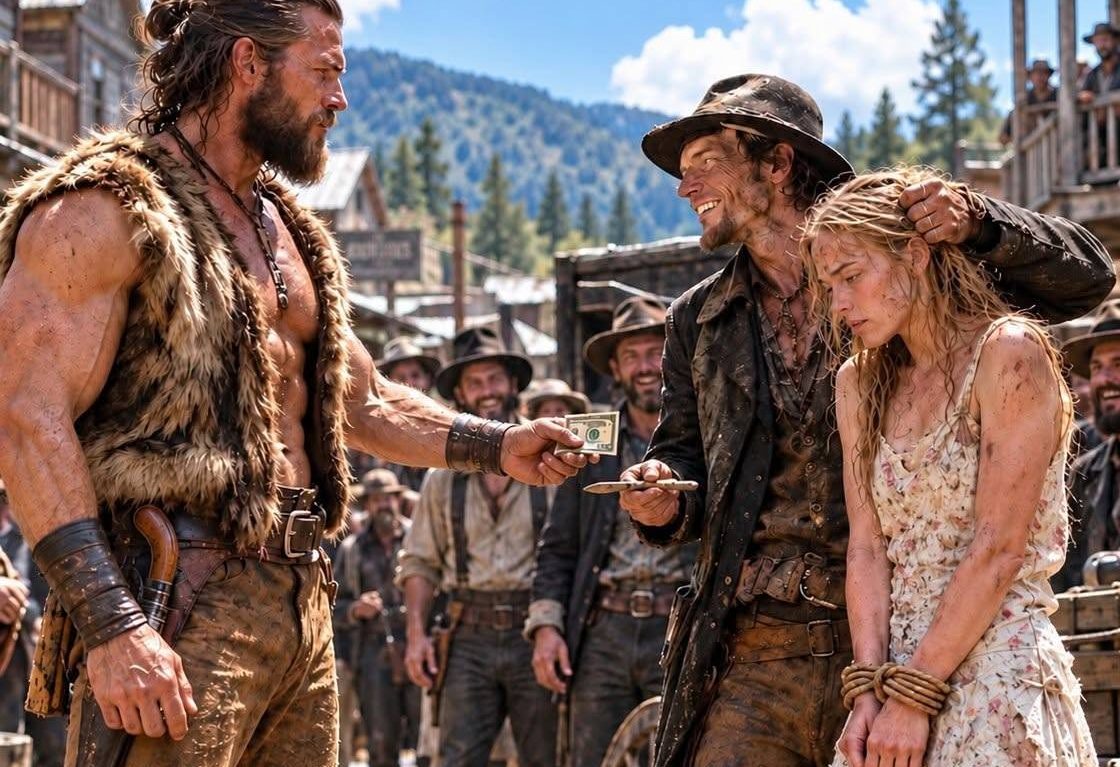
“No,” he said quietly. “I paid twenty dollars so that bastard would let go of the rope.”
For the first time since leaving Orofino, Cora began to cry.
Not loudly.
Not dramatically.
She simply folded forward, pressed both hands against her mouth, and shook.
Harlon turned away.
He had never been good at comforting people.
So he did the only thing he understood.
He put another log on the fire.
***
The first three days were difficult.
Cora woke before sunrise and cleaned everything she could reach.
She scrubbed the floor until her fingers cracked.
She washed Harlon’s shirts in water so cold it made her hands swell.
She apologized whenever she dropped something.
And every evening, she asked whether she had earned her supper.
On the fourth morning, Harlon found her standing outside in the snow without a coat.
She was chopping firewood.
The ax was almost too heavy for her to lift.
“What in God’s name are you doing?”
Cora flinched.
“Working.”
“Why?”
She looked confused.
“Because you fed me.”
Harlon took the ax from her hands.
“Inside.”
“But I haven’t finished.”
“Inside, Cora.”
She hurried toward the cabin, clearly expecting punishment.
Instead, Harlon followed her carrying an armful of wood.
He placed it beside the stove and pointed toward the chair.
“Sit.”
She sat.
“You want to help around here?”
She nodded quickly.
“Then you’ll help when you’re strong enough. Not because you’re afraid I won’t feed you.”
Cora lowered her eyes.
“And if I don’t work?”
Harlon rubbed his beard.
“Then you’ll still eat.”
She looked at him as though he had just told her the moon was made of silver.
***
A week later, Harlon discovered the biscuits.
Seven of them.
Hard as stones.
Hidden beneath a loose floorboard near Cora’s bed.
Beside them lay three pieces of dried venison, a small handful of beans, and half a potato.
He stood looking at the little collection.
Cora appeared in the doorway.
The moment she saw what he had found, all the color drained from her face.
“I wasn’t stealing.”
Harlon said nothing.
“I saved them from my own plate.”
Still he said nothing.
“I thought… if you changed your mind…”
Her voice broke.
Harlon knelt and carefully returned every scrap beneath the floorboard.
Then he replaced the plank.
“Keep them.”
Cora stared.
“You’re not angry?”
“No.”
“But it’s your food.”
Harlon rose.
“Not anymore.”
That evening, he built a second shelf beside the stove.
He filled it with flour, dried apples, beans, and two jars of preserved peaches.
Then he took a piece of charcoal and wrote a single word across the wood.
CORA.
“That’s yours,” he told her.
She touched the letters with her fingertips.
Nobody had ever given her a shelf before.
Nobody had ever given her anything that couldn’t be taken away.
***
By the second week, Cora began to speak.
Little things at first.
She liked the smell of pine after snowfall.
She hated the sound of horses screaming.
She knew how to mend leather, bake cornbread, and identify nearly every wild herb growing along the Missouri River.
And sometimes, when she thought Harlon wasn’t listening, she sang.
Softly.
A strange little lullaby about a bluebird finding its way home.
One evening, Harlon asked where she had learned it.
Cora’s expression changed.
“My mother sang it.”
“Where is she now?”
“Gone.”
Harlon didn’t press.
But Cora continued.
“My little sister used to sing it too.”
He remembered what she had said that first night.
Her father had sold her sister for ten dollars.
“What’s her name?”
Cora stared into the flames.
“Elsie.”
“How old?”
“She was eight when he took her away.”
Harlon felt something tighten inside his chest.
“And you haven’t seen her since?”
Cora shook her head.
“Three years.”
“Do you know who bought her?”
“A man named Silas Crowe. He said he was taking her west.”
Harlon’s hand stopped moving.
Silas Crowe.
He knew that name.
And he knew exactly why it made his blood run cold.
***
Twenty years earlier, before Harlon disappeared into the mountains, he had ridden with a territorial scouting party.
They had tracked horse thieves, escorted supply wagons, and hunted men who preyed on isolated settlements.
Silas Crowe had been one of those men.
A gambler.
A thief.
A trader in stolen horses and forged papers.
And according to rumors, something far worse.
Harlon had believed Crowe was buried somewhere outside Fort Benton.
Apparently, the devil had survived.
“Describe him,” Harlon said.
Cora frowned.
“Who?”
“The man who took Elsie.”
She swallowed.
“Thin. Gray eyes. A scar across his chin. He wore a silver ring shaped like a snake.”
Harlon stood so suddenly that his chair scraped across the floor.
Cora recoiled.
He immediately stopped.
“Sorry.”
She watched him carefully.
“You know him.”
Harlon didn’t answer.
“You know where my sister is?”
“I know where Crowe used to operate.”
Cora rose.
“Then we have to go.”
“No.”
The word came out harder than he intended.
Her face crumpled.
“Please.”
“Cora, the passes are buried. You wouldn’t survive two days in this weather.”
“Then I’ll go alone.”
Harlon stared at her.
She was trembling, but for the first time, there was something stronger than fear in her eyes.
Determination.
“She’s all I have,” Cora whispered.
Harlon looked toward the snow-covered mountains.
He had spent fifteen years avoiding other people’s troubles.
Now trouble was standing in his kitchen wearing his shirt.
And it had a little sister.
***
That night, Harlon couldn’t sleep.
He sat beside the dying stove, staring at an old leather satchel he hadn’t opened in years.
Inside were letters.
A faded photograph.
And a small blue ribbon.
He took the ribbon between his fingers.
His daughter had worn one just like it.
Maggie.
She had been seven years old when the fever came through their settlement.
His wife had fallen ill first.
Then Maggie.
Harlon had ridden thirty miles through a blizzard looking for a doctor.
By the time he returned, the cabin was silent.
He had buried them both beneath a cottonwood tree.
Afterward, he had sold the farm, abandoned the town, and disappeared into the mountains.
He had convinced himself that living alone meant never having to lose anyone again.
Then Cora had asked whether she needed to dig her own grave.
And something inside him had begun to break.
He looked down at Maggie’s ribbon.
“I’m sorry, little bird,” he whispered.
For fifteen years, he had believed he couldn’t save anyone.
Perhaps he had been wrong.
***
Three days later, the storm finally weakened.
Harlon saddled his horse before dawn.
Cora appeared in the doorway.
“Where are you going?”
“Down to Orofino.”
Her face went pale.
“Are you taking me back?”
Harlon turned.
“No.”
“Then why?”
“To ask some questions.”
“About Elsie?”
He nodded.
Cora stepped into the snow.
“I’m coming.”
“No, you’re not.”
“But—”
“Cora.”
He looked at her for a long moment.
“If I find your sister, I’ll bring her home.”
Cora’s eyes filled.
“You promise?”
Harlon hesitated.
He knew the danger of promises.
Then he reached into his coat and handed her something.
A small blue ribbon.
“That belonged to my daughter.”
Cora stared at it.
“You had a daughter?”
“Once.”
“What happened?”
Harlon’s jaw tightened.
“Winter took her.”
Cora looked down at the ribbon.
Then she gently placed it in her pocket.
“I’ll keep it safe.”
Harlon mounted his horse.
“Keep the stove burning. And don’t open the door for strangers.”
He rode away before she could see the tears gathering in his eyes.
***
Orofino was quieter when he returned.
But the trouble was still there.
Harlon found the rat-faced auctioneer drinking behind the livery stable.
The man grinned when he saw him.
“Well, mountain man! Tired of your purchase already?”
Harlon grabbed him by the collar and slammed him against the wall.
“Silas Crowe.”
The grin disappeared.
“What about him?”
“Where is he?”
“I don’t know any—”
Harlon pressed his forearm against the man’s throat.
“Try again.”
The auctioneer’s eyes widened.
“Mercy Creek! He’s got a place near Mercy Creek!”
Harlon loosened his grip.
“What kind of place?”
The man swallowed.
“A boarding house. That’s what he calls it.”
“And the children?”
Silence.
Harlon leaned closer.
“What children?”
The auctioneer began to shake.
“Crowe buys girls from families that can’t feed them. Says he’ll find them work.”
Harlon felt his stomach turn.
“Where do they go?”
“I don’t know.”
“You’re lying.”
“I swear!”
Then the man said something that made Harlon’s blood turn cold.
“Listen, mister. If you’re asking about the little blonde girl from Missouri, you might already be too late.”
Harlon froze.
“What did you say?”
The auctioneer licked his lips.
“Crowe had a girl named Elsie. Small thing. Sang all the time.”
Harlon’s grip tightened.
“Where is she?”
The man glanced toward the stable door.
Then whispered:
“He sold her again last month.”
“To whom?”
The auctioneer shook his head.
“Someone you don’t want to meet.”
Harlon drew his knife.
“Name.”
The man finally spoke.
And when Harlon heard it, the world seemed to stop.
Because the man who had bought little Elsie was the same man Harlon had spent fifteen years believing was dead.
His own younger brother.
Wade.