A Crack in the Skull, and a Grandmother at the Gate of Angkor
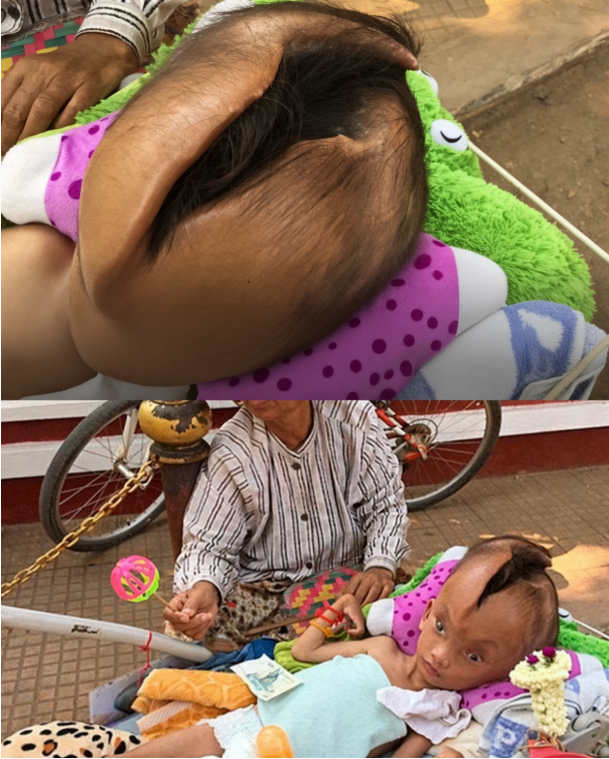
When Srey was seven months pregnant in Cambodia, doctors told her the baby’s head was not right. At three months they had said it was fine. Pheaktra Pov was born with a small crease on the crown. Local physicians sent the family home. The crease did not stay small. By the time he was six, in 2017, it ran from forehead to occiput, deep enough that his grandmother, Thorn Hong, said she could put her hand into the middle. The boy lived with his mother and grandmother; his father had left before the birth. Charities gave medicine to blunt seizures. Nothing closed the bone.
Thorn Hong, then sixty-seven, wheeled him to Angkor Wat on Fridays, Saturdays and Sundays. Tourists left dollars. She told reporters she collected ten to twenty-five dollars a week and that they prayed every day for someone, somewhere, who knew how to fix a skull that kept opening as the child grew. Photographs from those weekends show a wasted child on a padded cart, a floral garland, a rattle, an old woman on a mat beside a bicycle. The pictures travelled farther than the money. Tabloids called the defect a four-inch crack and left it at that. No published scan or operative note has surfaced in English to give it a precise name. It is not the typical Cambodian frontoethmoidal meningoencephalocele, a facial hernia of brain and membranes that surgical teaching programmes in Phnom Penh have learned to repair. It looks more like a catastrophic failure of the vault to form or to stay closed—an extreme calvarial cleft, perhaps with hydrocephalus earlier on. Thorn Hong recalled a time when the head seemed full of water and swelling. Without imaging, that remains a grandmother’s description, not a diagnosis.
Southeast Asia sees more anterior neural-tube and frontoethmoidal defects than Europe does. Folic acid, poverty, season and access to paediatric neurosurgery all play a part. A child with an open sagittal trough is still an outlier even there. Reconstructive options, if any existed, would have meant bone grafts or custom plates, infection risk, and a centre willing to take a malnourished six-year-old whose local doctors had already said they could do nothing. Whether that centre ever appeared is not recorded in later reliable reporting. The viral plea froze the family in 2017: a temple, a cart, a hand in a wound that should have been bone.
Hope in that setting is not a slogan. It is a weekend commute to a world heritage site, antiseizure syrup, and the belief that a surgeon on another continent might answer a photograph. Medicine can close many skulls. It cannot, by itself, close the distance between Siem Reap and an operating theatre that never called back.
Sources: Daily Mirror and Daily Mail reports, March 2017 (Viral Press interviews with Thorn Hong and Srey); syndicated 2017 coverage of Pheaktra Pov in Siem Reap; Journal of Neurosurgery: Pediatrics literature on frontoethmoidal meningoencephalocele programmes in Cambodia (context for regional craniofacial surgery, not a confirmed diagnosis of this child)