Love and Legacy: What the Viral Story of “Hussain El-Kerdi” Gets Wrong — and What Osteosarcoma Really Is
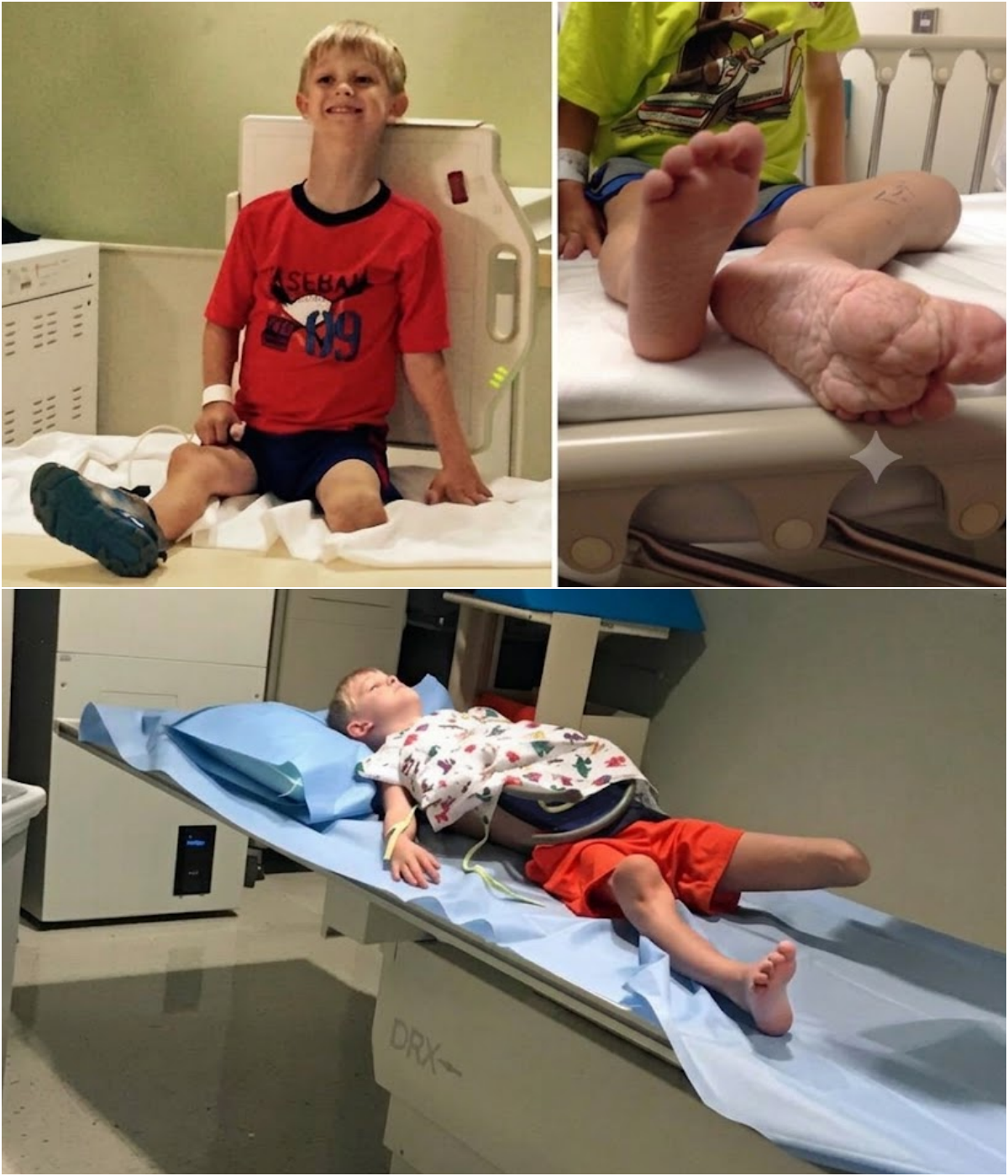
A Spanish-language post circulating with hospital photographs describes an 11-year-old British boy named Hussain El-Kerdi who developed a massive osteosarcoma in his left leg, underwent chemotherapy and amputation, later died, and whose parents then donated his body to scientific research.
That specific account does not match the public record.
The name that does appear in medical news is Hussein El Kerdi (also spelled El-Kerdi): a Lebanese infant diagnosed with ADA-SCID, or “bubble baby disease.” In 2015–2018 his family traveled from Lebanon to UCLA, where he received experimental stem-cell gene therapy developed by Dr. Donald Kohn. Reports from that period describe a child who was treated and lived, not an 11-year-old British cancer patient who died and was donated to science.
The photographs attached to the viral post show a fair-haired child on an imaging table, then sitting after what appears to be a below-knee amputation, and a close-up of severely damaged feet. Those images are consistent with a pediatric bone-cancer or reconstructive-surgery pathway. They are not documented as belonging to Hussein El Kerdi, and they should not be used to invent a death that has not been reported.
What is true, and worth stating clearly, is the disease the caption names.
Osteosarcoma is the most common primary bone cancer in children and teenagers. It usually starts near the growth plates of long bones — most often the distal femur or proximal tibia — and can first look like a sports bruise or a bump from a fall. Pain that does not fade, a growing lump, and a limp are typical early signs. Treatment is almost always a combination of chemotherapy and surgery. When the tumor cannot be removed with a safe margin, amputation is still sometimes required. Five-year survival for localized disease is now roughly in the 60–70 percent range; metastatic disease is far harder.
Whole-body donation after a child’s death is rare, tightly regulated, and almost never announced with the child’s full name and identifiable photos unless the family has chosen that publicity themselves. No major British or international outlet has published a verified obituary matching the viral caption.
Stories of children who fight bone cancer are real. So is the grief of families who lose them, and so is the value of research donation when it is freely chosen. Mixing a living child’s name, a set of unrelated hospital pictures, and an invented ending does not honor any of that. It only spreads a false death.
If the photographs belong to a real patient whose family wanted their story told, that story should be told under the correct name, with the family’s consent, and with the medical facts they actually lived — not a template pasted onto the wrong child.
Sources: UCLA Broad Stem Cell Research Center / PressReleasePoint report on Hussein El Kerdi and ADA-SCID gene therapy (2018); NCBI StatPearls and related clinical reviews of pediatric osteosarcoma; no matching verified news report was found for an 11-year-old British boy named Hussain El-Kerdi who died of osteosarcoma and whose body was donated to science.