THE BOY WHO WANTED A MEDAL FOR FINISHING LAST
**PART 1: **
The woman at the craft store asked if we sold blank medals.
Not trophies.
Not ribbons.
Medals.
I was working the closing shift at Craft Barn in Sioux City, Iowa, where the aisles smelled like cinnamon pinecones, hot glue, and whatever glitter gets into the air and stays there forever.
It was almost 8 p.m. when she came in.
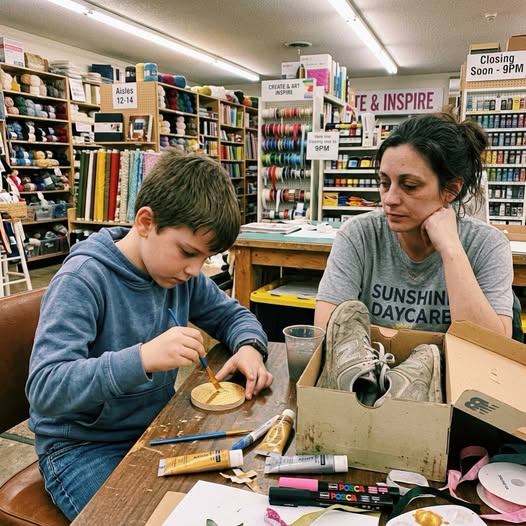
She was wearing a faded daycare T-shirt under a winter coat, with her hair pulled back in a loose ponytail and a phone charger hanging halfway out of her purse. A little boy followed her, maybe ten years old, carrying a shoebox against his chest.
He had one of those serious faces kids get when they are trying very hard not to ask for too much.
“Excuse me,” the woman said. “Do you have medals that don’t say anything yet?”
I pointed toward the party aisle.
“We have plastic award medals. Most say things like WINNER or CHAMP.”
She shook her head.
“I need one that’s blank.”
The boy looked down at the shoebox.
“It can say winner,” he said quietly.
His mother’s face tightened.
“No, baby. It needs to say what you want it to say.”
I led them to aisle nine.
There were cheap gold medals for birthday games, blue ribbons for science fairs, little trophy cups that leaned sideways even before anyone touched them. But every medal already had a word stamped on it.
SUPERSTAR.
CHAMPION.
FIRST PLACE.
The boy picked up FIRST PLACE and turned it over.
“This one’s okay,” he said.
His mother took it gently from him.
“You weren’t first place.”
The boy flinched.
She saw it and crouched down fast.
“I don’t mean it like that, Tyler. I mean your medal should tell the truth.”
He nodded, but his ears went red.
I pretended to straighten a pack of foam letters so he had a second to breathe.
“What kind of medal are you making?” I asked.
The mother stood.
“For a race.”
Tyler hugged the shoebox tighter.
“It was a mile,” he said. “At school.”
His mother nodded.
“He finished last.”
Tyler looked at the floor.
The mother’s voice softened.
“He finished after everyone had already gone back inside.”
That made me turn toward him.
He opened the shoebox.
Inside was one gray sneaker.
The sole had split near the toe. The laces were knotted in two places. A piece of duct tape circled the front like somebody had tried to keep it alive one more day.
“My shoe broke on the second lap,” Tyler said.
“He wanted to stop,” his mother said. “The gym teacher said he could. I said he could. But he kept walking.”
Tyler’s fingers moved over the box edge.
“Grandpa said Morris men finish what they start.”
The mother blinked hard.
“My dad passed in August,” she said. “He used to walk with Tyler every evening after dinner. Told him he was training him for something important.”
Tyler looked up.
“He said maybe not fast important. Just important.”
There are some sentences kids repeat because the person who said them is gone and they are afraid the words will disappear too.
That was one of them.
The mother looked back at the medals.
“The school gave medals to the first three kids. Tyler clapped for them. He really did. But when we got home, he put his shoe in this box and asked if Grandpa would still count it.”
Tyler whispered, “I just want one that says I finished.”
I looked at the shelf.
SUPERSTAR.
CHAMPION.
FIRST PLACE.
None of them were right.
“Come with me,” I said.
We walked to the wood aisle.
I found a small round wooden ornament, plain and smooth, with a tiny hole at the top. Then I grabbed gold paint, a black paint marker, and a spool of red-white-and-blue ribbon.
Tyler watched carefully.
“That’s not a medal.”
“Not yet.”
His mother checked the prices fast, the way people do when they are trying not to show fear in public.
The ornament was $1.29. The paint marker was $3.99. Ribbon was on clearance. Gold paint was more than she wanted it to be. I could see the math happening in her face.
“I can just use crayon at home,” she said.
I looked at Tyler.
He had already placed the FIRST PLACE medal back on the hook.
Not because he didn’t want one.
Because he knew his mother was counting.
I took the gold paint and marker to the register.
“We have a damaged-craft station in the back,” I said.
“We don’t need—”
“It’s for samples,” I lied.
Craft stores have many things.
A damaged-craft station was not one of them.
But we did have a break-room table with a paper towel roll, a sink, and one manager who had already mentally gone home.
I brought them back.
Tyler painted the wooden circle gold. Slowly. Carefully. His tongue stuck out at the corner of his mouth.
His mother sat beside him with the broken shoe box in her lap.
“What should it say?” I asked.
Tyler didn’t answer right away.
Then he said, “Still finished.”
I wrote the words on a scrap paper first.
STILL FINISHED.
He looked at them and nodded.
When the paint dried enough, I wrote it on the medal with the black marker.
The letters were not perfect.
Handmade things rarely are.
I threaded the ribbon through the hole and tied it off.
Then I handed it to Tyler.
He didn’t put it around his neck.
He placed it in the shoebox next to the broken sneaker.
**PART 2: THE MEDAL THAT SAID STILL FINISHED**
His mother looked confused.
“You don’t want to wear it?”
Tyler shook his head.
“I want Grandpa to see it first.”
The mother looked at me.
I looked away.
Some moments need somewhere to land.
At the register, she paid for the ornament and the clearance ribbon.
Not the paint.
Not the marker.
She noticed.
“I know what you did.”
I smiled.
“I don’t.”
She stared at me for a second, then let it go because dignity is also knowing when to accept the door someone opened without making them explain it.
Two days later, they came back.
Tyler was wearing the medal.
The ribbon sat crooked over his sweatshirt.
His mother had the shoebox under one arm.
She handed me a folded photo.
In it, Tyler stood at a cemetery beside a small headstone, wearing the homemade medal and holding the broken sneaker. His hand was raised like he was showing someone the words.
STILL FINISHED.
On the back, his mother had written:
He said Grandpa counted it.
I had to stand behind the counter for a minute and pretend to organize gift bags.
Tyler looked up at me.
“Can I show you something?”
He opened the shoebox.
Inside was the broken sneaker.
But now there was a note tucked inside it.
Blue ink. Grown-up handwriting. Shaky in places.
His mother said, “We found it in Dad’s tackle box.”
Tyler handed it to me.
It said:
Ty,
Fast is nice. Finishing is better. If I’m not there when you cross something hard, look down. I’ll be in your feet.
Grandpa
I read it twice because the first time my eyes would not behave.
Tyler took the note back carefully.
“I think he knew,” he said.
“Maybe he did.”
After that, we made a little basket near the register.
At first, it was just leftover ribbon and plain wooden circles.
Then someone added safety pins.
Someone else donated old race bibs from a 5K.
A teacher brought in stickers that said YOU DID HARD THINGS.
My manager rolled her eyes at first, then came in one morning with a label maker and made the basket official.
NOT FIRST. STILL WORTH CELEBRATING.
People started using it.
A teenage girl made a medal for passing her driving test on the fourth try.
A father made one for his son who spoke at a spelling bee even though he froze on the first word.
An elderly woman made one for herself after finishing physical therapy.
She wore it out of the store over her purple coat and told everyone in the parking lot, “I earned this walking sideways on a foam mat.”
Three months later, Tyler’s school called the store.
His gym teacher wanted to know who made the medal.
I thought maybe we were in trouble.
Instead, she came in and bought twenty-five wooden circles.
The next school mile, every child who crossed the finish line got one.
First place got one.
Last place got one.
Kids who ran got one.
Kids who walked got one.
One boy with asthma finished almost ten minutes after the others, and Tyler waited at the line for him.
When the boy crossed, Tyler put a medal around his neck and said, “Grandpa says it counts.”
The gym teacher sent us a picture.
Twenty-five kids standing on a cracked blacktop beside orange cones, holding wooden medals that said:
I FINISHED.
Tyler was in the back row.
Smiling like someone had given him more than a medal.
Like someone had given his grandfather’s words a place to keep walking.
I taped that picture behind the register.
Right beside the first photo of Tyler at the cemetery.
Because sometimes a medal is not about winning.
Sometimes it is about refusing to quit with one broken shoe and a heart full of somebody’s voice.
And sometimes the kindest thing you can do for a child is help them name the victory nobody else thought to count.