THE GIRL WHO BROUGHT HER FATHER’S CASSETTE TAPES TO THE RADIO STATION
**PART 1: **
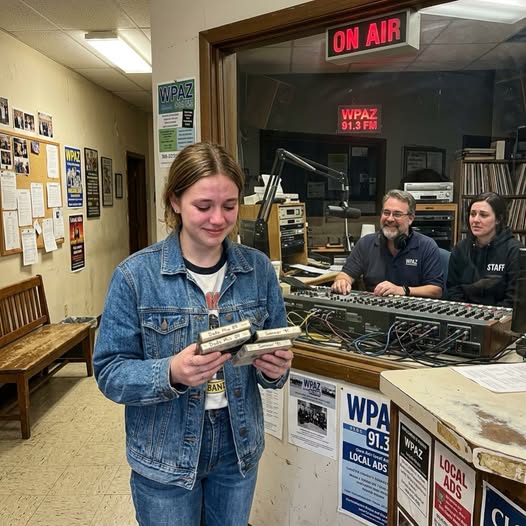
The teenage girl came into the small-town radio station carrying a shoebox full of cassette tapes.
Not records.
Not CDs.
Cassettes.
I worked the afternoon board at WPKR, a tiny station in western Pennsylvania that played old country in the morning, high school football on Friday nights, church announcements on Sundays, and whatever local businesses paid us twenty dollars to promote between weather updates. The carpet was older than most interns. The coffee machine made sounds like it was trying to leave this world. Half the callers still began with, “Am I on the air?”
The girl stood in the lobby like she had rehearsed walking in but not what came after.
She was maybe seventeen, with a denim jacket, chipped black nail polish, and a tired backpack hanging off one shoulder. The shoebox in her hands was wrapped with a rubber band. On the lid, someone had written in faded marker:
**Dad’s driving tapes.**
Our receptionist, Barb, looked over her glasses.
“Can we help you, honey?”
The girl swallowed.
“I need to play one song on the radio.”
Barb smiled kindly. “You mean request one?”
“No,” the girl said. “I mean from this.”
She set the shoebox on the counter and opened it.
Inside were old cassette tapes, each labeled in blue pen. **Truck Mix 2009. Rain Songs. Sunday Roads. For Emma when she gets older.**
That last one made her look away.
“My name’s Emma,” she said.
I came out from the studio because I had heard enough to know this was not a regular request.
Emma explained that her father, Dale, had driven a snowplow for the county in winter and a dump truck in summer. He made cassette mixes for every season because he hated silence in a cab. Even after phones and Bluetooth and all that, he kept an old tape deck in his truck because, according to Emma, “new things had too many opinions.”
“He died last year,” she said. “Heart attack. At the yard. They said it was quick.”
The way she said quick told me people had been offering that word to her like it helped more than it did.
She picked up one tape from the box.
**For Emma when she gets older.**
“I turned eighteen tomorrow,” she said. “I found this in his toolbox.”
Barb put one hand to her chest.
Emma kept going because sometimes stopping is harder.
“There’s a song on it he used to sing badly when I was little. He’d put me in the passenger seat when he plowed the church lot, and I’d pretend I was helping by yelling at snowbanks. He told me when I got my license, he’d play it on the radio and embarrass me.”
She looked toward the studio window.
“He didn’t get to.”
Our station still had a cassette deck.
Barely.
It sat under the counter in production room two, mostly because nobody wanted to be the person who threw it away. The buttons stuck. The left speaker crackled. The last time we used it, it ate a tape from a polka band and Barb said that was probably mercy.
I told Emma, “We can try.”
She handed me the cassette like it was a newborn.
The tape squeaked when I placed it in the deck. I pressed play.
Nothing.
Then a hiss.
Then a little warble.
Then a man’s voice came through, low and rough and close, like he was sitting right there with us.
“Testing, testing. Emma Jean, if this thing still works when you’re old enough to hear it, your dad is officially smarter than your uncle Ray.”
Emma made a sound and covered her mouth.
The tape kept rolling.
“Okay,” the voice said. “You’re probably rolling your eyes already. That’s fine. You get that from your mother. I made you this because one day you’ll be driving around acting grown, and I want you to remember a few things. Number one, keep a blanket in your trunk. Number two, don’t trust a man who’s mean to waitresses. Number three, if you’re lost, pull over before you cry. Crying while driving is how mailboxes get hurt.”
Barb laughed and cried at the same time.
Emma stood perfectly still.
Then Dale’s voice softened.
“And number four, when you hear this song, know I loved you before you could even say snowplow.”
The song began.
It was an old country song I won’t name, but everyone in that station knew it. The kind of song fathers sing wrong with the windows down. The kind daughters pretend to hate until the day they would give anything to hear it badly one more time.
Emma pressed both hands over her face.
I stopped the tape.
“No,” she said quickly. “Don’t stop it.”
So I let it play.
When it ended, she wiped her cheeks with her sleeve.
“Can that go on the air?”
I looked at the clock.
We had the 3:40 weather, then an ad for a feed store, then two songs scheduled. Nothing that couldn’t move.
But stations have rules. Licensing. Logs. Timing. Management.
Barb looked at me.
I looked at Barb.
Then I said, “Your dad ever listen around this time?”
Emma nodded.
“Every day. In the truck.”
That was enough for Barb.
She marched into the studio, took the ad log off the clipboard, and said, “The feed store can wait four minutes. Cows don’t wear watches.”
At 3:43, I turned on the mic.
“This next one is going out to Emma Jean, who turns eighteen tomorrow. It comes from her dad, Dale, who knew a good song, gave solid advice, and apparently had strong opinions about trunk blankets.”
Emma laughed through tears from the other side of the glass.
I cued the tape.
The hiss went out over the air.
Then Dale’s voice.
Not the whole message. Just the part Emma nodded yes to.
“Emma Jean… when you hear this song, know I loved you before you could even say snowplow.”
Then the song played.
For four minutes, that tiny radio station became a bridge.
Between a county truck and a teenage girl.
Between a promise made beside snowbanks and a birthday her father missed.
Between grief and every kitchen, garage, feed store, pickup, and nursing home radio tuned to WPKR that afternoon.
The phone lines lit up before the song even ended.
Barb answered the first call.
It was a man from the road crew.
“I knew Dale,” he said. “Tell his girl he kept extra gloves for everybody and complained if you thanked him.”
The next caller was a waitress from the diner off Route 22.
“Dale tipped two dollars on coffee even when coffee was ninety-nine cents,” she said. “He was good people.”
Then a woman from the church.
Then a mechanic.
Then a school bus driver.
People who had known her father in tiny ways started calling in with pieces of him.
He cleared snow from the senior center before sunrise.
He carried jumper cables.
He whistled badly.
He once rescued a beagle from a culvert and called it “sir” the whole time.
Emma sat in the lobby listening while strangers returned her father to her one small memory at a time.
At 4:30, a county snowplow pulled into the station parking lot.
Then another.
Then three more.
By five o’clock, six orange county trucks were lined up outside WPKR, engines rumbling softly in the cold. Men and women in reflective jackets came in stamping snow from their boots, each one holding something.
A thermos Dale had left in a truck.
A photo from a Christmas party.
A faded ball cap with the county logo.
One man, older and broad-shouldered, handed Emma a pair of work gloves.
“He kept these in his cab for you,” he said. “Said when you finally learned to drive stick, you’d need them.”
Emma took them like they were made of gold.
“I don’t know how,” she whispered.
The man smiled.
“Then we’ll teach you.”
**PART 2: THE BIRTHDAY SONG THAT BROUGHT A WHOLE TOWN TO THE RADIO**
On her birthday, the road crew came back.
They brought one of the county trucks to the empty fairgrounds lot after getting permission from every person who needed to say yes. Emma sat behind the wheel wearing Dale’s gloves while three grown men argued over the safest way to explain a clutch. She stalled it twelve times. Maybe fifteen. Nobody counted out loud.
When she finally got the truck moving in a slow, jerky circle, everyone cheered like she had won Daytona.
Emma cried.
Then she laughed.
Then she turned on the old tape deck they had rigged up just for that day.
Dale’s song crackled through the cab.
Not perfect.
Better than perfect.
Alive in the way old sound can be alive when love has nowhere else to go.
A week later, Emma came back to the station with a thank-you note.
On the front, she had taped a photo of herself sitting in the county truck, both hands on the wheel, her father’s gloves too big on her fingers.
Inside she wrote:
**I thought I only had a tape. Turns out I had a whole town that remembered him.**
We pinned it next to the broadcast board.
It stayed there through spring storms, summer parades, football season, and the first snow that made everybody call in to complain about roads Dale used to clear before they woke up.
I still think about that cassette.
How close it came to sitting in a toolbox forever.
How a father’s rough voice crossed time on a strip of brown tape.
How an old radio station with bad coffee and a stubborn cassette deck gave a girl four minutes with her dad, and somehow the whole town heard themselves in it too.
People say voices fade after someone dies.
Maybe some do.
But not all.
Some wait in shoeboxes.
Some wait in old trucks.
Some wait for a daughter to get brave enough to press play.
And when they finally come through the static, they remind everybody listening that love does not need perfect signal.
Sometimes it only needs one old tape, one small station, and a town quiet enough to hear.