THE MAN WHO WANTED TO LAMINATE HIS WIFE’S LAST GROCERY LIST
**PART 1: **
The man at the small-town print shop asked if we could laminate a grocery list.
Not a photo.
Not a certificate.
A grocery list.
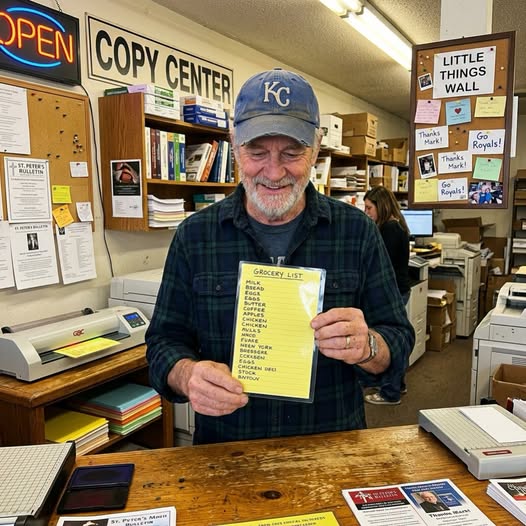
I was working the counter at Miller Copy & Print in Topeka, Kansas, where half our business came from church bulletins, lost-dog flyers, and people who waited until ten minutes before closing to print something “real quick.”
He came in on a Thursday afternoon wearing a faded Royals cap, a denim jacket, and work pants with drywall dust on one knee. He was maybe sixty, maybe younger in the way grief can make a person look older without asking permission.
In his hand was a folded piece of yellow notebook paper.
He held it carefully.
Too carefully for a grocery list.
“Can you laminate this?” he asked.
“Sure,” I said. “Letter size?”
He looked confused.
“I don’t know. Just… whatever keeps it from tearing.”
He unfolded the paper on the counter.
It was a list written in blue ink.
Milk
Eggs
Bananas
Coffee
Dog food
Tom’s cereal
Don’t forget stamps
The handwriting leaned slightly to the right. The word bananas had been crossed out and rewritten because someone had started with two n’s.
At the bottom, in smaller letters, it said:
Love you. Drive safe.
I looked up.
The man was staring at the paper, not me.
“My wife wrote it,” he said, before I asked anything.
I nodded.
“She’s in memory care now.”
The copy machines hummed behind me. A woman at the self-serve station was fighting with the stapler. Outside, a school bus hissed to a stop at the corner.
The man ran one finger near the words, not touching them.
“Her name is Patty. She wrote me a grocery list every Friday for thirty-four years. Even when I told her I didn’t need one.”
He gave a soft laugh.
“I always needed one.”
I smiled a little.
He kept going.
“She doesn’t write much anymore. Some days she knows me. Some days she asks if I’m the man fixing the sink.”
His mouth pulled tight.
“Last week, she had a good morning. Asked me if I was going to the store. I said maybe. She took the nurse’s notebook and wrote this.”
He tapped the page.
“First time she wrote my name in almost a year.”
I looked again.
Tom’s cereal.
Not cereal.
Tom’s cereal.
His name was on the list.
That was why he had brought it in like glass.
“I can laminate it,” I said gently.
He nodded too fast.
“I want to put it on the fridge.”
Then he added, quieter, “She used to say a house without a list on the fridge looked like nobody lived there.”
I took the paper and placed it in a laminating sleeve.
He watched every second.
When I fed it through the machine, he stepped closer like the rollers might swallow it wrong.
The warm plastic came out smooth and shiny.
I trimmed the edges.
He picked it up with both hands.
For a long moment, he just looked at it.
Then his face folded.
Not loud. Not dramatic.
Just one hand over his eyes, shoulders shaking once.
“I’m sorry,” he said.
“Don’t be.”
He nodded, but he didn’t move.
“There’s nobody at home to show it to,” he said.
That sentence was so quiet I almost missed it.
I thought of the list on his fridge.
Milk. Eggs. Dog food. Love you. Drive safe.
A whole marriage reduced to errands and handwriting.
A whole home waiting for a woman who was still alive but not fully there.
“Do you want another copy?” I asked.
He looked up.
“For what?”
“For her room.”
He stared at me.
“In case she wants to see it too.”
He looked back at the laminated list.
“She won’t know.”
“Maybe not.”
I reached for the copier.
“But maybe she will.”
He stood very still.
Then he nodded.
I made three copies.
One laminated for his fridge. One laminated for Patty’s room. One plain paper copy folded neatly, because sometimes plastic makes memories feel too far away.
When I rang him up, he reached for his wallet.
I charged him for one laminate.
He saw the receipt.
“You did more than one.”
“I know.”
“That’s not right.”
“It is today.”
He frowned.
“My Patty would say people should pay for what they use.”
“My grandma would say sometimes a store can afford to be decent.”
That almost made him smile.
He tucked the lists into a cardboard mailer and left.
**PART 2: THE GROCERY LISTS THAT FILLED AN ENTIRE WALL OF LOVE**
I thought that was the end of it.
But the next Monday, he came back.
Same Royals cap. Same denim jacket. Different expression.
He placed a small paper bag on the counter.
Inside was a box of cereal.
Tom’s cereal.
Honey Nut Cheerios.
“She remembered,” he said.
I looked at him.
His eyes were bright.
“I taped the list on her wall. She looked at it for maybe ten seconds, then said, ‘Tom, why didn’t you buy your cereal?’”
He laughed once.
Then he cried.
Right there between the business cards and the passport-photo backdrop.
“She knew me for about five minutes,” he said. “Five whole minutes.”
I didn’t know what to say, so I said the truth.
“That’s a long time when you miss somebody.”
He nodded hard.
Then he pushed the cereal box toward me.
“Patty said I should bring you some.”
I smiled.
“She told you that?”
“No,” he said. “But she would have.”
That became his thing.
Every few weeks, Tom brought in something from the list.
Bananas.
A book of stamps.
A small carton of eggs once, which we had to keep in the break-room fridge because Marcy from accounting said salmonella was not part of customer service.
And every time, he had a new story.
“Patty asked if the dog had eaten.”
“Patty told me I was buying the wrong coffee.”
“Patty said I looked tired and should sit down.”
Tiny moments.
Tiny returns.
Each one no bigger than a grocery item.
Each one worth more than anything we printed in that shop.
One afternoon in November, Tom came in without his cap.
I knew before he spoke.
People look different when the waiting is over.
He held another folded paper.
Not yellow notebook paper this time.
White stationery from the care home.
“She passed Sunday,” he said.
The shop went soft around the edges.
“I’m so sorry.”
He nodded.
“She had a good day Saturday.”
He unfolded the paper.
It was shaky handwriting. Almost unreadable in places.
But there were words.
Tom
milk
coffee
home
At the bottom, after a long empty space, she had written:
drive safe
Tom touched that last line.
“Nurse found it on her tray after dinner.”
I had to look away.
The woman at the self-serve printer stopped pressing buttons. Marcy from accounting came out of the back and stood beside me without saying anything.
Tom cleared his throat.
“I need this one laminated too.”
“Of course.”
This time, when I fed the paper through the laminator, nobody in the shop pretended not to watch.
The machine hummed.
The plastic sealed.
The paper came out warm.
Tom held it against his chest.
“I’m putting this one by the door,” he said. “So it’s the last thing I see when I leave.”
A week later, after the funeral, Tom came back with a cardboard box.
Inside were old grocery lists.
Dozens of them.
Maybe hundreds.
Some on notebook paper. Some on envelopes. Some on the backs of receipts. Some written in Patty’s careful younger hand. Some shaky near the end.
He set the box on the counter.
“I don’t know what to do with them.”
I looked through the top few.
Hamburger buns. Pickles. Light bulbs. Call your sister. Anniversary card. Batteries. Don’t buy cheap paper towels.
Every list was ordinary.
Every list was a love letter pretending to be practical.
“What do you want them to do?” I asked.
Tom thought about that for a long time.
Then he said, “Help somebody remember they were loved.”
So we made a wall.
Not a big wall. Just the blank space by the self-serve copier where people usually taped complaints about paper jams.
We called it:
THE LITTLE THINGS WALL.
Tom picked the first list.
Milk
Eggs
Bananas
Coffee
Dog food
Tom’s cereal
Don’t forget stamps
Love you. Drive safe.
We placed it in a simple frame.
Under it, Tom wrote:
Patty always sent me out with a list. I thought she was reminding me what to buy. Turns out she was reminding me I had someone waiting for me.
People started reading it while their copies printed.
Some smiled.
Some cried.
Some took pictures.
Then people began bringing their own little things.
A sticky note that said, “Take your medicine, Dad.”
A lunchbox napkin with a heart drawn in red marker.
A receipt with “I’m proud of you” written on the back.
A school note from a child that said, “Mom, we are out of waffles.”
Nothing fancy.
Everything sacred.
Tom still comes in on Fridays.
He doesn’t always bring something.
Sometimes he just stands by the wall and reads Patty’s list like it might tell him what to do next.
One Friday, I saw him touch the frame lightly.
Then he smiled.
Not a big smile.
Just enough.
Before he left, he turned back and said, “I bought the good paper towels today.”
I laughed.
“So Patty won?”
He nodded.
“Patty always won.”
After he walked out, I looked at the list again.
Milk. Eggs. Bananas. Coffee.
The kind of words most of us throw away without thinking.
But that job taught me something I never forgot.
Love is not always roses, speeches, or grand gestures.
Sometimes love is knowing which cereal belongs to someone.
Sometimes it is writing “drive safe” at the bottom of a list because the world is big and roads are dangerous and you need your person to come back.
And sometimes the most ordinary piece of paper in the house becomes proof that somebody was waiting for you.