THE MAN WHO ORDERED TWO COFFEES EVERY THURSDAY FOR HIS WIFE WHO WAS NO LONGER THERE
**PART 1: **
The man came into the diner every Thursday at 6:10 and ordered two cups of coffee.
One black.
One with cream and two sugars.
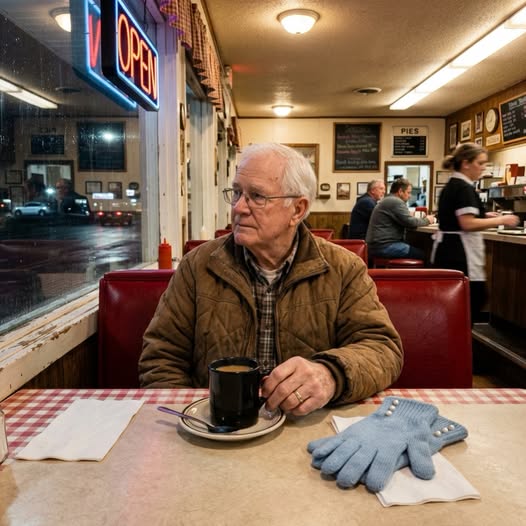
He always sat in the same booth by the window, the one with the cracked red vinyl seat and the view of the gas station across the street. He wore a brown work jacket no matter the weather, folded his napkin into a neat square, and placed the second coffee across from him like somebody was running late.
Nobody asked about it at first.
In a small diner, you learn what to notice and what to leave alone.
My name is Marlene. I’m sixty-three years old, and I’ve worked the evening shift at Rosie’s Diner in western Pennsylvania for almost twenty years. I’ve seen truckers cry into meatloaf, teenagers count coins for milkshakes, and married couples sit through whole dinners without saying a word.
So a quiet old man with two coffees didn’t seem like the strangest thing in the world.
His name was Mr. Callahan. I learned that from his credit card receipt. First name Arthur. He tipped exactly three dollars every time, even if all he ordered was coffee and toast.
The second cup always went cold.
After about a month, I started bringing it without him asking.
“One black,” I’d say, setting it in front of him. “One cream and two sugars.”
He’d look up and nod. “Thank you, ma’am.”
“Call me Marlene,” I told him once.
He smiled politely, but he never did.
He came in through September. Then October. Then most of November. Always Thursday. Always 6:10. Always two coffees.
On Thanksgiving week, the diner was half-empty and smelling like turkey gravy and burnt pie crust. Arthur came in wearing his brown jacket, but this time he had a small paper bag in his hand.
He sat down, took something from the bag, and placed it on the table across from him.
A pair of blue gloves.
Women’s gloves. Soft-looking. The kind with little pearl buttons at the wrist.
I stood behind the counter pretending to wipe the same spot over and over.
After a while, I brought the coffees.
Arthur looked at the gloves, then at the cup across from him.
“My wife hated cold hands,” he said.
It was the first personal thing he had ever told me.
I didn’t move.
“She used to sit right there,” he said, nodding to the empty side of the booth. “Every Thursday after her arthritis class. We’d meet here because she said this place made better toast than any restaurant had a right to.”
I smiled a little. “She was correct.”
He laughed softly, but it didn’t last.
“Her name was Elaine,” he said. “She died in August.”
I looked at the second coffee.
“I’m sorry.”
He nodded once, like he had heard those words too many times and didn’t know where to put any more of them.
“She liked cream and two sugars,” he said. “Said black coffee tasted like punishment.”
That made me laugh before I could stop myself.
Arthur smiled then. A real one. Small, but real.
After that, he talked a little more each week.
Not much.
Just pieces.
Elaine used to steal the pickle from his plate. Elaine sang too loud in church. Elaine kept coupons she never used because throwing them away felt “financially disrespectful.” Elaine had once backed their Buick into their own mailbox and blamed the mailbox for being “poorly placed.”
Every Thursday, the second coffee went cold.
And every Thursday, Arthur sat a little longer.
Then, one Thursday in January, he didn’t come.
I told myself roads were icy.
The next Thursday, he didn’t come again.
By the third Thursday, I was worried enough to do something stupid.
I still had one of his old receipts under the register. Arthur Callahan. The last four digits of his card. No phone number. No address.
But small towns have their own search engines.
I asked Doreen, who works breakfast and knows everybody’s cousin. She said there was an Arthur Callahan who lived in the brick duplex behind St. Mark’s.
So after my shift, I drove over with a container of chicken noodle soup, two slices of apple pie, and the blue gloves he’d left behind the last time he came.
I almost turned around twice.
It felt nosy.
It felt like too much.
Then I thought about that empty coffee cup and knocked anyway.
It took a long time for him to answer.
When he opened the door, he looked smaller than he had in the booth. Same brown jacket, but no shoes. Just socks. His face was pale, and the house behind him was dark except for the kitchen light.
“Marlene?” he said, like my name surprised him.
That was the first time he used it.
“You forgot these,” I said, holding up the gloves.
He looked at them and his face changed.
Not dramatically. Not like in movies.
It just folded in on itself for one second.
“Oh,” he whispered. “I wondered where they went.”
I handed him the soup too.
He stared at it.
“I’m not hungry much lately,” he said.
“I didn’t ask if you were hungry,” I told him. “I brought soup.”
That made him laugh, but his eyes were wet.
He stepped aside.
His kitchen was tidy in the way lonely kitchens get tidy. One plate in the drying rack. One mug by the sink. A calendar still turned to December. On the table was a stack of unopened mail and a framed photo of a woman with silver hair and bright red lipstick, laughing at something just outside the picture.
Elaine.
I put the soup in a pot and found two bowls without asking.
Arthur sat at the table holding the blue gloves in both hands.
“She wore these the last time we went to Rosie’s,” he said. “She kept saying her fingers were cold, but she wouldn’t let me turn the car heat up because she said it made her hair flat.”
I set a bowl in front of him.
He took one spoonful.
Then another.
Then he covered his face with one hand and cried so quietly it hurt worse than loud crying.
I didn’t touch his shoulder. I didn’t tell him it would get better. People say that because silence scares them.
I just sat across from him and let the soup steam between us.
**PART 2: THE BOOTH THAT BECAME ELAINE’S**
After a while, he said, “Thursday was our day.”
“I know,” I said.
He looked at me.
“You noticed?”
“Arthur,” I said, “you ordered her coffee for five months.”
He nodded slowly, still holding the gloves.
“I thought if I stopped ordering it, that meant I was leaving her behind.”
There it was.
The thing grief does.
It turns coffee into loyalty. Gloves into proof. An empty booth into a promise you don’t know how to break.
“You’re not leaving her behind,” I said. “You’re learning how to bring her with you differently.”
He looked down at the soup.
“I don’t know how.”
“Neither does anybody,” I said. “We just start with dinner.”
After that, Arthur came back to the diner.
But something changed.
The first Thursday in February, he ordered one coffee.
Black.
I didn’t say anything.
I just poured it and set down a small plate with two slices of toast.
He looked at the empty side of the booth.
Then he reached into his jacket pocket and took out Elaine’s blue gloves. He placed them across from him, beside the napkin dispenser.
Not like a person was missing.
More like a person was remembered.
A few weeks later, he came in and asked if the booth was taken.
It wasn’t.
But a young woman was standing near the door with a little boy hiding behind her coat. She looked exhausted. The boy had a backpack with a broken zipper and one shoe untied.
Arthur noticed them before I did.
“Ma’am,” he said, standing slowly. “You and the boy take the booth. I can sit at the counter.”
The woman started to refuse.
Arthur shook his head.
“My wife would haunt me if I let a child stand while I sat,” he said.
The little boy giggled.
Arthur sat at the counter that night.
Then the next week, he did it again for a tired truck driver.
Then for an older couple.
Then for a nurse who came in after a double shift and looked like she might fall asleep standing up.
He started calling it Elaine’s booth.
Not officially.
Just quietly.
If somebody looked like they needed a soft place to sit, Arthur would tap the table and say, “You take Elaine’s booth tonight.”
By spring, everyone knew.
Doreen knew. The cooks knew. The regulars knew.
Sometimes people left notes tucked behind the sugar holder.
Thank you.
Needed this today.
Your wife must have been lovely.
Best toast in town.
Arthur read every one.
He kept them in a cigar box he brought with him on Thursdays.
Last week, he came in at 6:10, same brown jacket, same careful walk. I brought him one black coffee. He reached into his pocket and pulled out the blue gloves.
But this time, he handed them to me.
“I think Elaine would want these somewhere useful,” he said.
I didn’t know what to say.
So I put them on the shelf behind the register, next to the extra straws and the bell we ring when someone leaves a ridiculous tip.
Now they stay there.
A pair of blue gloves with pearl buttons.
Most people don’t notice them.
But I do.
Arthur does too.
And every Thursday, when somebody tired or grieving or lonely walks into Rosie’s Diner, we try to give them Elaine’s booth.
Because sometimes love looks like two coffees.
Sometimes grief looks like one cup going cold.
And sometimes healing starts when somebody finally notices the empty seat across from you and doesn’t look away.
Not every person needs advice.
Not every person needs saving.
Some people just need soup.
Some need toast.
Some need a booth by the window where their sadness can sit down for a while.
And some need to hear their person’s name spoken out loud again.
Elaine.
Her name was Elaine.
And because Arthur loved her well, strangers are still being cared for in her seat.
Every Thursday at 6:10.