PART 2 — FULL ENDING THE TWO BABIES WHO GAVE A GRIEVING MOTHER A REASON TO LIVE AGAIN
Graham Rowe had buried his wife six weeks earlier.
Clara Bell had buried her daughter three days ago.
Neither of them knew that the night she stepped through his farmhouse door, three broken hearts were about to begin healing.
But before the winter ended, Clara would face a choice that could cost her the only family she had left.
And Graham would discover that saving his children was not the same as learning how to love again.
The first thing Clara noticed inside Willow Bend Ranch was the silence between the babies’ cries.
It was the kind of silence that frightened her.
The smaller twin lay against Graham’s chest, her tiny mouth moving without strength. Her brother screamed in his father’s other arm, his face red from hunger.
“What are their names?” Clara asked.
“Thomas and Lily.”
“Which one is Lily?”
Graham looked down at the quiet infant.
“Her.”
Clara set her small bag beside the door.
“Please warm some water. And bring me a clean cloth.”
Graham hesitated.
“Are you certain?”
She looked at the little girl.
“No. But I’m here.”
He led her into a sitting room where a fire had burned almost to ashes. A cradle stood beside the hearth. Two small blankets hung over its wooden rail.
On the mantel sat a woman’s photograph.
She was smiling.
Clara looked away.
Graham placed Lily carefully in her arms.
The baby weighed almost nothing.
Clara sat in the rocking chair and loosened the front of her dress beneath her shawl.
Her hands trembled.
Three nights earlier, she had held Rose against her breast in a room that smelled of blood, lavender soap, and fresh linen.
Now another newborn searched weakly against her skin.
“Come on, sweetheart,” Clara whispered. “Just a little.”
Lily’s mouth opened.
Then closed.
Clara adjusted her gently.
For one terrible moment, nothing happened.
Then the baby latched.
Clara felt the first small pull.
And she began to cry.
She had spent three days wishing her body would understand that Rose was gone.
Now, for the first time, she was grateful that it hadn’t.
Graham stood beside the fireplace, holding Thomas.
He watched his daughter feed.
Then he turned his face toward the wall.
Clara heard him struggling to breathe evenly.
Neither spoke.
When Lily had taken what she could, Clara wrapped her warmly and reached for Thomas.
The boy latched immediately.
His desperate crying softened into hungry little gulps.
Graham lowered himself into the chair opposite her.
For several minutes, he simply watched.
Then he said, “I thought I was going to lose them both tonight.”
Clara looked at the twins.
“You haven’t.”
He rubbed his face with both hands.
“I don’t know what I’m doing.”
“Neither do I.”
He looked up.
She gave him a tired, trembling smile.
“But I suppose we can learn.”
That was how their first night began.
Not with romance.
Not with promises.
Only two exhausted strangers keeping watch over two newborn babies while snow gathered against the farmhouse windows.
By sunrise, Lily had managed two more small feedings.
Thomas was sleeping with his fist pressed against his cheek.
Graham had not slept at all.
Clara found him standing in the kitchen, staring at a kettle as though he had forgotten why he had put it on the stove.
“You should rest,” she said.
He shook his head.
“They might need something.”
“They will. And you won’t be much use if you collapse.”
He looked at her.
“When did you last sleep?”
Clara considered the question.
She couldn’t remember.
That made him smile for the first time.
“Seems neither of us is qualified to give advice.”
She almost laughed.
Almost.
Instead, she poured him a cup of coffee.
By noon, Graham had brought fresh firewood inside, heated water, and found clean blankets.
Clara had fed the twins again.
Lily still worried her. The little girl was weak, and Clara knew that milk alone could not guarantee her survival.
“Send for the doctor,” she told Graham. “Tell him she’s feeding, but she needs examining.”
Graham saddled his horse immediately.
Before leaving, he stopped at the doorway.
“Mrs. Bell?”
“Yes?”
“You saved them.”
Clara looked down at Lily.
“Not yet.”
Then she added quietly, “Please hurry.”
Dr. Whitcomb arrived shortly before dusk.
He was an elderly man with silver spectacles and a medical bag worn smooth at the corners.
He examined both children carefully.
Thomas protested loudly.
Lily barely stirred.
The doctor listened to her breathing, checked her temperature, and watched Clara feed her.
“She’s terribly depleted,” he said. “But she’s swallowing. That’s encouraging.”
Graham gripped the back of a chair.
“Will she live?”
The doctor removed his spectacles.
“I cannot promise you that. Keep her warm, feed her frequently if she’s able, and wake me if her breathing worsens.”
He turned toward Clara.
“And you, young woman, need care yourself. You gave birth only days ago.”
Clara lowered her eyes.
“I’m managing.”
“Managing is not the same as healing.”
After the doctor left, Graham brought Clara a bowl of hot stew and placed it beside her chair.
She stared at it.
“I haven’t earned this.”
His expression changed.
“Mrs. Bell, you have fed my children all day.”
“I meant—”
“I know what you meant.”
He pulled a chair closer.
“You’re not here as a beggar.”
Clara looked at him.
“Then what am I?”
Graham glanced toward the cradle.
“Someone this house desperately needed.”
That evening, he offered her the bedroom across from the nursery.
He told her she could stay as long as she wished.
He would pay her fairly, provide meals, and make certain she had everything she needed.
Clara accepted.
But when she entered the bedroom, she found a neatly folded quilt at the foot of the bed.
It was pale yellow, stitched with tiny blue flowers.
She touched the fabric.
Then she noticed a small embroidered letter in one corner.
E.
Evelyn.
Clara stood motionless.
This had been Graham’s wife’s room.
She stepped back into the hallway.
“Graham?”
He appeared from the nursery.
“Is something wrong?”
“This room belonged to your wife.”
He looked past her.
For a moment, his face seemed to lose all its strength.
“Yes.”
“I can’t sleep here.”
He swallowed.
“I should have thought of that.”
He moved the quilt gently from the bed.
“There’s another room downstairs. I’ll prepare it.”
Clara touched his arm.
“Please don’t move her things because of me.”
Graham looked at her hand.
Then at her face.
“Thank you,” he whispered.
It was the first time either of them had spoken openly about the person the other had lost.
And somehow, it made the house feel less lonely.
Over the next two weeks, Willow Bend Ranch slowly changed.
The kitchen stove stayed warm.
Clean diapers hung near the fireplace.
Fresh bread appeared on the table.
Thomas grew stronger, filling the house with furious cries whenever his meals were late.
Lily remained delicate, but her cheeks began to round.
Graham learned how to hold both babies without looking terrified.
He learned to warm blankets.
He learned that Thomas preferred being carried upright, while Lily settled when someone hummed softly.
One evening, Clara found him standing beside the cradle singing a song so badly that she stopped in the doorway.
“What are you doing?”
Graham looked embarrassed.
“Trying to get them to sleep.”
“By frightening them?”
He stared at her.
Then laughed.
It was a deep, startled sound.
Clara laughed too.
For several seconds, neither could stop.
Then Clara pressed a hand over her mouth.
The laughter died.
Graham noticed.
“What is it?”
She shook her head.
“I haven’t laughed since Rose.”
He said nothing.
Clara looked toward the cradle.
“It feels wrong.”
Graham moved beside her.
“Evelyn used to laugh at my singing.”
Clara glanced up.
“She had good judgment.”
He smiled faintly.
Then he said, “I think she’d be glad someone else still can.”
Clara began to cry.
Graham did not touch her.
He simply stayed.
And that was enough.
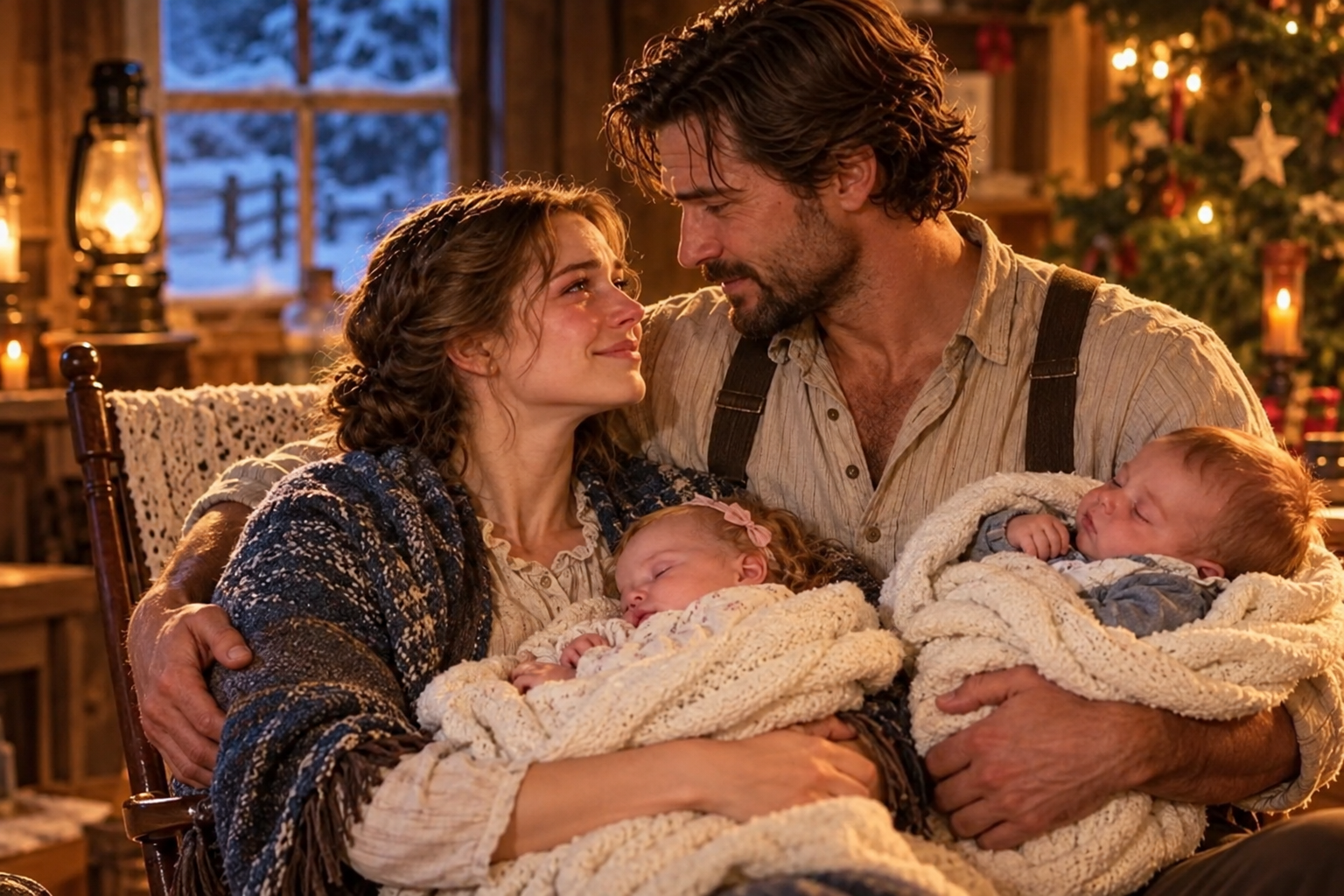
Christmas arrived beneath a heavy snowfall.
Graham brought a small evergreen into the sitting room.
He admitted he hadn’t intended to celebrate.
Clara insisted the twins deserved their first Christmas, even if they would never remember it.
Together they decorated the tree with dried apple slices, scraps of red ribbon, and small wooden stars Graham carved beside the fire.
On Christmas Eve, Clara placed two tiny knitted stockings above the hearth.
Then she added a third.
It was smaller than the others.
Graham noticed immediately.
“Rose?” he asked.
Clara nodded.
“I made it before she was born.”
Her voice trembled.
“I know she isn’t here.”
Graham stepped beside her.
“She was here.”
Clara looked at him.
He nodded toward the little stocking.
“And she mattered.”
Those three words nearly brought her to her knees.
Because since Rose’s burial, everyone had told Clara to be strong.
To move forward.
To remember she was young enough to have other children.
No one had simply told her that Rose mattered.
Graham reached for a wooden star.
“Would you like me to make one with her name?”
Clara could not speak.
She nodded.
That night, three little stars hung on the tree.
THOMAS.
LILY.
ROSE.
And for the first time since her daughter died, Clara slept without dreaming of the tiny grave beneath the cottonwood tree.
But peace did not last.
Three days after Christmas, Silas Dorne arrived at Willow Bend Ranch.
He came in a black wagon with Helen beside him.
Clara saw them through the kitchen window.
Her stomach tightened.
Graham was repairing a harness in the barn.
Silas climbed the porch steps and knocked hard.
When Clara opened the door, he looked her over with open disapproval.
“So it’s true.”
“Good afternoon, Silas.”
“You’ve been living here.”
“Yes.”
“With a man who isn’t your husband.”
“With two infants who needed care.”
Silas pushed past her.
Helen followed quietly.
The twins were sleeping beside the fireplace.
Silas glanced at the cradle.
Then at Clara.
“You’ve embarrassed your sister.”
Helen flinched.
Clara folded her hands.
“I’ve done nothing shameful.”
“You abandoned a respectable household.”
“You turned away starving babies.”
His face darkened.
“I was protecting your reputation.”
Clara’s voice became very quiet.
“My reputation was never hungry. Those children were.”
Silas stepped toward her.
“You’ll collect your things and come home.”
“No.”
He blinked.
“What did you say?”
“I said no.”
Silas gave a short, disbelieving laugh.
“You have no husband. No money. No home. You are in no position to make demands.”
Clara felt the old fear rising.
For months, she had lived under Silas’s roof, grateful for every meal and terrified of becoming a burden.
But then Thomas stirred in his cradle.
Lily made a tiny sound.
Clara looked at them.
And something inside her steadied.
“I have work,” she said. “I have a room. And I have people who need me.”
Silas sneered.
“People who need your milk. What happens when they don’t?”
The words struck harder than Clara expected.
Before she could answer, Graham appeared in the doorway.
His coat was dusted with snow.
“Then she’ll still have a place here,” he said.
Silas turned.
“This is a family matter.”
Graham removed his gloves.
“Mrs. Bell is free to make her own decisions.”
“Do you understand what people will say about a widow living beneath your roof?”
Graham’s eyes hardened.
“I understand what people said when my wife died and I couldn’t keep my children fed.”
Silas opened his mouth.
Graham continued.
“I understand what it feels like to stand at a stranger’s door begging for help and be told to leave.”
The room fell silent.
“And I understand that Mrs. Bell walked three miles through a freezing night to do what I couldn’t.”
He stepped closer.
“So if you came to thank her, you’re welcome to stay.”
His voice lowered.
“If you came to shame her, you can leave.”
Silas’s face turned crimson.
He grabbed his hat.
“Helen. We’re going.”
But Helen didn’t move.
She stood beside the cradle, looking at the sleeping twins.
Then she turned toward Clara.
“I should have spoken that night.”
Clara’s eyes filled.
“Helen—”
“I heard him send Mr. Rowe away. I knew you would have helped.”
Silas snapped, “Get in the wagon.”
Helen straightened.
“For once, Silas, let me finish.”
He stared at her.
Helen took Clara’s hands.
“I’m sorry.”
Clara embraced her sister.
It was a small moment.
But for Helen, it was the beginning of finding her own voice.
After they left, Clara stood at the window watching the wagon disappear.
Graham approached quietly.
“Are you all right?”
She nodded.
Then shook her head.
“I don’t know.”
He waited.
“Silas asked what happens when the babies no longer need me.”
Graham looked toward the cradle.
“Then perhaps you can stay because you want to.”
Clara turned.
Their eyes met.
For a moment, neither spoke.
Then Lily began crying.
And the moment passed.
January brought the worst storm Ash Creek had seen in eleven years.
Snow buried the fences.
The creek froze solid.
The road to town disappeared beneath drifts.
On the second night of the storm, Lily developed a fever.
Clara noticed it while changing her blanket.
The baby’s skin was too warm.
Her breathing came faster than usual.
“Graham.”
He heard something in her voice and came immediately.
“What’s wrong?”
“Lily’s sick.”
Graham touched his daughter’s forehead.
His face drained.
“No.”
Clara wrapped the baby carefully.
“We need the doctor.”
Graham looked outside.
Wind struck the windows with such force that the shutters rattled.
“The road’s buried.”
“Then we have to try.”
He saddled his strongest horse.
Before leaving, he stood beside Clara, looking at Lily.
“Don’t let her go.”
Clara’s throat tightened.
“I’ll do everything I can.”
Graham rode into the blizzard.
Hours passed.
Clara sat beside the fire with Lily against her chest.
She watched the baby’s breathing.
She offered milk whenever Lily was alert enough to feed.
She kept Thomas warm in the cradle and prayed that the storm would break.
But Lily grew weaker.
At midnight, Clara heard a sound she knew too well.
A tiny, exhausted breath.
Then another.
She remembered Rose.
The same helplessness.
The same terrible waiting.
“No,” Clara whispered.
She held Lily closer.
“Not you too.”
Tears fell onto the baby’s blanket.
“Please, sweetheart. Stay.”
For the first time since Rose’s burial, Clara prayed aloud.
Not for her daughter to return.
Not for the pain to disappear.
Only for the little girl in her arms to have another morning.
Near dawn, the front door burst open.
Graham stumbled inside, half-frozen.
Dr. Whitcomb followed him, his coat covered in ice.
The doctor immediately examined Lily.
He listened to her chest.
Checked her breathing.
Then worked beside the fire while Graham brought warm water and Clara followed his instructions.
The hours crawled.
Finally, just after sunrise, Lily stirred.
She opened her eyes.
Her tiny hand moved against Clara’s dress.
And she began to cry.
Not a weak little sound.
A furious, healthy protest.
Clara looked at the doctor.
He listened again.
Then smiled cautiously.
“That’s a stronger voice than she had an hour ago.”
Graham sank to his knees.
He covered his face.
Clara held Lily against her heart and wept.
The fever did not vanish instantly, and the doctor remained to watch her.
But by the following evening, Lily was feeding better.
Her breathing had eased.
And Graham finally allowed himself to believe his daughter might survive.
When Dr. Whitcomb left, he told Clara something she never forgot.
“You cannot save every child, Mrs. Bell. But what you did for these two mattered.”
Clara watched the doctor’s wagon disappear.
Then she walked into the sitting room.
Graham was asleep in the rocking chair with both twins resting safely nearby.
For a long time, she watched him.
She had arrived at Willow Bend believing she was only a woman whose body had failed to understand her daughter’s death.
Now she was beginning to understand something else.
She was still a mother.
Rose’s mother.
And she was also becoming someone important in the lives of two children who had lost theirs.
One truth did not erase the other.
By February, Lily was strong enough to laugh.
Her first laugh came when Graham sneezed so loudly that Thomas startled awake.
Clara laughed.
Graham laughed.
And Lily laughed again.
That evening, Graham found Clara in the kitchen writing a letter.
“To Helen?” he asked.
She nodded.
“She’s coming to visit Sunday.”
“I’m glad.”
Clara folded the paper.
“Graham, may I ask you something?”
“Anything.”
“Do you ever feel guilty when you’re happy?”
He leaned against the doorframe.
“Every day.”
She looked at him.
“Does it get easier?”
He thought for a long moment.
“I don’t know if easier is the word.”
He looked toward Evelyn’s photograph on the mantel.
“I loved my wife. I still do. But sometimes I hear the children laughing, and I think she’d want me to hear it too.”
Clara lowered her eyes.
“I thought loving them might mean forgetting Rose.”
Graham shook his head.
“You’ve never forgotten her.”
“No.”
“And you never will.”
Clara’s eyes filled.
He stepped closer.
“Maybe the heart doesn’t make room by throwing someone out.”
She looked up.
“Maybe it grows.”
The words settled between them.
Then Graham reached for her hand.
Clara let him take it.
Neither moved for a long time.
Spring came slowly to Ash Creek.
The snow melted into muddy roads.
The cottonwoods began to bud.
New calves appeared in the pasture.
Thomas learned to roll onto his stomach.
Lily discovered her own feet and seemed endlessly fascinated by them.
Clara planted a small garden beside the farmhouse.
Graham repaired the porch.
They worked together as naturally as breathing.
But one question remained unspoken.
What were they becoming?
The answer arrived on a warm April afternoon.
Clara had taken the twins outside beneath the cottonwood trees.
Graham returned from town carrying a small parcel wrapped in brown paper.
He found her sitting on a blanket with Lily in her lap and Thomas reaching for a fallen leaf.
“I brought something,” he said.
Clara smiled.
“For the babies?”
“For you.”
She looked surprised.
He handed her the parcel.
Inside was a small wooden box.
Its lid had been carved with a rose.
Clara stared at it.
“Graham…”
“Open it.”
Inside lay a silver locket.
It was simple and old-fashioned.
Clara opened it carefully.
One side held a tiny painted rose.
The other contained a folded scrap of paper.
She unfolded it.
Three names were written in Graham’s careful handwriting.
Rose Ellen Bell.
Thomas Daniel Rowe.
Lily Evelyn Rowe.
Clara pressed a hand to her mouth.
“Thomas Daniel?”
Graham nodded.
“I wanted to ask you first. I’ve been thinking of using Daniel as his middle name.”
Her eyes filled.
“After my husband?”
“He was part of your life. And your life is part of theirs now.”
Clara looked at the locket.
Then at Graham.
“Why are you doing this?”
He lowered himself onto the grass beside her.
“Because I love you.”
The world seemed to become very still.
Even the wind quieted.
Graham continued before she could speak.
“I didn’t expect to. I wasn’t looking for another wife. I thought that part of my life was finished.”
He looked toward the children.
“Then you came to my door in the middle of a storm and gave my babies something I couldn’t.”
Clara whispered, “Milk.”
He shook his head.
“Hope.”
Tears slipped down her cheeks.
“You gave me that too,” she said.
Graham took her hand.
“I know you loved Daniel. I know you’ll always love Rose.”
His voice trembled.
“I’m not asking you to leave them behind.”
He reached into his coat and removed a plain gold ring.
“I’m asking whether there’s room in your heart for us too.”
Clara looked at the ring.
Then at the twins.
Then at the man who had never once asked her to stop grieving.
“Yes,” she whispered.
Graham blinked.
“Yes?”
She laughed through her tears.
“Yes, Graham Rowe.”
He slipped the ring onto her finger.
Then he kissed her.
It was not a desperate kiss.
Not a promise that sorrow would never return.
It was gentle.
Steady.
The kind of kiss that felt like coming home after a long winter.
Thomas chose that moment to begin crying.
Graham pulled back.
Clara laughed.
“Your son has terrible timing.”
“Our son,” Graham said softly.
Clara looked at him.
And began to cry all over again.
They married in June.
There was no grand ceremony.
Only a gathering beneath the cottonwoods beside Willow Bend Ranch.
Dr. Whitcomb stood with his wife.
Several neighboring families brought food.
Helen arrived early carrying a wedding cake she had baked herself.
Silas came too.
He stood quietly at the back.
Before the ceremony, he approached Clara.
She braced herself.
But he removed his hat.
“I was wrong,” he said.
Clara stared at him.
Silas looked toward Graham, who stood beneath the trees holding Thomas and Lily.
“Those babies would have suffered because I cared more about what people might say than what they needed.”
His voice became rough.
“I’m sorry.”
Clara studied him for a moment.
Then nodded.
“Thank you for saying it.”
It was not enough to erase the past.
But it was enough to begin something better.
Helen kissed Clara’s cheek.
“You look happy.”
Clara looked toward Graham.
“I am.”
Then she touched the locket at her throat.
“And I miss them.”
Helen understood.
“You can do both.”
Clara smiled.
“Yes. I think I finally can.”
When the ceremony began, Graham stood beneath a cottonwood tree with a baby in each arm.
Thomas wore a white linen shirt.
Lily had a tiny ribbon tied around her bonnet.
Clara walked toward them in a simple cream-colored dress Helen had helped her sew.
There was no father to give her away.
No grand procession.
She walked on her own.
And when she reached Graham, he handed Thomas to Helen and took Clara’s hand.
The minister spoke about patience.
Kindness.
Faithfulness.
But Clara remembered only one moment clearly.
When Graham promised to love her in sorrow as well as joy, his voice broke.
Clara squeezed his hand.
Then she made the same promise.
Afterward, everyone gathered around the farmhouse for supper.
The twins slept through most of the celebration.
Graham danced with Clara beneath the trees as lanterns glowed around them.
And for the first time in many months, she allowed herself to imagine growing old.
But their story did not end with the wedding.
It continued through ordinary days.
Through sleepless nights and teething fevers.
Through harvests that went badly and seasons that went well.
Through disagreements about money, muddy boots on clean floors, and Graham’s stubborn habit of forgetting his coat in the rain.
It continued through Thomas’s first steps.
Lily’s first word.
The morning both children began calling Clara “Mama.”
That morning, Clara stood frozen in the kitchen.
Lily reached toward her from the floor.
“Mama.”
Clara stared.
Thomas repeated it.
“Mama!”
Graham looked up from the breakfast table.
His expression softened.
Clara knelt.
The twins crawled into her arms.
And she held them tightly.
Later, when they were sleeping, Graham found her beside the window.
“Are you all right?”
She nodded.
“They called me Mama.”
He smiled.
“They know who you are.”
Clara looked out toward the cottonwoods.
“I wish Rose had lived long enough to say it.”
Graham wrapped an arm around her shoulders.
“I know.”
Clara leaned against him.
“But I’m glad they did.”
Years passed.
Thomas grew tall and fearless.
Lily became a determined little girl who followed Graham through the barn and insisted she could do anything her brother could.
The house filled with noise.
Laughter.
Arguments.
Music.
And love.
Every December, three wooden stars appeared on the Christmas tree.
Thomas.
Lily.
Rose.
When the twins were six years old, Lily finally asked about the third star.
“Who was Rose?”
Clara sat beside the fireplace with both children.
Graham watched quietly from his chair.
Clara took the little wooden star from the tree.
“Rose was my first daughter.”
Lily frowned.
“Where is she?”
Clara drew a slow breath.
“She died when she was very small.”
Thomas moved closer.
“Before us?”
“Just before I came here.”
Lily looked at the star.
“Did you love her?”
Clara’s eyes filled.
“Very much.”
Lily thought about that.
Then asked, “Do you still?”
Clara nodded.
“Every day.”
The little girl considered the answer.
Then she climbed into Clara’s lap.
“That’s all right, Mama.”
Clara held her breath.
Lily wrapped her arms around her neck.
“You can love all of us.”
Thomas nodded solemnly.
“There’s enough room.”
Graham turned toward the fire.
But Clara saw him wipe his eyes.
That Christmas, Lily insisted that Rose’s star be placed at the very top of the tree.
“Because she was our sister,” she explained.
And no one argued.
On the tenth anniversary of the night Clara arrived at Willow Bend, Graham woke before sunrise.
He prepared coffee.
Then carried two cups onto the porch.
Clara joined him wrapped in a thick shawl.
The house behind them was quiet.
Thomas and Lily were nearly eleven.
Their laughter would soon fill the kitchen.
But for now, the world belonged to the two of them.
Snow covered the fields.
The same cottonwoods stood beyond the fence.
Graham handed Clara her coffee.
“Do you remember that night?”
She smiled.
“Every moment.”
“You were freezing.”
“You had your shirt buttoned wrong.”
He laughed.
“I had two babies screaming in my arms.”
“One screaming,” Clara corrected gently. “The other barely making a sound.”
Graham grew quiet.
They looked across the snow-covered land.
Then he said, “I nearly didn’t open the door.”
Clara turned toward him.
“What?”
“I heard someone knocking, and I thought it might be another neighbor coming to tell me what I was doing wrong.”
She touched his hand.
“I’m glad you opened it.”
He looked at her.
“So am I.”
After a moment, Clara spoke.
“I used to believe the worst thing that could happen to me was losing Rose.”
Graham listened.
“And it was terrible. It still is.”
Her voice softened.
“But for a long time, I thought that because she died, everything good in my life had ended with her.”
She looked toward the farmhouse.
“Then I came here.”
Graham squeezed her hand.
Clara smiled through tears.
“I used to think my body betrayed me by continuing to make milk after my baby was gone.”
She paused.
“Now I think it was simply doing what a mother’s body does. Trying to give life.”
Graham drew her closer.
“And it helped save two lives.”
Clara shook her head gently.
“We saved each other.”
He kissed her forehead.
They stood together as the first light spread across the snowy fields.
Then the farmhouse door opened.
“Mama!”
Thomas came running onto the porch.
“Lily says I can’t have the last biscuit!”
From inside came his sister’s furious reply.
“Because you already ate three!”
Graham sighed.
Clara laughed.
“Some things never change.”
She set down her cup.
Then turned toward the warmth of the house.
Before stepping inside, she looked once more toward the distant cottonwoods.
Somewhere beyond them, beneath another tree, lay a little grave marked with a wooden cross.
ROSE ELLEN BELL.
BELOVED DAUGHTER.
TWO HOURS, NINETEEN MINUTES.
Clara still visited every spring.
She brought flowers.
She told Rose about Thomas and Lily.
She told her about Graham.
And sometimes she simply sat quietly, allowing herself to miss the daughter whose brief life had changed everything.
She no longer believed healing meant forgetting.
She understood now that grief and gratitude could live in the same heart.
That love did not have to end because a life did.
And that sometimes, when the world seemed impossibly cruel, a single act of courage could open a door no one knew was waiting.
Ten years earlier, Clara Bell had walked three frozen miles believing she had nothing left to give.
She arrived at Willow Bend with twelve cents, a small bag, and a heart broken beyond anything she thought could be repaired.
She had come because two babies needed milk.
She stayed because two children needed a mother.
And she found love because a grieving father had the courage to open his door.
But the greatest truth of Clara’s story was something she would carry for the rest of her life.
Rose had lived only two hours and nineteen minutes.
Thomas and Lily would have an entire lifetime.
And Clara would spend that lifetime loving all three.
THE END.
Some families are born beneath one roof. Others are brought together by loss, courage, and the simple decision to open a door.
Clara could never bring Rose back. Graham could never bring Evelyn back. But together, they discovered that loving someone new did not mean loving those they had lost any less.
If this story touched your heart, leave a ❤️ for Clara, Graham, Thomas, Lily, and little Rose.
And tell us in the comments: Do you believe that sometimes the people we save are the very people who save us?