PART 5 — THE TWIST THAT SAVED THE BRIDE
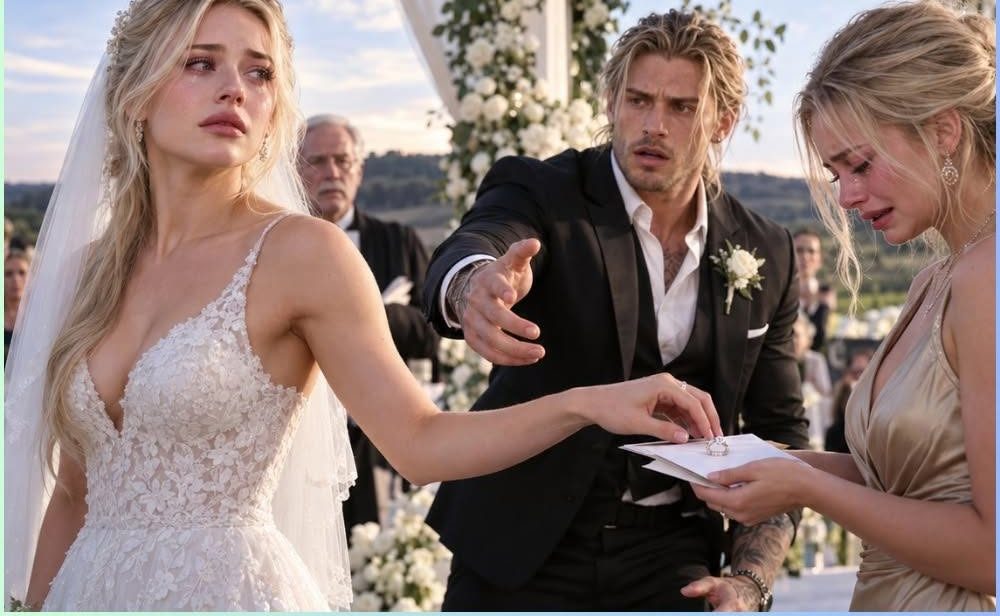
Six months after Madison Hale walked away from her wedding, she returned to the same vineyard.
But this time, she wasn’t wearing a wedding dress.
She was wearing jeans, a white blouse, and the quiet smile of a woman who had finally learned the difference between being loved and being controlled.
The wedding arch was gone.
The white roses had been replaced by wildflowers.
And the man waiting for her beneath the oak trees was not Everett Cross.
It was Daniel Mercer.
But the story of how Madison got there began with the photograph Camille had handed her on the night of the ruined wedding.
For three days, Madison believed the handwritten message might mean Joanne was her biological mother.
The possibility made her physically ill.
Had she nearly married her own brother?
Had her entire childhood been a lie?
Then her grandmother’s oldest friend arrived with a sealed letter.
Inside was the truth.
Decades earlier, Madison’s grandmother had helped Joanne through a difficult pregnancy. Joanne had given birth to a daughter, but the baby had been placed for adoption.
That daughter was Camille Porter.
The photograph had been taken the day Joanne signed the adoption papers.
The message on the back referred to Camille, not Madison.
Camille had discovered her biological mother’s identity only a year before the wedding.
And Joanne had used that discovery to manipulate her.
She had promised Camille a relationship, financial support, and a future together.
In return, Camille had allowed her photography studio to become part of Joanne’s financial scheme.
Everett had known Camille was searching for her biological family.
He had not known his mother was the woman she had found.
When Joanne realized that Madison’s inherited farmhouse sat on land valuable to a proposed commercial development, she devised a plan.
She wanted control of the property.
The forged guarantee was intended to pressure Madison into transferring the farmhouse into a trust after the wedding.
Everett had been useful because Madison trusted him.
Camille had been useful because she desperately wanted her mother’s love.
And Joanne had mistaken both kinds of love for weakness.
But the scheme collapsed.
The disputed guarantee was declared unenforceable against Madison after the forged authorization was established.
The lender released the claim against her assets.
Her grandmother’s farmhouse remained hers.
Joanne faced criminal charges arising from the falsified financial documents, while the studio transactions became the subject of a separate civil case.
Everett lost his relationship, his reputation among many of their friends, and the comfortable future he had taken for granted.
Madison never went back.
Not even when he appeared outside her workplace three months later carrying the engagement ring.
“I still love you,” he said.
Madison looked at the diamond.
Then at the man holding it.
“Maybe you do.”
His eyes brightened.
“But love that asks me to abandon myself isn’t the kind I want anymore.”
She walked past him.
That was the last time they spoke.
Camille eventually wrote Madison a letter.
She admitted that her interruption at the altar had been both an attempt to stop the wedding and a desperate act of jealousy.
She apologized without asking for forgiveness.
Madison replied with two sentences.
“I hope you find the family you deserve. But I cannot be the person who repairs what happened between us.”
It was enough.
Meanwhile, Madison used part of the recovered savings to renovate her grandmother’s farmhouse.
She turned it into a small retreat for families traveling to receive medical care.
There were six guest rooms.
A large communal kitchen.
A garden filled with rosemary and white roses.
And a porch facing the Texas hills.
Daniel helped her navigate the paperwork.
At first, they met over documents and coffee.
Then over dinner.
Then on quiet Sunday walks.
He never asked Madison to trust him simply because he loved her.
He gave her reasons to trust him.
One evening, six months after the ruined wedding, he invited her back to the vineyard.
Madison hesitated.
“Why here?”
“Because I think this place deserves a better memory.”
They walked beneath the oak trees as the sun lowered over the hills.
Daniel stopped beside the spot where she had once stood alone.
“I have something for you.”
Madison’s heart jumped.
But he didn’t kneel.
He didn’t open a ring box.
Instead, he handed her a small brass key.
“What is this?”
“The farmhouse.”
She laughed.
“I already own the farmhouse.”
“I know.”
Daniel smiled.
“It’s the key to the final guest room. The contractors finished it this morning. Your retreat is ready.”
Madison stared at him.
Then she began to cry.
Not because she had been abandoned.
Not because someone had humiliated her.
But because, for the first time in years, someone had given her something without expecting ownership of her in return.
Daniel brushed a tear from her cheek.
“Madison, you don’t have to promise me forever.”
She looked at him.
“Then what do I have to promise?”
“Nothing. I just hope you’ll let me be part of whatever comes next.”
She kissed him.
And beneath the same Texas sunset where her wedding had fallen apart, Madison finally understood the truth.
The happiest ending wasn’t finding another man willing to marry her.
It was becoming a woman who no longer needed a marriage to prove she was worthy of love.
One year later, the farmhouse welcomed its hundredth family.
Madison stood on the porch watching children run through the garden when Daniel came outside carrying two mugs of coffee.
He placed one beside her.
Then he showed her a photograph that had arrived in the mail.
It was a picture of the old wedding arch.
On the back was a handwritten message from Judge Martin Bell, the man who had officiated the ceremony that never happened.
Madison read it aloud.
“Some promises are meant to be broken so that better ones can finally be kept.”
She smiled.
Daniel slipped his hand into hers.
And this time, when Madison looked toward the future, she didn’t see an altar.
She saw a home.
A purpose.
A life she had chosen.
And someone walking beside her, rather than asking her to follow.
THE END.